
TL;DR
- Maverick spending is any purchase made outside your company's agreed process, whether that's an unvetted supplier or a skipped approval.
- It hides in small buys like a subscription bought off-contract, a supplier paid without sign-off, a taxi charged to a personal card, or a purchase split in two to duck an approval limit.
- The cost runs deeper than the leaked dirhams: Scattered spend weakens your supplier pricing, blurs budgets, and buries finance in month-end detective work.
- Prevention is a design problem: Give people an easy, sanctioned way to spend, then build the rules into the card so anything off-policy gets stopped at checkout.
- Pemo helps UAE teams fix maverick spending with card-level limits, approval routing by team or merchant category, live spend visibility, and automatic sync into Wafeq, Xero, QuickBooks, Zoho Books, and Tally.
What is maverick spending?
Maverick spending is purchasing that happens outside your company's agreed process.
Someone buys from a supplier you never vetted, or skips an approval step the policy never made clear in the first place.
You might also see it called maverick buying or rogue spend. The name sounds hostile, though the behaviour usually isn't.
Most of it comes from people trying to get their jobs done.
The approval queue dragged, the right card wasn't there, the policy read like fog, so they found a workaround and moved on.
There's a real line between this and fraud, and it's worth drawing.
Fraud means taking money you know you have no claim to.
Maverick spending means spending the company's money in a way it never signed off on, usually for a legitimate business reason.
Fraud calls for an investigation. Maverick spending calls for a better system.
What does maverick spending look like in a UAE business?
Once a team grows past its first handful of people, it starts to show up like this.
- An account manager closes a deal and books a celebratory client dinner at a venue nobody pre-approved, on the shared company card.
- The ops lead needs printer ink today, pays with her personal card, and takes her spot in the reimbursement queue.
- A department keeps a AED 1,100-a-month software tool running on a card nobody's watching, months after the project it was bought for ended.
- Someone sitting on a AED 5,000 sign-off limit splits a AED 9,000 purchase across two invoices so neither one trips the second approver.
On their own, these are rounding errors.
They don't stay on their own.
A UAE SME spread across a Dubai mainland office, a free-zone entity, and a handful of remote hires around the Gulf is dealing in several currencies most weeks.
Dirhams for office supplies one day, dollars for a SaaS renewal the next.
Once that spending is scattered across personal cards, one shared corporate card, and the petty cash drawer, "outside the process" stops being the exception and quietly becomes the process.
Why maverick spending keeps happening
Trace the behaviour back, and you land on a handful of causes, none of them "your people are careless."
- First, your current spending policy (start here).
A spending policy written into a PDF and shared once at onboarding can describe a rule perfectly well.
What it can't do is stop a purchase at the moment someone makes one.
The check, if it comes at all, comes after the money's already moved.
- Second, the sanctioned route is too slow to use.
Make someone wait three days for a card or ping a manager on WhatsApp for a AED 200 approval, and they'll just reach for their own wallet.
Call it defiance if you like, but it's really people picking the fastest path open to them, which is what people do.
- Third, everything gets sent for approval, so nothing really gets approved.
Push every trivial purchase through a manager, and the queue clogs, and a clogged queue turns into reflexive rubber-stamping.
Ask for sign-off on too much and you end up enforcing almost none of it.
- Fourth, finance is flying blind until month-end.
Numbers that only arrive weeks late give you no shot at catching a pattern while it's forming.
By the time an off-contract subscription surfaces in a reconciliation, it's on its third billing cycle.
What does maverick spending actually cost you?
The money spent outside the rules is the obvious cost, and usually the smallest one.
The real damage is what scattered buying does to your negotiating position.
When a dozen people each buy a similar tool from a different supplier on a different card, you never pull together the volume that would get you a better rate.
You pay list price across the board, because nobody can see that half the team bought the same thing.
Then there's the load on finance.
Every purchase made outside the system is one more transaction someone has to hunt down, match to a receipt, code by hand, and defend at audit.
Run that over a year, and you've burned real salary hours reconstructing a trail the right control would have captured automatically.
And there's a cost that never lands on a P&L: budgets you can't rely on.
When a slice of spending happens away from the books you keep, last month's numbers are an educated guess, and the leadership team steers on figures that are already stale.
Every missing receipt finance has to chase widens the distance between them and everyone else a little more.
How to prevent maverick spending?
You won't fix maverick spending with a firmer policy or a sharper email.
The fix is to make the sanctioned way to spend the fastest way to spend, then wire the rules into the tools people already use.
Here are the moves that matter, roughly in order of payoff.
Give everyone a sanctioned way to pay
Most maverick spending exists because the approved option was missing or too slow to bother with.
Hand each person or team a card of their own, with a limit attached, and the pull toward a personal card mostly fades.
No card, no workaround.
Build the rules into the card
Written rules only work if someone remembers to apply them, and at the checkout nobody does.
Put the limit on the card, and the check runs on its own.
Cap it by amount, by merchant category, by supplier, or by location, and a charge that breaks the rule gets turned down at the register.
Approve by exception
The classic error here is asking for approval on everything. If you do that, the queue you were trying to clear just reappears somewhere else.
You can let low-value, low-risk purchases clear on their own, and keep real sign-off for spending that carries weight, like a new supplier or anything above a threshold you set.
Keep a AED 40 taxi out of the approval flow, and the sign-offs that actually matter stop drowning in noise.
Watch spending as it happens
A running view of every transaction, grouped by person, team, card, and category, lets you catch a drifting pattern in week one.
You spot the off-contract renewal early, while cancelling it still costs nothing.
Close the loop with your books
When each transaction is coded and pushed into your accounting automatically, off-policy spend has nowhere to hide and no "miscellaneous" line to slip into.
It lands in your books, categorised, the same day.
You're not tightening the leash on your team here.
You're building a setup where the fast way to pay is also the sanctioned one, so choosing right takes no extra thought.
How can Pemo handle maverick spending?
Pemo (that's us) is a spend management platform built for the UAE and the wider MENA region, and closing off this kind of leakage is most of what it's for.
The cards and the software are one product, so every rule you set is carried by the card at the moment of purchase, with nobody needing to open a handbook.
Each of the moves above maps to something concrete in the product.
Cards for the whole team, issued in seconds
You can create unlimited virtual cards at no cost, assign one to a person or a project, and set the limit before the first charge.
Physical cards cover in-person spending, and single-use cards handle one-off buys you don't want quietly renewing next month.
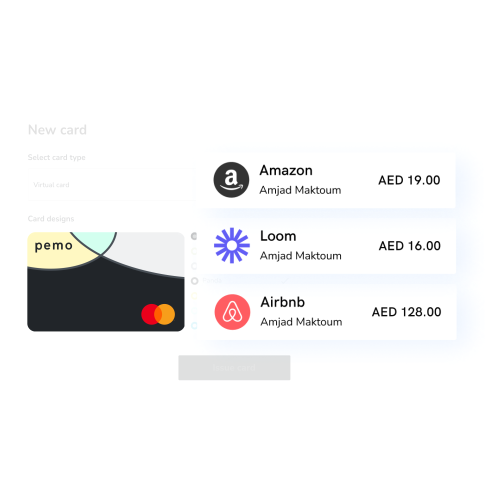
Powered by Mastercard, the cards work in store, online, and through Apple Pay or Google Pay.
Controls that enforce themselves
Every card carries its own rules: limits by day, week, month, or year, a ceiling per transaction, and restrictions down to a merchant category or a single supplier.
Break one of those rules and the transaction is turned down where it's attempted.
Lose a phone or offboard a contractor, and you can freeze the card from the app in a tap.
Approvals that route themselves
Approval policies run by team or by merchant category, and if one expense could fall under both, the merchant-category rule takes the charge, so the two never collide.
Approvals key off spend brackets, and each bracket hands the charge to its own approver, so a small buy clears untouched while a larger one lands with the right person first.
A single policy can carry up to three rules, each with its own chain of steps, and you can point any rule at a named person or a job function, so sign-offs keep flowing even when one approver is away.
Visibility without the month-end wait
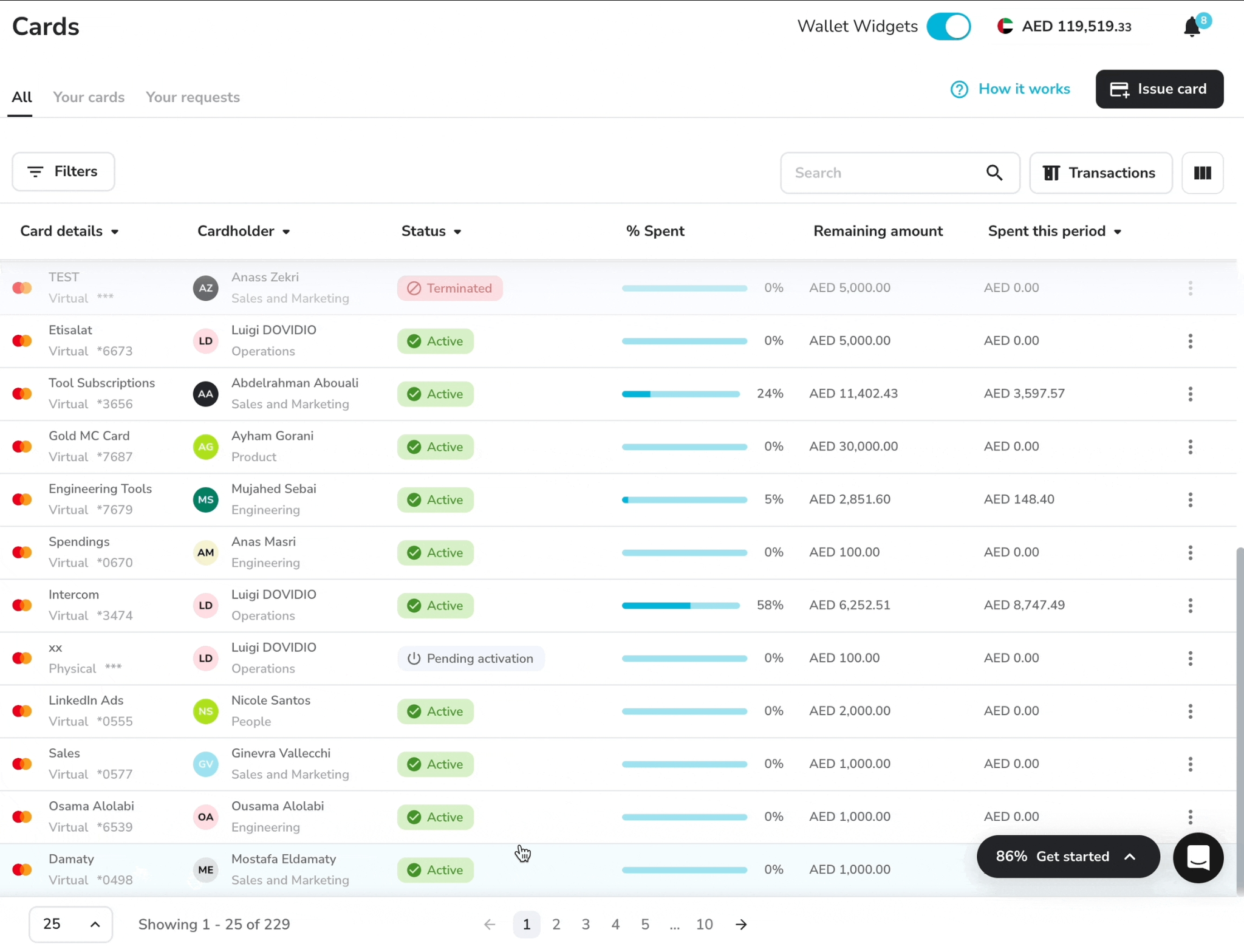
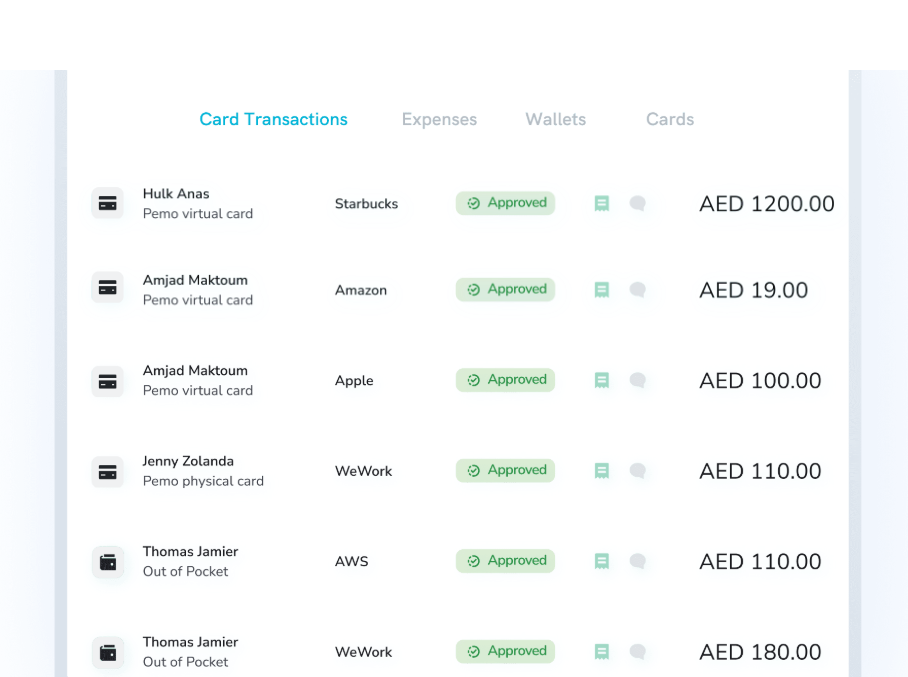
Every transaction shows up in the dashboard as it happens, split out by person, team, card, and merchant, on desktop and on mobile.
The finance lead who used to reassemble last month's spending after the fact watches it accumulate in real time.
Accounting that finishes the job
Pemo Copilot, the model behind every transaction, files each expense against the right account in your chart of accounts and keeps improving as your team corrects it.
From there, the coded data feeds straight into Wafeq, Xero, QuickBooks, Zoho Books, or Tally, so an off-policy charge turns up in your books the same day it happens, well before you sit down to reconcile.
Pemo's pricing
Pemo runs one free plan and two paid tiers, billed by the number of card users.
- Kickoff (free, AED 0/month): up to 2 card users, unlimited virtual and single-use cards, expense management, AI receipt matching, and accounting integrations. Approval workflows aren't included here.
- Essential (AED 29/month per cardholder): adds the approval workflows this whole article is about, plus spend analytics, multiple wallets, advanced card controls, and 0.5% cashback on online ad spend.
- Business+ (custom pricing, from 20 card users): adds up to 2% cashback, a dedicated customer success manager, custom onboarding, priority support, and unlimited physical cards.

Kickoff costs nothing, so it's a low-stakes way to see whether card-level control changes how your spending behaves.
Next Steps: Sign Up For Pemo For Free
Pemo offers an all-in-one expense management software for SMEs and growing businesses in the UAE, with pre-loaded corporate cards that turn every transaction into a tracked, categorised, audit-ready expense.
Our cards and AI software work together so your finance team stops chasing receipts, month-end reconciliation moves much faster, and your spending stays inside the rules you set before anyone swipes a card.
If you're looking for expense management software with smart corporate cards that can help you resolve maverick spending with unlimited virtual cards that let you assign one to a person or a project, and set the limit before the first charge.
You can sign up for the free plan or book a demo to see why over 10,000 businesses across the MENA region run on Pemo.
⚠️ Disclaimer: This article was last updated on the 23rd of July, 2026, and if there's any misinterpretation of the information, please contact us, and we will fact-check it.
Maverick spending FAQs
What's the difference between maverick spending and fraud?
Intent, mostly.
Fraud is deliberate theft, where the person knows the money was never theirs to spend.
Maverick spending is off-policy but not dishonest, usually a genuine business purchase that skipped the right channel.
That difference matters because the two need completely different responses, one disciplinary and the other structural.
How do you measure maverick spending?
Compare the spend that went through your approved process against total spend for the same period.
Whatever's left over is your maverick spend.
That comparison gets a lot easier once every transaction runs through one system you can filter by whether it followed policy.
Without a single view of company spending, the number stays a rough estimate at best.
Is maverick spending always a bad thing?
Not necessarily.
Now and then the person who went off-script had a point, and the process was too slow or too rigid for a real need.
Read as a signal that tells you something useful about where your rules chafe.
When people keep routing around the same rule, the rule is often the thing worth changing.
Zero exceptions is the wrong target.
Aim instead for exceptions you can see coming and sign off on deliberately, which keeps the quiet, constant kind from piling up.
Can spending controls stop maverick spending without slowing my team down?
Yes, as long as you set them by exception.
Small, routine purchases clear on their own, and approvals get reserved for spending that actually carries risk.
Card-level limits quietly handle the rest in the background, turning down whatever's out of bounds without a person policing every receipt.
Set up well, the team feels less friction than before, because the sanctioned way to pay is finally the quick one.
Do I need corporate cards to prevent maverick spending, or is a policy enough?
A written policy sets the expectation, but expectations don't stop a charge at the register.
That's the job corporate cards with built-in controls do, checking each rule as the transaction happens, so an out-of-policy purchase gets blocked as it's attempted.
Plenty of UAE teams find it simpler to run the spending and the rules on one platform than to keep a policy document and a separate bank card in sync by hand.


