
This guide covers how to make a business expense policy hold up in 2026, and why the rules on paper stop meaning much once a UAE team gets busy.
TL;DR
- A written expense policy is only worth the spend it changes, and in most UAE companies, the gap between the rule on the page and the money going out widens as the team grows.
- Reinforcing a policy by hand depends on spending limits, an approval threshold, a receipt rule, named categories, and a submission deadline, all held together by someone who remembers to check them. It slips the moment reminders stand in for real controls, and the approval arrives after the card has already been used.
- The durable fix is to build each rule into the payment itself, so an over-limit purchase never clears and a large one waits for sign-off before it goes through.
- Pemo puts the policy inside corporate cards and approval workflows, matches receipts sent by email, upload, or WhatsApp, and exports clean data to QuickBooks, Xero, Zoho Books, Wafeq, Tally, and Microsoft Dynamics 365.
What does "reinforcing" an expense policy actually mean?
Most companies have an expense policy somewhere in a shared drive.
Fewer have one that changes what a card gets used for on a Tuesday afternoon.
Reinforcement is that second part.
You keep the written rule and the real spending pointed at each other, week after week: the limits people buy under, the sign-off a purchase clears, the receipts behind each line, and the checks that catch what got through.
Drafting the policy takes a morning. Keeping it true is the work that never quite ends.
Why do expense policies drift in the UAE specifically?
A policy almost never fails on the day you publish it.
It loosens over months, and a few local realities pull it apart faster.
Plenty of routine spend here is small and paid in cash or on a personal card, the kind that never reaches a system until someone hunts for it.
A receipt that never gets captured is spend finance can't tie back to anything, and the detail fades fast once the month moves on.
Teams buying across the Gulf deal in several currencies at once, which makes reconciliation after the fact slower and easy to round into balance.
Stack that on a headcount that keeps growing, and the gaps open faster than one person can close them.
What goes into a policy you can actually reinforce?
A rule you can check will always beat a rule that asks people to be sensible. Every line worth keeping is one you can act on.
At a minimum, set down:
- Spending limits: a ceiling per person or per category that marks where a purchase stops being routine.
- An approval threshold: the figure above which a purchase needs a manager's sign-off first, written as a specific number so nobody has to interpret it.
- A receipt rule: a fixed window to submit a valid receipt, with no quiet exceptions that slowly become the norm.
- Named categories: what the company pays for and what it will not, defined tightly enough that "software" or "meals" cannot be stretched.
- A submission deadline: the date each month by which expenses must be in, so two forgetful people cannot hold up the close.
None of this is exotic. The trouble starts when the account stops matching the document, usually on the days nobody is looking.
How do you reinforce a policy without a system?
Doing it by hand means one person repeats a short set of jobs and hopes the team plays along.
- You brief new joiners, then re-brief anyone who slips.
- You send the reminder before month-end.
- You approve requests as they land in your inbox, usually after the purchase already went through.
Now and then you pull the receipts and read them against the claims.
Every one of those jobs waits on a person to remember it, on a day already crowded with other work.
Miss the reminder once, and submissions crawl in late.
Approve on trust because the inbox is full, and the control was never doing much anyway.
The policy reads exactly the same. It has just stopped being reinforced.
Where does manual reinforcement quietly break?
Manual reinforcement breaks between the rule and the moment money actually leaves.
Picture a software subscription renewing on a personal card that finance never sees, or a supplier paid AED 900 for something that should have triggered sign-off at AED 500.
The charge turns up on a statement long after the fact, once the budget is committed and the person who spent it has half-forgotten the detail.
Any approval that might have stopped it arrived too late to count.
Scale that across a company that keeps hiring, and the finance lead loses the last week of every month piecing together what already happened.
None of this is a people problem.
A control that only fires after the payment clears, and depends on someone recalling it, was never doing its job in the first place.
What does it take to make a policy stick?
The fix is to stop leaning on people to honour a document and to build the rules into the payment itself.
You want to put a limit on the card and an over-limit purchase will not clear.
Anything above your threshold routes to a manager before it is paid, and the receipt gets captured at the till, so there is nothing to track down later.
At that point, the policy is no longer a request you make of people. It is the condition under which money moves.
That is the core idea behind spend management software, and it maps onto an expense policy almost line for line.
How Pemo builds the policy into the way people spend
Pemo (that's us) is made for UAE businesses and keeps your policy running at the moment each payment is made, so there is far less to sort out at close.
Each rule maps to a setting:
Controls that block off-policy spend before it clears
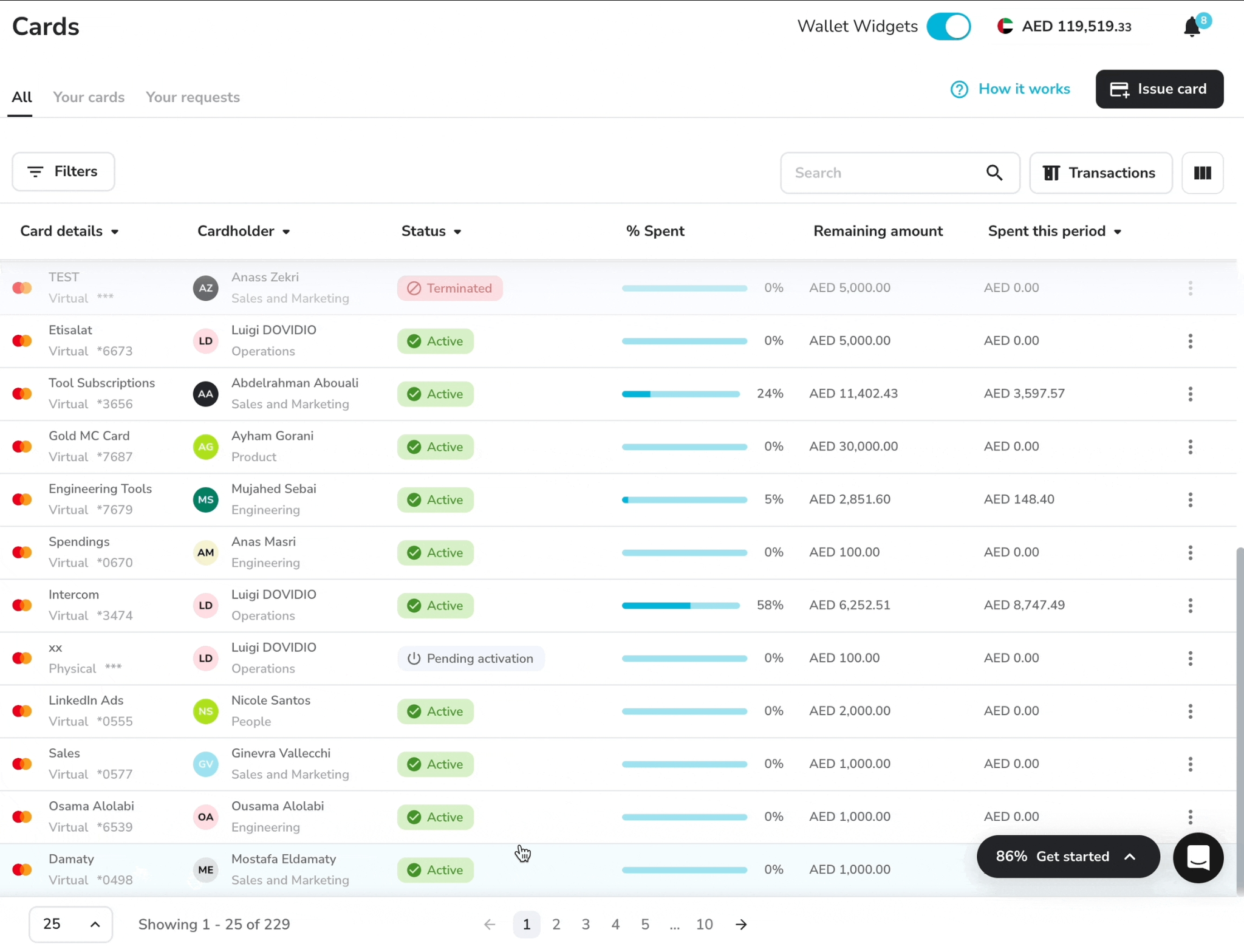
- Approval policies: rebuild your sign-off chain as steps a purchase must pass, set by merchant category or by team, with category rules taking priority and a default policy covering the rest.
- Approval by amount: send any spend above your threshold to the right manager before it is paid, so the "sign-off over AED X" rule holds without anyone watching an inbox.
- Card limits: cap each card by transaction, or by day, week, month, or year, turning a spending limit into a hard number the card will not cross.
- Category locks: bind a card to the categories it is meant for, so a fuel card is declined at an electronics shop.
Budgets, receipts, and reimbursements
- Budgets: set a budget by team, member, card, or category and track spend against it live, with alerts as you approach or pass it while work keeps moving.
- Receipt matching: forward the invoice by email, drop it in the Receipts Inbox, or send it over WhatsApp, and Pemo ties it to the transaction on its own, so the receipt rule is met the same day.
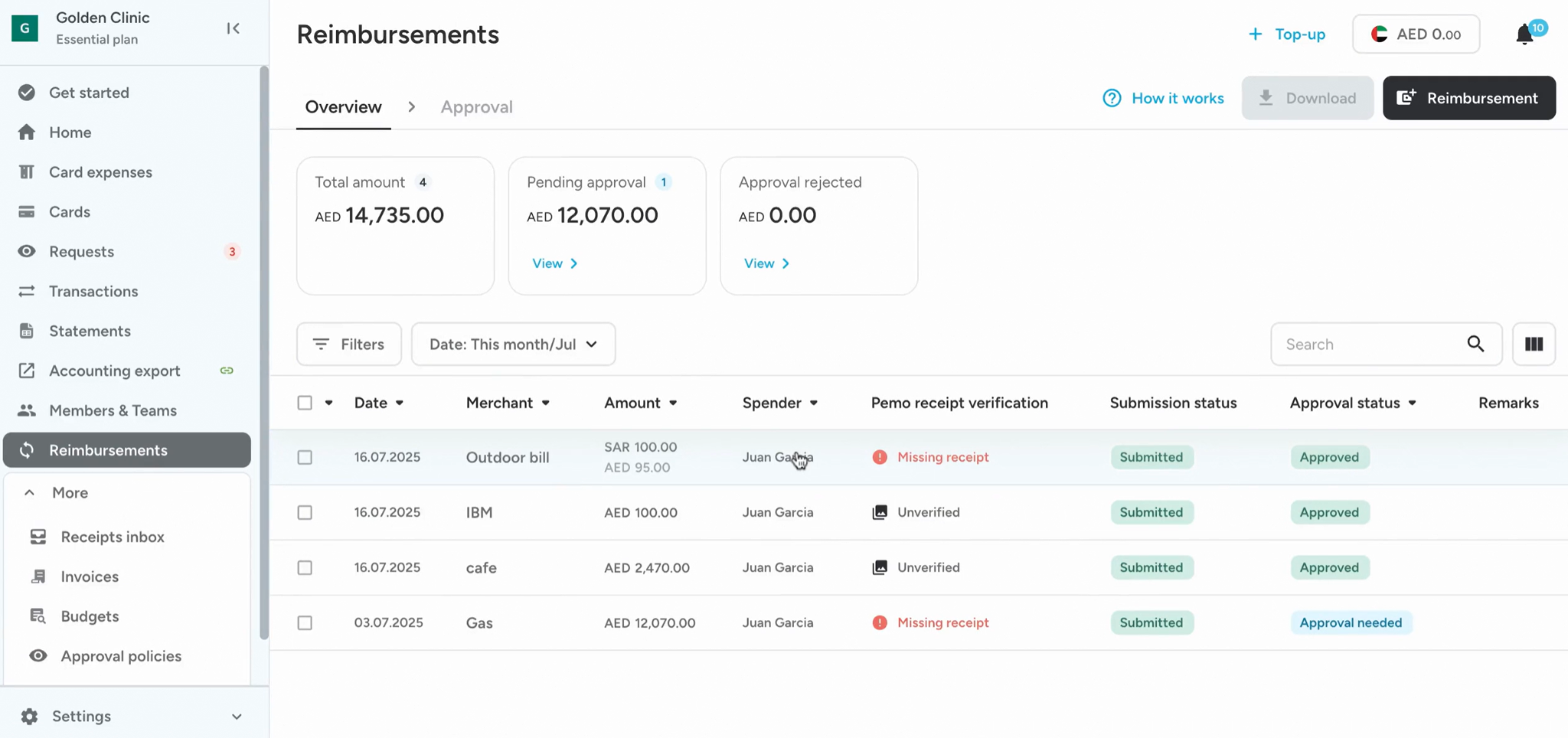
- Reimbursements: for anything bought without a card, staff log it with a receipt under a policy you set, and it arrives in the same place for approval.
Card security and clean accounting

- Freeze and single-use cards: freeze a card the minute a phone goes missing or someone resigns, and issue single-use cards that expire once one payment clears.
- Accounting export: send transactions, reimbursements, and invoices into QuickBooks, Xero, Zoho Books, Wafeq, Tally, or Microsoft Dynamics 365, so closing the books becomes a quick check of figures that already line up.
More than 10,000 businesses across the MENA region run on Pemo, many of them after a manual policy buckled under a growing headcount.
Handing out cards is quick.
Virtual cards appear in seconds, and physical ones arrive within about 72 hours, and every limit and category rule you set rides along with the card from the first swipe.
How do you move your policy into Pemo?
You keep the policy you already wrote. The job is to translate each rule into a setting and let the software hold it:
- Recreate each rule as a setting: a spending limit turns into a card cap, and the same mapping carries across for approval thresholds (approval steps) and categories (locks on the relevant cards).
- Issue cards to the people who spend: anyone who used to reach for a personal card or petty cash gets a Pemo card, set to the limit their role actually warrants.
- Make receipts automatic: point everyone at the email, upload, and WhatsApp options so receipts land the moment a purchase happens, with nothing left to chase.
- Mirror your real approval structure: build one policy per category or team the way the business already works, and let the default policy cover everything else.
- Watch the first month, then adjust: real spend shows which limits are too tight and which are too generous, and you tune from what actually happened.

Most everyday spending moves onto cards almost immediately.
The rare cases where cash or a personal card cannot be avoided stay on the reimbursement flow, under the same rules, tracked in the same account as everything else.
Sign Up For Pemo For Free
Strip it back and a reinforced policy is five things running at once: a limit that bites, an approval that happens in time, a receipt for every purchase, a deadline people meet, and a second person checking the totals.
Every one of those asks a person to act correctly, every time, while carrying a full workload.
Some teams keep it up for years, and the policy holds. Most watch it wear through, one skipped reminder at a time.
Cards funded from one company wallet carry the same five things, minus the part that leans on memory.
The limit is now a hard stop, and sign-off clears before any money moves.
Receipts file themselves against each charge, so by the time your accountant opens the books, most of the reconciliation is done.
You can sign up for the free plan or book a demo to see why over 10,000 businesses across the MENA region run on Pemo.
⚠️ Disclaimer: This article was last updated on the 10th of July, 2026, and if there's any misinterpretation of the information, please contact us, and we will fact-check it. This is not legal, tax, or accounting advice, so always consult a qualified professional before making decisions.


