
Indirect spending is every purchase your company makes to keep itself running, separate from the money that goes into producing whatever customers pay for.
TL;DR
- Indirect spending is defined by revenue attachment, meaning whether the cost travels into what your customer buys.
- The line moves with the business model: One freelancer, one cleaning contract, two different answers depending on who the work was done for.
- Sorting indirect spend by how hard it is to stop gives you four rungs with four control points, and only two of them respond to supplier negotiation in any given year.
- Pemo attaches a control to each category, with a sub-wallet for whoever owns it on Premium, a capped card on every recurring vendor, single-use cards for one-off purchases, and coding applied as each expense lands.
What is indirect spending?
Indirect spending covers every purchase that keeps a business operating without ending up inside the thing it sells.
Office rent, insurance, accounting software, recruitment fees and the agency running your ads all qualify.
One question settles most cases: Take the expense away and see whether the customer receives anything different.
A no puts the purchase on the indirect side.
Direct spend answers the other way: raw materials, the stock a retailer buys in, the subcontractor billed to one client project, the courier that puts an order in a customer's hands.
Size has no bearing on which side a purchase falls. A five-year office lease worth AED 3 million is indirect.
Meanwhile, a AED 40 courier charge can be direct, provided you sent it as part of a job you invoiced.
How do you tell direct from indirect in your own business?
You apply the revenue attachment test purchase by purchase, because whole categories rarely land cleanly on one side.
They split more often than finance teams expect, as two UAE examples show:
A Dubai marketing agency
A freelance designer hired to build a client's campaign is direct.
Those hours get billed on, and the cost vanishes the day the client leaves.
Book the same designer to rebuild the agency's own website, and the cost turns indirect.
Design software covers client work and internal work on a single licence.
Most agencies book the whole subscription as indirect and accept that gross margin flatters delivery slightly as a result.
A restaurant group in Abu Dhabi
Produce, gas, kitchen labour and packaging are direct with no argument from anyone.
Cleaning is where the category splits. The nightly kitchen deep clean is hard to separate from serving food at all, which is why plenty of operators treat it as a cost of delivery.
Cleaning the head office two floors up never touches a customer.
That one stays indirect. Drawing this line carefully is a gross margin exercise.
If you misclassify a direct cost as indirect, your margin looks better on paper than it is. Push an indirect cost the other way, and delivery looks more expensive than it is.
Which categories usually land on the indirect side?
Here are the most common categories that usually land on the indirect spending side:
- Software and subscriptions: productivity tools, design licences, cloud hosting, anything billed monthly to a company email.
- Facilities: rent, utilities, cleaning, pantry supplies, maintenance.
- Professional services: legal, audit, recruitment agencies, consultants.
- Marketing: ad platforms, events, sponsorships, retained agencies.
- Travel and vehicles: flights, hotels, Salik, servicing, fuel.
- IT and equipment: laptops, monitors, phones, warranties.
Why does indirect spending go uncontrolled?
Mostly because nobody owns it.
Direct spend gets an owner by default: somebody is measured on gross margin, and that person watches material costs and subcontractor rates without being asked to.
Indirect spend is bought by everyone and defended by nobody.
- Marketing signs an annual tool while operations renews the maintenance contract.
- HR pays a recruitment fee, and somewhere above both of them the founder signs a lease.
Every one of those looks reasonable in isolation, which is precisely how the total escapes scrutiny.
Finance becomes the accidental owner by default, hearing about a commitment when the invoice lands.
By then, anyone who might have said no has missed the window.
How do you give each category an owner?
You want to write your category list on one page and put a name against each line.
That person approves anything new inside their category and opens the renewal list once a quarter.
Two ways this goes wrong.
The first is putting the finance manager against every category, which reads as accountability and functions as a blank.
Giving an owner the review without the authority to cancel fails the same way.
You get a list of problems and no decisions.
How hard is each type of indirect spend to stop?
Not equally hard.
The control that works changes at every level, which is the reason to sort the pile into four rungs.
- Locked: lease, insurance, trade licence renewals. Committed for the term, which leaves the notice date as your only lever. Put it in a shared calendar with a reminder 30 days ahead, since missing it is what costs you the chance to renegotiate.
- Contracted: annual software deals, retainers, service agreements. These reopen yearly. Watch the seat count you renew on more closely than the discount you argue for.
- Recurring and open: monthly subscriptions, courier accounts, ad platforms. Cancellable this month, which puts the payment method in charge.
- Ad hoc: one-off equipment, single-engagement consultants, replacement hardware. Nothing exists to cancel. Your control has to arrive before the purchase does.
Two pieces of arithmetic show why the rung matters more than the amount:
Take a lease at AED 260,000 a year on a 90-day notice period.
Miss that window by a week, and you have committed another AED 260,000, which is more than most SMEs will find in a full year of subscription tidying.
Now the contracted rung.
A tool at AED 55 per seat per month, signed for 18 seats, comes up for renewal a year later on 31 seats because nobody removed the leavers.
That gap is AED 715 a month, or AED 8,580 across the year, on a line item that never triggered a single conversation.
Most published advice on indirect spend opens with supplier negotiation.
That advice holds up on the middle two rungs, where a renewal comes round every year.
On the locked rung, your negotiating window opens once a term, and only if you catch the notice date.
On the ad hoc rung, the sourcing effort usually costs more than the purchase saves.
Does indirect spend arrive as an invoice or as a card charge?
Both. Each route needs its own control.
Invoice-led indirect spend covers the landlord, the insurer, the law firm, the retained agency and the maintenance contractor.
By the time the document reaches your inbox, the decision is weeks old.
Approving at that stage means approving something already agreed.
The control has to move back to the commitment.
Card-led indirect spend covers subscriptions, ads, travel and small equipment.
Merchant, amount, timestamp and category all land the moment the payment authorises, which is early enough to put the control on the card.
The common mistake is one system, pointed at everything.
An approval chain built for invoices will not catch a subscription that renews silently.
Point a card limit at a signed retainer, and it has nothing to bite on.
The capture and approval mechanics are covered in our guide to vendor invoice processing.
When indirect purchases get made outside whatever process exists, that behaviour is maverick spending.
Fragment the indirect pile into hundreds of tiny suppliers and the shape you get is tail spend.
How does Pemo control indirect spending?
Pemo puts a different control on each rung, approving invoices before they commit you and capping card spend at the moment of purchase.
Catch a commitment before it becomes an invoice
Invoices forward straight from your inbox into Pemo, where the data gets extracted without retyping.
Status runs from submission to approval, viewable and actionable from desktop or mobile.
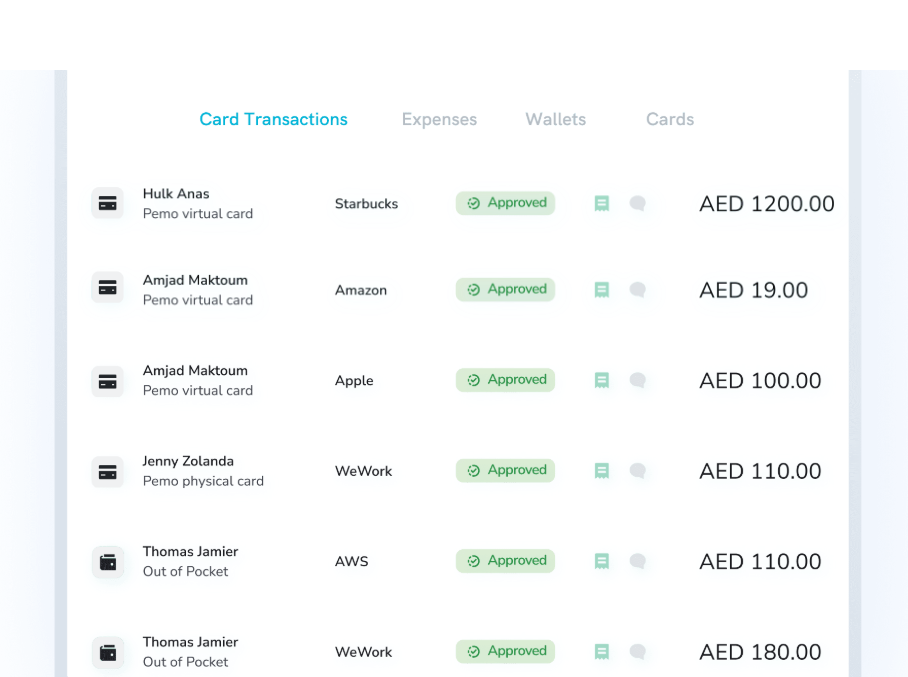
Approval workflows follow your own structure.
Approvers only see what concerns them, and every transaction carries a full audit trail.
You’ll also be able to access multi-layer workflows, advanced submission policies and maker-checker on-card actions.
That last one starts to matter once the person requesting spend also holds card rights.
On Premium and above, approval-based and pre-approval cards move the decision in front of the purchase.
A category owner signs off before the vendor sees a payment.
Let each category owner see their own number
Sub-wallets carve the account into separate pots: three on Premium, unlimited on Enterprise.
Give each owner a wallet and a budget, and their category stops being a line inside one company-wide number.
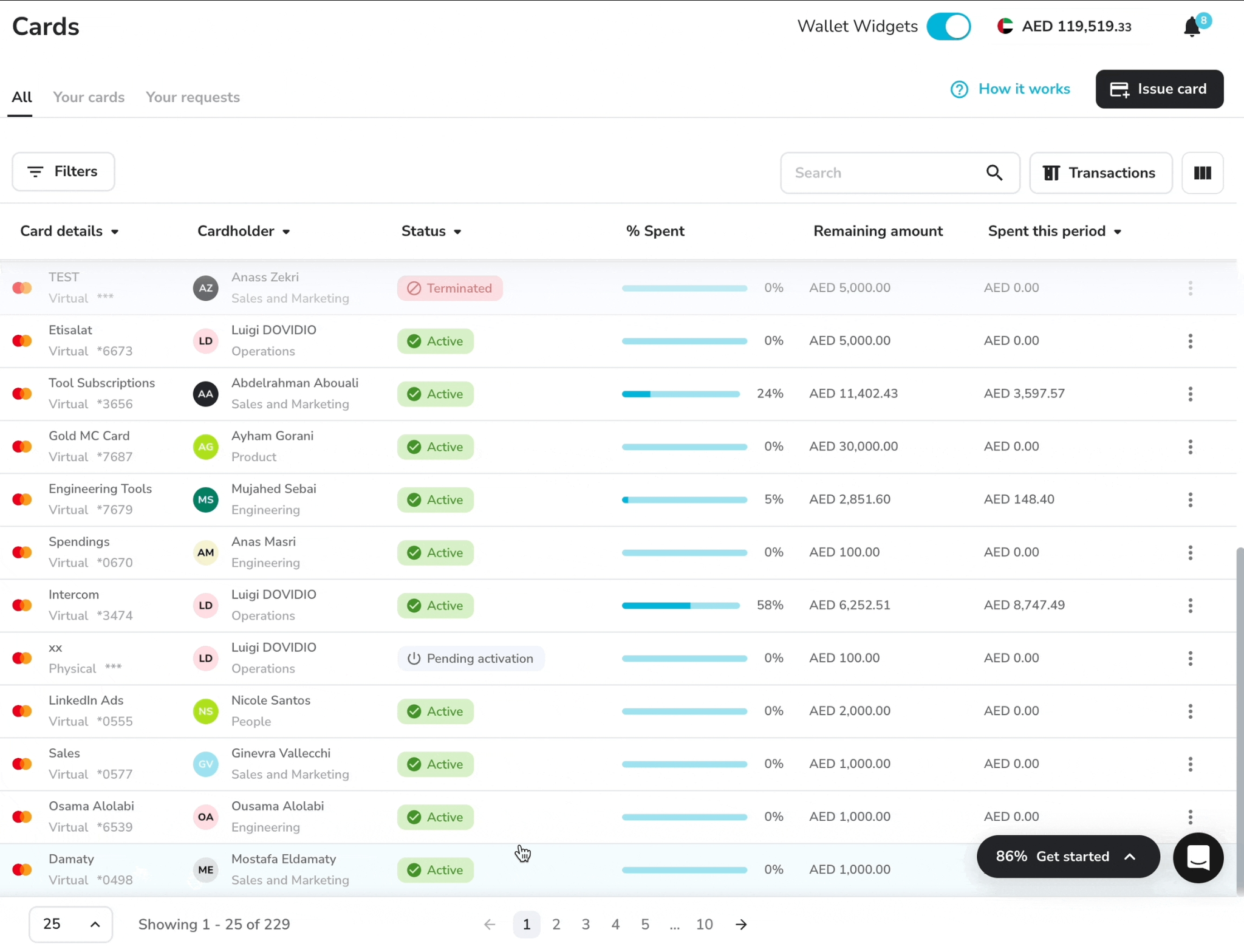
Card controls cover the rest.
Per-transaction limits and cycle limits come on every plan, set daily, weekly, monthly or yearly. Premium adds restrictions by merchant category. Vendor- and country-level restrictions sit in advanced controls.
Your finance team can slightly above what a vendor charges today, and their next price rise shows up as a declined payment with a same-day alert.
Leave headroom on anything you can't afford to have lapse, though (a declined renewal on insurance or a critical platform can cost more than the increase you were trying to catch).
Freezing a card stops the renewals riding on it, which is the fastest way to halt a subscription you've decided to drop, and a reason to check what else is billed to that card first.
Stop one-off purchases from becoming permanent
Single-use virtual cards expire the moment the transaction clears.
A supplier you dealt with once never keeps credentials that work twice.
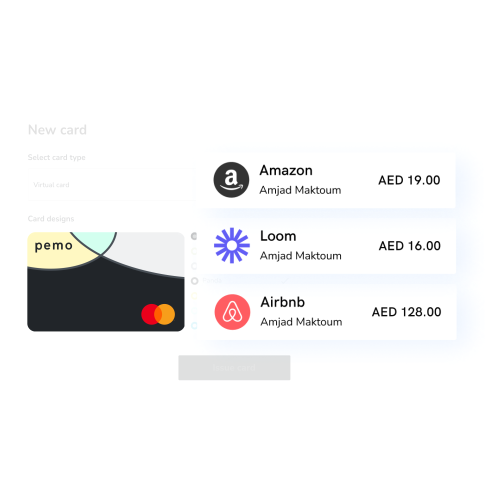
Pre-funded cards take the bigger one-offs, like a trade show stand, holding an approved amount until the purchase happens and staying adjustable in both directions while the card is active.
Unlimited cards and cardholders come with every plan, issued in seconds.
Running one card per supplier never changes your bill.
How does the total become something you can look at?
Pemo AI Copilot reads each expense on arrival, sets the account code from your category and vendor mappings, and matches the supplier.
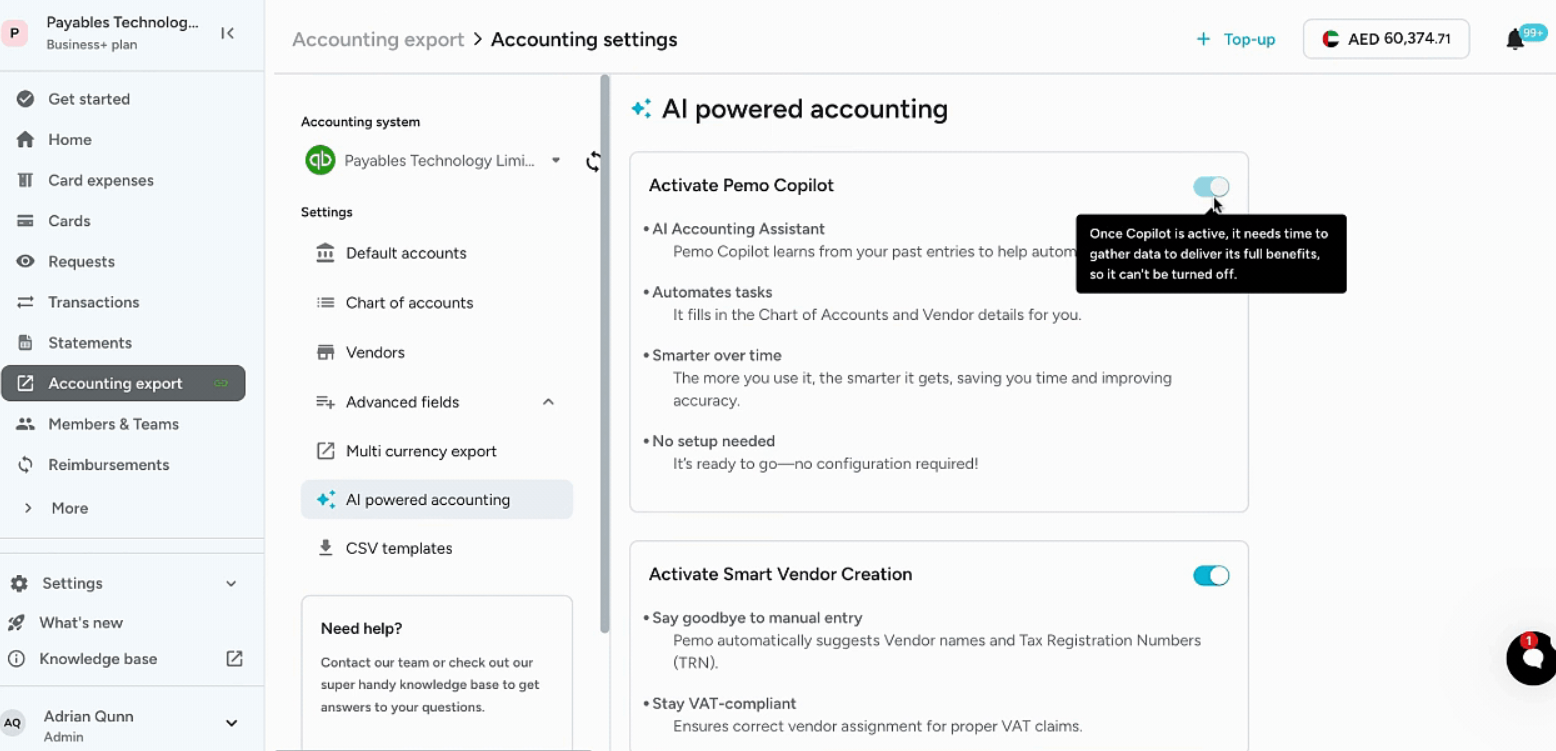
Auto vendor creation opens a supplier record on first payment.
Custom fields carry your financial dimensions through to the ledger.
Receipts arrive by email, by upload, or by OCR matching in the mobile app.
Premium layers on duplicate detection, receipt reminders, the spend analytics dashboard, spend trends and consolidated statements.
Everything syncs to Xero, QuickBooks, Zoho Books, Odoo, Wafeq or Mazeed, with standard ERP connections to NetSuite, Odoo and Dynamics 365 Business Central on Premium, and custom ERP on Enterprise.
Cashback on international spend runs 0.5% on Starter and up to 2% flat and uncapped on Premium, with a custom rate on Enterprise.
Two things move the number you actually see: which suppliers bill you from outside the UAE, and your account's foreign exchange fee profile, which is why two companies on the same plan can earn different rates.
Companies whose KYB was approved on or after 1 July 2026 also carry a 3.68% FX fee including VAT, so net that against the cashback before treating international card spend as a saving.
Ask questions about indirect spend without building a report
Pemo MCP connects an AI assistant to your live Pemo data.
You can ask about last month's software bill and the answer comes back from the account with no export in between.
It works with Claude, ChatGPT, Gemini, Copilot and any client that supports remote MCP servers.
Here are four example questions that you can now ask:
- What did we spend on software last month?
- Which cards have no recent activity?
- Show me any declined transactions today.
- Give me a month-end spend summary.
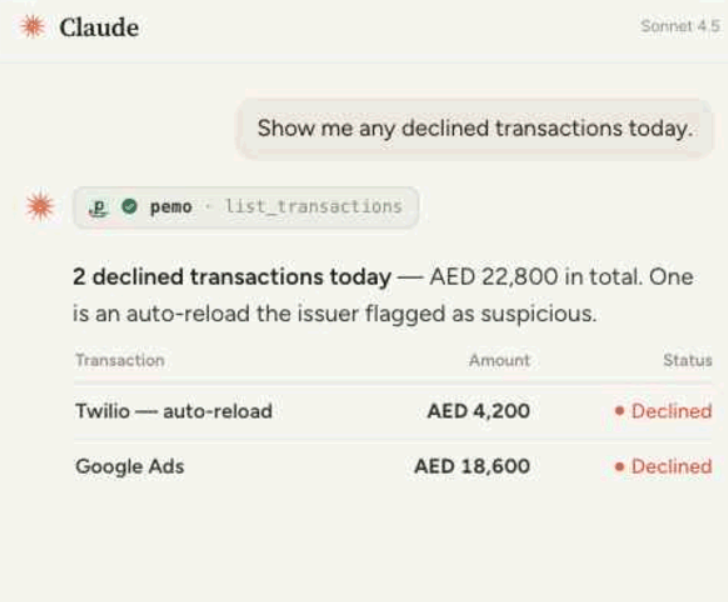
Access is read-only throughout.
An assistant can pull and summarise, though it cannot issue a card, approve a transaction, change a limit or edit anything else in the account.
Your Pemo role carries across the connection.
A team lead sees their team's cards and spend, while an admin queries company-wide.
➡️ Full card numbers, CVVs and PINs are never exposed, and cards show only the last four digits.
Pemo MCP is rolling out to customers now, with access starting from a request to Pemo support.
Sign up for Pemo for free
Once every indirect category has a name against it and a control matched to its rung, month-end stops generating questions nobody in the room can answer.
Renewal dates surface while you can still act on them. The vendors you used once stay used once.
With Pemo, that setup looks like:
- Invoice approvals that happen before a commitment is signed, with multi-layer workflows on Premium.
- A sub-wallet and budget for every category owner, giving each one their own total and nothing else.
- Single-use cards covering one-time purchases, with no per-card charge on any plan.
- Coded expenses landing in Xero, QuickBooks, Zoho Books, Odoo, Wafeq or Mazeed without a manual export.
Starter is free with no SaaS fees, and Premium runs AED 399 per month per company. Enterprise pricing starts at AED 1,500 per month.
You can sign up for Pemo's free plan or book a demo to see why 10,000+ businesses in the MENA region have chosen us.
⚠️ Disclaimer: This article was last updated on the 6th of August, 2026. It covers general information, not tax, accounting, or legal advice, so confirm anything affecting your filings with a qualified adviser. Product features and plan availability change, so check current plan details before relying on them. If you spot something that needs correcting, contact us, and we will review it.
FAQs
Is indirect spending the same as overhead?
Close, though the two words come from different vocabularies.
Overhead is an accounting term for costs that don't attach to a unit of production.
Indirect spend is a procurement term for supplier purchases outside what you sell.
Most line items sit under both, though overhead also picks up costs nobody purchased, like depreciation.
Is all indirect spending tail spend?
No, and the reverse is closer to true. Tail spend is the small, scattered, unnegotiated end of your supplier list.
Most of it happens to be indirect. Indirect spend also holds your largest commitments, like the lease and the insurance renewal. Those get negotiated with real care.
Does indirect spending include payroll?
Salaries usually get handled separately, on their own process and their own controls.
Where the split does get applied to people costs, delivery staff count as direct labour.
Finance, HR, IT and admin count as indirect.
Can you cut indirect spend without cutting services?
On the two middle rungs, usually yes.
Unused seats, duplicate tools, licences still running after a project closed and renewals nobody read are the standard finds.
Removing them changes nothing about what the team can do.
Cuts on the locked rung depend on a notice period.
Those take most of a year to reach the accounts.
Who should own indirect spending when there is no procurement team?
The department that consumes the category.
Finance holds the master list while the decisions stay with the owners.
Marketing takes ad platforms and design tools, IT takes hardware and software, operations takes facilities and vehicles, and HR takes recruitment and training.
Someone in finance keeps the renewal calendar and chases the owners.
One person can run that in an afternoon a quarter.


