
The UAE is moving business invoicing from PDFs and paper to structured electronic files, starting with the largest companies on 1 January 2027.
This guide covers which deadline applies to your business and what finance teams can prepare now, based on the Ministry of Finance rules in force as of October 2026.
TL;DR
- E-invoicing in the UAE means exchanging invoices as structured PINT AE files over Peppol, through providers accredited by the Ministry of Finance.
- The first go-live is 1 January 2027 for businesses with AED 50 million or more in revenue, whose ASP appointment deadline is 30 October 2026.
- Smaller businesses go live on 1 July 2027; government entities follow on 1 October 2027.
- Each business appoints one ASP for sending and receiving, picked from a Ministry register of 69 accredited providers.
- October 2026 eased three rules: a 24-month exclusion for tax group transactions, the end of the UAE-only storage requirement and the removal of the two-business-day system failure notice.
- The main fine is AED 5,000 a month for a business that misses its go-live or ASP deadline.
What is e-invoicing in the UAE?
E-invoicing in the UAE is the exchange of invoices and credit notes as structured XML files through accredited providers, who also report the tax data to the Federal Tax Authority (FTA).
The Ministry of Finance's eInvoicing programme overview rules out PDFs, Word files, invoice images and OCR-scanned paper as e-invoices.
Every UAE e-invoice follows PINT AE (the UAE edition of the Peppol invoice standard) and carries no QR code or barcode.
Compared with a PDF, the difference shows up at each step of an invoice's life:
The UAE rules lean on a handful of terms:
- Peppol: the international e-invoicing network that UAE invoices travel over, connected on each business's behalf by its provider.
- Accredited Service Provider (ASP): a company the Ministry of Finance has accredited to exchange e-invoices for businesses and report them to the FTA.
- Tax Identification Number (TIN): for a business registered with the FTA, the first 10 digits of its 15-digit Tax Registration Number (TRN).
- Participant identifier: a business's address on the network, written as 0235 followed by its 10-digit TIN.
The UAE Electronic Invoicing Guidelines add one wrinkle for groups: each tax group member uses the first 10 digits of its own TRN, not the representative's.
How does an e-invoice travel from supplier to buyer in the UAE?
A standard UAE e-invoice involves five parties: the supplier, the supplier's ASP, the buyer's ASP, the buyer and the FTA, which receives the tax data.
The Ministry of Finance's name for this setup is the decentralised continuous transaction control and exchange (DCTCE) model, or five-corner model for short.
As an example, a Dubai marketing agency bills a Sharjah retailer AED 20,000 plus AED 1,000 VAT for a campaign.
The AED 21,000 invoice then moves in this order, following the Ministry's five-corner framework:
- Corner 1, the agency: its accounting software sends the invoice data to the agency's ASP in a format the two have agreed.
- Corner 2, the agency's ASP: checks the data and, where needed, converts it into a PINT AE XML file addressed to the retailer's participant identifier.
- Exchange: over Peppol, the XML invoice travels to the retailer's ASP.
- Seller-side reporting: at the same time, the agency's ASP reports the invoice's tax data to the FTA.
- Corner 3, the retailer's ASP: validates the file and confirms receipt to the agency's ASP before reporting the buyer-side tax data.
- Corner 4, the retailer: receives the invoice in the format agreed with its own ASP, ready for approval and payment.
- Corner 5, the FTA: confirms each successful report to both ASPs, which pass the confirmations on to the agency and the retailer.
If the file fails validation at Corner 3, the retailer's ASP notifies the agency's ASP and the FTA.
No buyer-side tax data reaches the FTA in that case. If the retailer isn't live yet, the agency addresses its e-invoice to the predefined endpoint 0235:9900000098 and also sends a regular tax invoice, such as a PDF.
Which businesses and transactions are in scope for UAE e-invoicing?
Every business transaction made in the UAE needs an e-invoice once the seller's phase starts, whether or not the seller is registered for VAT, unless one of the exceptions below applies.
The main exceptions come from two places: the excluded list in Ministerial Decision No. 243 of 2025 and the B2C carve-out in Ministerial Decision No. 244 of 2025.
Coverage depends on who is on each side of the sale, as the Ministry's scope chapter shows:
- B2B and B2G sales: in scope, including goods and services sold to government entities through UAE procurement portals.
- G2B and G2G transactions: in scope once government entities reach their October 2027 go-live.
- B2C sales: outside the system until the Minister decides otherwise, which also leaves a business selling only to consumers uncovered.
- Commercial invoices: sales that need no VAT tax invoice, such as exempt supplies or sales by a business that isn't VAT-registered, still move to e-invoices.
Ministerial Decision No. 243 of 2025 and its October 2026 amendment leave out the following transactions:
- Sovereign government activity: a government entity's sovereign functions, provided they don't compete with private businesses.
- Airline passenger services: international passenger flights sold on an electronic ticket, plus ancillary services billed on an electronic miscellaneous document.
- Air cargo: international goods transport under an airway bill, excluded for 24 months only.
- Financial services: VAT-exempt financial services under Article 42 of the VAT Executive Regulation, including exempt services zero-rated as exports to non-residents; standard-rated financial services stay in scope even when exported.
- Tax group transactions: sales between members of the same tax group, excluded for 24 months from 1 January 2027.
Some situations need a second look before anyone marks them out of scope:
- Investment holding companies: a company with only passive income has no business transactions to invoice, but recharges such as management fees bring it into scope.
- Non-resident suppliers: a business without a UAE residence that must issue VAT tax invoices issues them as e-invoices.
- Free zone sales: in scope, with the beneficiary's details added when the customer is a free zone entity.
- Imported concerned goods and services: imports under the reverse charge mechanism carry no e-invoicing requirement.
When does e-invoicing become mandatory in the UAE?
UAE businesses with AED 50 million or more in revenue for their most recent accounting period must be issuing e-invoices by 1 January 2027.
Everyone else in scope follows on 1 July 2027. Government entities come last, on 1 October 2027.
The table uses Ministerial Decision No. 244 of 2025 and the Ministry of Finance's May 2026 amendment, both checked on 20 October 2026:
Which row applies depends on these details:
- Revenue test: Decision 244 measures gross income for the most recent accounting period, taken from the financial statements or, if none are available, from other documents the FTA accepts.
- Exactly AED 50 million: the first phase covers revenue equal to or above the line, putting a business at exactly AED 50 million in the January group.
- One date moved: only the first phase's ASP appointment was pushed back in May 2026, leaving the 1 January 2027 go-live untouched.
- Early adopters: businesses that start voluntarily follow the full technical rules, though penalties only begin from their mandatory date.
The pilot programme opened on 1 July 2026 for a taxpayer working group that the Ministry invited and that agreed in writing.
Where an entity's revenue is close to the AED 50 million line, a tax advisor can confirm its phase before any ASP contract is signed.
Which 2026 decisions changed the rollout?
Ministry of Finance decisions in May and October 2026 moved one deadline, changed how providers get accredited and relaxed three rules for businesses:
- ASP deadline extension (May 2026): large businesses gained three extra months to appoint a provider.
- Ministerial Decision No. 168 of 2026 (effective 1 October 2026): the pre-approval stage for providers was removed, giving previously pre-approved providers 30 days to complete full accreditation.
- Ministerial Decision No. 197 of 2026, tax groups (effective 1 October 2026): transactions between members of the same tax group are excluded for 24 months from 1 January 2027.
- Ministerial Decision No. 197 of 2026, records: neither UAE-only data storage nor the two-business-day system failure notice to the FTA is required any more.
What must a UAE e-invoice contain?
An electronic tax invoice in the UAE carries 51 mandatory fields, set out in the official mandatory fields document of 23 February 2026 and summarised by KPMG.
Commercial invoices, which aren't VAT tax invoices, use an adapted list without the TRN requirement.
Grouped by purpose, the fields cover:
- Invoice details: number, issue date, invoice type code, currency and a unique ID (UUID) generated for each invoice.
- Seller details: legal name, TRN, participant identifier, trade licence number with its issuing authority, and address.
- Buyer details: the same identifiers for the customer, including the buyer's participant identifier.
- Totals and tax breakdown: VAT broken down by tax category, with the total payable stated in AED even on invoices raised in another currency.
- Line items: quantity and unit price for each line, plus its VAT amount and the amount payable in AED.
Each line also carries one of six tax categories: standard rate, zero rate, exempt, out of scope, reverse charge or margin scheme.
PINT AE doesn't accept extra optional fields added by businesses themselves. Industry-specific data has to be agreed with the ASP.
When is an electronic credit note required?
Electronic credit notes are required whenever a sale is cancelled, its price drops, payment is returned or an error needs correcting.
Article 6 of Ministerial Decision No. 243 of 2025 frames those triggers in legal terms:
- Cancellation: a business transaction is cancelled.
- Price reduction: the agreed consideration is reduced for any reason.
- Refund: all or part of the consideration is returned.
- Correction: an administrative or numerical error has occurred on the original invoice.
Both documents have to pass through the system within 14 days of the business transaction date, meaning the earlier of the transaction or the payment.
For VAT-registered issuers, the VAT law's tax invoice timelines come first.
What is an Accredited Service Provider (ASP) in the UAE?
An Accredited Service Provider (ASP) is a company accredited by the UAE Ministry of Finance to exchange e-invoices on behalf of businesses and report their tax data to the FTA.
Article 5 of Ministerial Decision No. 243 of 2025 requires both the issuer and the recipient of an e-invoice to appoint one.
One provider covers both directions, since the Ministry's guidelines require a single ASP per business for sending invoices (receivables) and receiving them (payables).
The Ministry's ASP register lists 69 accredited providers, up from 32 in May 2026.
Three more appear under a separate heading for providers completing their final accreditation assessment.
Those three were pre-approved under the old rules and, under Ministerial Decision No. 168 of 2026, have 30 days from 1 October 2026 to finish.
How do you pick a provider from the ASP register?
Picking a provider starts with the register's accredited heading, followed by a test of how each shortlisted ASP connects to the accounting software already in use.
Beyond accreditation, the Ministry's readiness checklist points to the details worth comparing:
- Connection to your books: the route invoice data takes from your accounting or ERP system to the ASP, which the Ministry leaves to the two parties.
- Inbound invoices: how supplier e-invoices reach your payables process, tested as carefully as outbound sending.
- Error handling: a process for rejected invoices and confirmation messages, agreed before go-live.
- Data storage: whether the ASP will keep records for you under contract, with the retention duty still resting on your business.
For the wider setup, the complete UAE finance stack guide maps where an ASP fits beside the ledger and spend management tools.
Do any accounting tools that work with Pemo hold ASP accreditation?
Three accounting tools that work with Pemo appear on the accredited list, as of 21 October 2026:
- Wafeq: listed as Wafeq FZ-LLC, accreditation number 129932.
- Zoho: listed as Zoho Software Trading LLC, accreditation number 121988.
- Tally: listed as Tally Software Solutions FZCO, accreditation number 162503.
Wafeq and Zoho Books sync with Pemo directly; Tally works through an offline export flow, since Tally doesn't accept direct online integrations.
A finance team already keeping its books in one of them can ask that provider how its e-invoicing service would fit the current setup.
All three also feature in our ranking of the 10 best accounting automation software in the UAE.
How should a UAE business prepare for e-invoicing?
A UAE business gets ready for e-invoicing in two stages: fixing its own data first, then appointing one ASP through EmaraTax and testing invoices both ways before go-live.
The steps below follow the readiness stages in the Ministry's guidelines, in the order a typical finance team would tackle them:
- Confirm each entity's phase: compare every trading entity's revenue for its most recent accounting period with the AED 50 million line.
- Confirm your TIN: the first 10 digits of the TRN serve as the TIN for any business already registered with the FTA for a tax.
- Collect customers' participant identifiers: each customer record needs its 0235 address next to the TRN, a job that falls to the supplier.
- Clean the master data: legal names, trade licence numbers, issuing authorities and addresses must match what PINT AE expects, for suppliers as well as customers.
- List every invoice type you issue: tax invoices, commercial invoices, credit notes, self-billed invoices, exports, free zone sales and summary invoices each carry their own rules.
- Appoint one ASP and onboard through EmaraTax: after the contract is signed, the EmaraTax account admin starts onboarding from the E-INVOICING tile; the ASP then shares the participant identifier once onboarding is complete.
- Test outbound and inbound flows: test invoices should travel in both directions before go-live, including the confirmation messages that tell your team each one arrived.
- Agree how errors get fixed: set out with the ASP who corrects a rejected invoice and how quickly, before the go-live date.
For first-phase businesses, the ASP appointment in step 6 has to happen by 30 October 2026, which pulls the earlier steps forward too.
Once live, e-invoice records follow the Tax Procedures Law retention periods: five years after the tax period for a taxable person.
💡 Pro tip: start the master data clean-up with the customers and suppliers you invoice most often. Their records give the first test runs realistic data to work with.
What are the penalties for not complying with UAE e-invoicing?
The main UAE e-invoicing penalty is AED 5,000 for each month, or part of a month, that an in-scope business goes without implementing the system or appointing an ASP.
Cabinet Decision No. 106 of 2025 sets that fine in an annexed table, next to the other violations:
- No system or no ASP by the deadline: AED 5,000 for every month the delay runs, counting a partial month as a full one.
- Late or missing e-invoices: AED 100 for each invoice not issued through the system in time, to a maximum of AED 5,000 a month.
- Late or missing credit notes: the same AED 100 per document, under its own AED 5,000 monthly limit.
- Registration changes not passed on: AED 1,000 per day when an issuer or recipient doesn't tell its ASP about changes to its FTA-registered data.
- System failure notices: AED 1,000 per day for issuers or recipients, a fine whose underlying notice duty Ministerial Decision No. 197 of 2026 removed from 1 October 2026.
These amounts follow Cabinet Decision No. 106 of 2025, the resolution the Ministry announced in December 2025.
Implemnt, a UAE e-invoicing implementation firm, reports that the Ministry's October 2026 programme presentation names a newer penalties resolution, Cabinet Decision No. 173 of 2026.
Its text wasn't published as of 21 October 2026, which makes it worth confirming the current amounts with a tax advisor before relying on them.
In practice, the first two fines build up like this:
- Late go-live: a first-phase business that appointed its ASP on time but goes live on 15 February 2027 has missed January and part of February, which counts as two full months: AED 10,000.
- Missed appointment too: a first-phase business that also missed the 30 October 2026 appointment date may face the AED 5,000 monthly fine from that earlier date, since the first violation covers both failures.
- PDF-only invoices: sixty invoices sent only as PDFs in one month would come to AED 6,000 at AED 100 each, before the monthly cap brings it down to AED 5,000.
Voluntary adopters aren't fined until their mandatory date arrives.
Separate VAT penalties for tax invoice failures can still apply on top; our guide to VAT penalties and fines in the UAE lists them.
This guide is general information, not tax or legal advice.
What does e-invoicing change for payables and receivables?
E-invoicing changes the way UAE businesses send and receive invoices without changing who approves and pays them.
With one ASP per business, the same provider carries a company's sales invoices and its supplier invoices.
What do finance teams need to change when sending invoices?
On the sales side, the emailed PDF gives way to an XML file sent through the ASP, followed by a delivery confirmation from the customer's ASP.
Day to day, that means a few new habits:
- Customer setup: each new customer that is already live needs its participant identifier on file before the first invoice goes out.
- Issuing window: invoices and credit notes must reach the system within 14 days of the transaction date, or within the VAT law's timeline when the issuer is VAT-registered.
- Mixed customers: a customer that isn't live yet still needs a regular tax invoice next to the e-invoice sent to the predefined endpoint.
- Price changes: discounts or refunds granted after invoicing go out as electronic credit notes.
A confirmation shows the invoice arrived and its tax data was reported.
Whether the customer has paid is a separate question, answered by matching incoming payments against open invoices.
Keeping those open invoices next to cash on hand is one of the fixes in our list of cash flow mistakes UAE SMEs make.
How will supplier invoices arrive under the new system?
Supplier invoices reach a buyer as structured data through the buyer's own ASP, in whatever format the buyer agreed with that provider.
Payables teams should plan for these shifts:
- Mixed inbound formats: a first-phase business is likely to receive e-invoices from live suppliers and PDFs from suppliers whose phase starts on 1 July 2027.
- Unique invoice IDs: every e-invoice carries a UUID from the supplier's ASP, making a duplicate entry of the same invoice easier to catch.
- Approval routing: the guidelines suggest reviewing approval workflows so invoices received through the ASP reach approvers without delay.
- Supplier records: vendor names and TRNs in your books need to match the data suppliers send.
Approval and payment steps after a supplier invoice arrives are mapped out in the AP automation guide for Dubai SMEs.
How can Pemo help UAE businesses with invoicing?
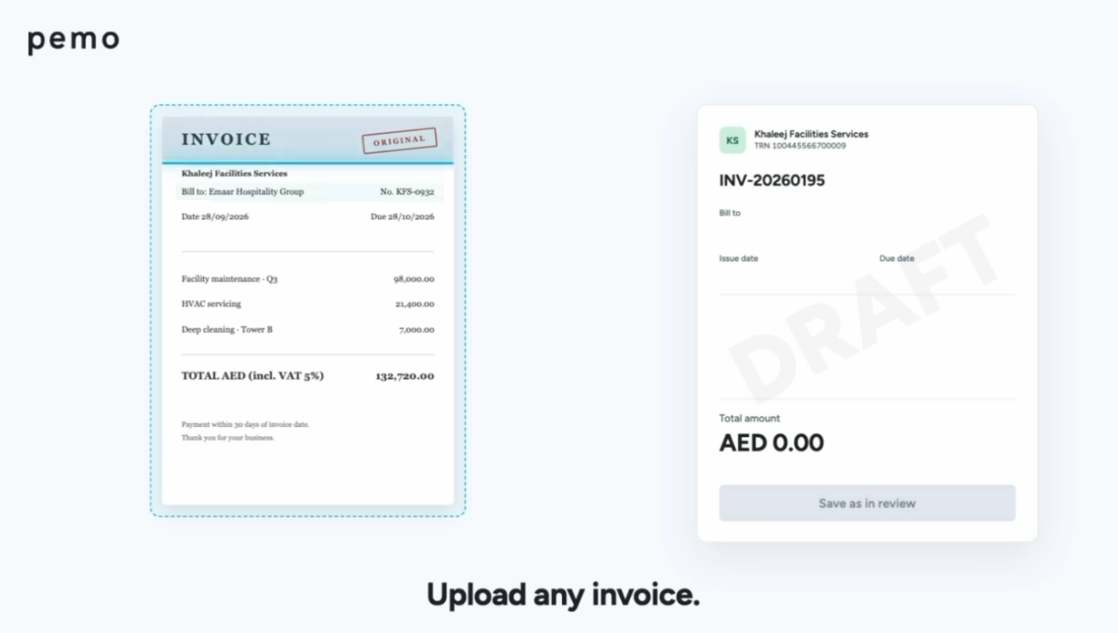
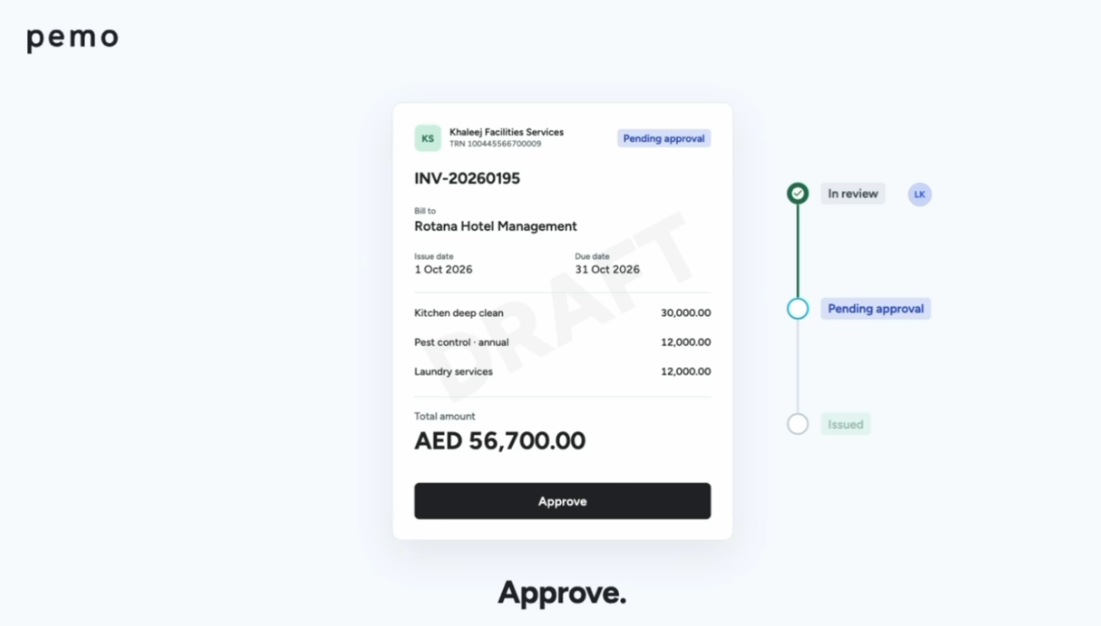
Pemo helps UAE businesses take supplier invoices from inbox to payment today, with customer invoicing and payment tracking arriving in November 2026.
Pemo (that's us) is a spend management platform for UAE businesses that brings corporate cards, expenses, supplier invoices and accounting sync together.
Full disclosure: Pemo isn't an Accredited Service Provider, which means invoices under the mandate still travel through the ASP your business appoints.
Banking services behind the Pemo Business Account come from ruya, a UAE-licensed, Shari'ah-compliant community bank.
The invoice workflow in Pemo runs in four parts:
- Supplier bills: invoices forwarded from email or uploaded are read automatically, then routed to the approvers each policy names.
- Bill Pay: the Payment Order Authorizer (POA) releases approved bills from the Pemo Business Account with a one-time SMS code, after automatic fraud checks on each bill.
- Ledger sync: paid bills are marked as paid in QuickBooks, Zoho or Xero, all among the accounting tools Pemo connects to on every plan.
- Customer invoicing (from November 2026): invoices created in Pemo go out to customers and, with a Pemo Business Account, can be tracked through to payment.
Plans start with a free Starter tier and Premium at AED 399/month per company, with the Pemo Business Account at AED 99/month under a current discount (list price AED 200/month).
Get your invoicing ready with Pemo
An ASP moves invoices between businesses; the approvals and payments around each invoice still need their own workflow.
Pemo's free Starter plan lets a UAE finance team connect its accounting software before the first go-live date.
To see Bill Pay or ask about the November 2026 invoicing release, book a demo with the Pemo team.
E-invoicing in the UAE FAQs
Is e-invoicing mandatory for SMEs in the UAE?
From 1 July 2027, every in-scope UAE business below the AED 50 million revenue line has to issue e-invoices.
Their ASP appointment deadline is 31 March 2027.
Does a business need to be VAT-registered to fall under UAE e-invoicing?
No, UAE e-invoicing applies to any person doing business in the UAE, whatever its VAT status.
A business with no tax registration of any kind registers with the FTA through EmaraTax to get a TIN.
Can a UAE business keep sending PDF invoices after its go-live date?
Once a business in scope reaches its go-live date, its invoices for in-scope transactions have to be issued as e-invoices through its ASP.
A PDF tax invoice still goes alongside the e-invoice when the customer hasn't gone live yet.
How many ASPs does a UAE business need?
One ASP per business handles both sending and receiving e-invoices.
Tax group members are treated separately and can each choose a different ASP.
Does UAE e-invoicing apply to sales to consumers?
Not yet, since B2C transactions stay outside the UAE e-invoicing system until the Minister of Finance issues a decision bringing them in.
Is Pemo an e-invoicing ASP?
No, Pemo isn't on the Ministry of Finance's ASP register as of 19 October 2026.
Pemo works next to whichever ASP a business appoints, handling supplier bill payments now and customer invoice tracking from November 2026.


