
This article walks through why employee reimbursement management is broken for most UAE businesses today, why corporate cards eliminate most of the workload upfront, how expense management software handles the rest, and what a clean rollout looks like for a UAE team.
TL;DR
- The real cost isn't reimbursements: it's the system that creates them, where employees front cash from personal accounts, and finance spends weeks chasing receipts.
- The fix is two-part: corporate cards for the spend you can predict, and a digital reimbursement flow for the rare cases where someone has to pay personally.
- Pemo runs both in one platform: unlimited virtual and physical cards prevent most reimbursements from existing, while the reimbursement module captures, approves, reconciles, and syncs the remainder to your accounting software without spreadsheets or WhatsApp photos.
What is employee expense reimbursement management?
Employee expense reimbursement management is the process of tracking and paying back team members who spent their own money on company business.
It covers everything from a taxi to a client meeting to a flight booked at midnight when the corporate card wasn't available.
The process sounds simple on paper:
- Employee pays.
- Employee submits the receipt.
- Finance approves.
- Finance reimburses.
In reality, each of those four steps hides its own mess.
Receipts can go missing, submissions can sit in someone's inbox for days, approvals can stall behind email and WhatsApp threads, and payouts can get bundled into payroll cycles that don't match the urgency of the spend.
If you've ever had a sales rep float AED 4,500 for a client dinner and wait three weeks to see it again, you know exactly what I mean.
Why is reimbursement management broken for some UAE businesses in 2026?
Reimbursement can be a broken model because it forces employees to be the bank, then makes finance teams play detective for weeks afterward.
A typical case looks like this:
A team member needs to spend on something the company hasn't pre-funded.
Maybe it's a client lunch in DIFC, or an AED 280 taxi to the airport at 4 AM.
They pay from their own account. That money is now gone.
They take a photo of the receipt. The photo lives somewhere, often in a WhatsApp group, sometimes in a personal inbox, or on a desk drawer with three other receipts they haven't submitted yet.
A week later, they remember to submit it. Or they don't.
If they do submit, the request travels through whatever approval system exists, which for most SMEs in the UAE is still email.
Their manager forwards it to finance. Finance asks for clarification. The employee replies three days later. The cycle continues.
Meanwhile, the company has no idea this expense even exists until it's already a problem.
- Cash that's been spent isn't tracked.
- Spend that should be coded against a project budget isn't.
- VAT details that should be captured for the FTA filing aren't.
- Reconciliation at month-end becomes guesswork.
When payroll runs, the reimbursement gets bundled in if everything is aligned and if the employee asked early enough.
And this is just one expense, for one person, in one month.
Now multiply it over a team of 30 people, each averaging four out-of-pocket expenses a month, and you'll have roughly 120 reimbursement events to manage every single month.
That's the actual problem. Not the reimbursement itself, but the volume, the chase, the cash flow burden on employees, and the invisibility of spend until it's too late to act on it.
What's the modern way to handle employee expense reimbursements?
The modern way is to stop creating reimbursements in the first place, then handle the few that remain through software that does the chasing for you:
- Old way: employees spend personal money, then finance reimburses through a manual process.
- New way: employees spend on company-issued corporate cards for almost everything, and the small number of personal payment cases get logged, approved, and paid through a digital flow that takes minutes, not weeks.
The math is straightforward. Say roughly 80% of your team's out-of-pocket spend could have happened on a corporate card.
That 80% of your reimbursement workload disappears the moment you issue those cards. The remaining bit gets handled through expense software that doesn't need email chains.
Two objections usually come up at this point:
- What about the cards getting misused?
Corporate cards in 2026 aren't the same product as a decade ago.
You can set per-card spend limits, restrict which merchant categories the card works at, and freeze the card instantly if anything looks off.
- What about spend that genuinely can't go on a card?
It still happens. A delivery driver tips a porter in cash, or a vendor only accepts a bank transfer to a personal account.
These are real cases. No one's trying to wipe out every reimbursement here.
The aim is to make rare cases easy and routine cases impossible to begin with, because a card was already issued for that spend type.
How does Pemo solve employee expense reimbursement management?
Pemo solves employee expense reimbursement management by attacking both sides of the problem at once:
- Corporate cards that prevent most reimbursements from ever existing.
- An expense management module that handles the rest in one place.
Let’s go over Pemo’s features: 👇
Virtual corporate cards that remove most reimbursements before they happen
Virtual corporate cards remove most reimbursements because they put company funds in the right hands instantly, without anyone touching their own money.
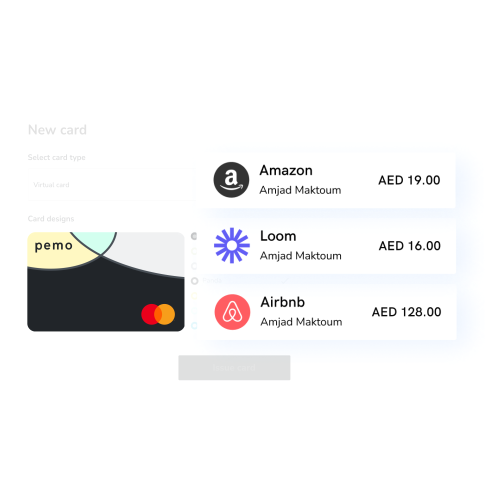
Inside Pemo, an admin can issue an unlimited number of virtual cards in seconds.
You assign each card to a team member or a specific project. The card is ready to use the moment you create it.
The cardholder adds it to Apple Pay, Google Pay, or Samsung Pay on their phone.
They can pay in store, online, at restaurants, or for SaaS tools, all without ever needing a physical card.
For purchases like ad spend or a new vendor, you can issue a single-use virtual card that expires after the transaction.
Every card has guardrails:
- You can set daily, weekly, monthly, or yearly limits.
- You can cap per-transaction amounts.
- You can restrict spend to specific merchant categories like fuel, advertising, travel, or office supplies.
- You can freeze the card from your desktop or phone in one tap.
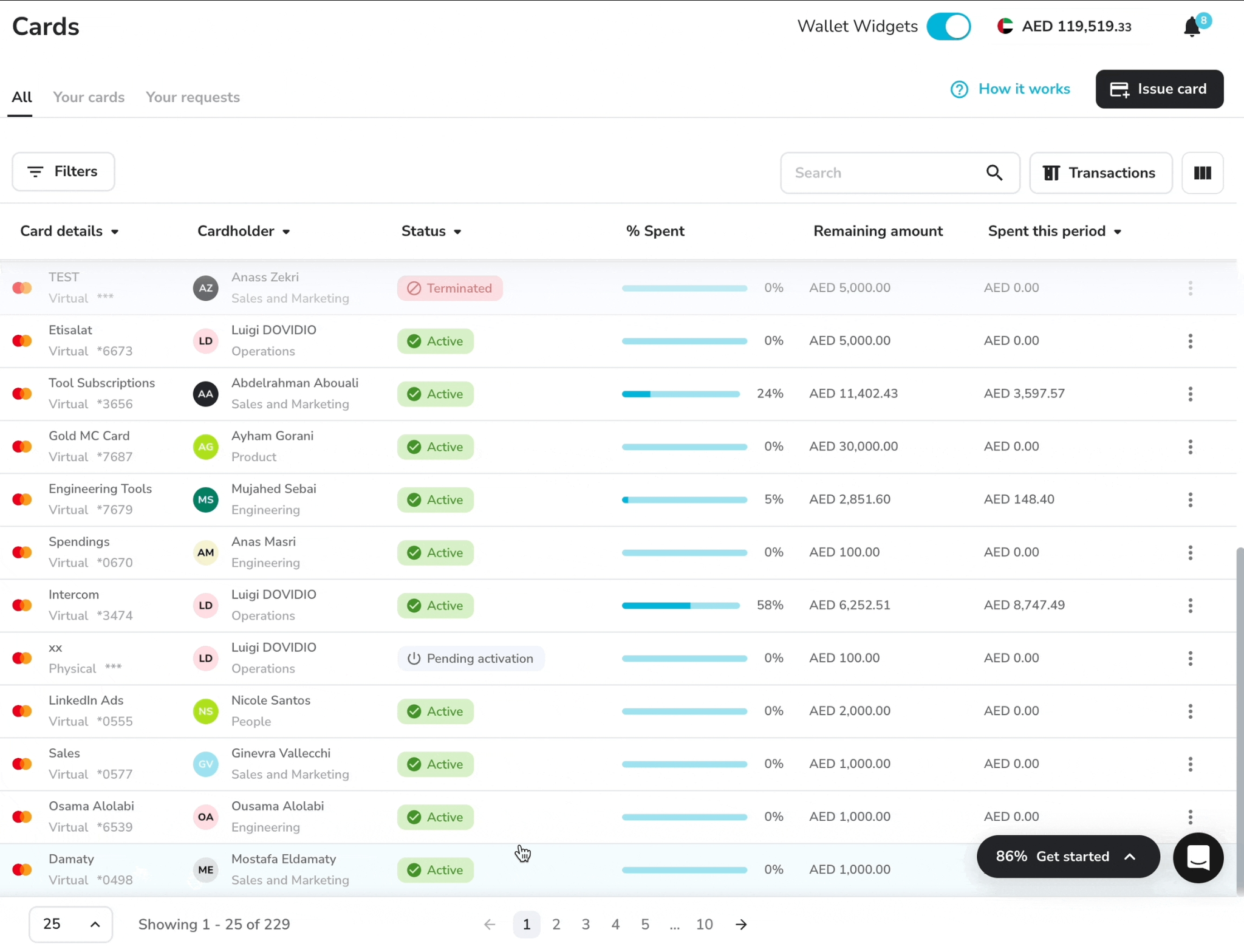
Your ops lead picking up office supplies on Sheikh Zayed Road doesn't reach for her personal Visa.
She taps with her Pemo virtual card, the transaction shows up in your dashboard within seconds, and the expense is already attached to the right card, the right person, the right project, and the right cost centre.
For UAE businesses where many monthly reimbursements are for things like meals, taxis, fuel, and software subscriptions, this single shift removes the bulk of the reimbursement workload before any approval process has to run.
Expense management software that handles the reimbursements you still need
Pemo's expense management software handles the remaining reimbursements through a digital submission and approval flow that lives in the same dashboard as your card expenses.
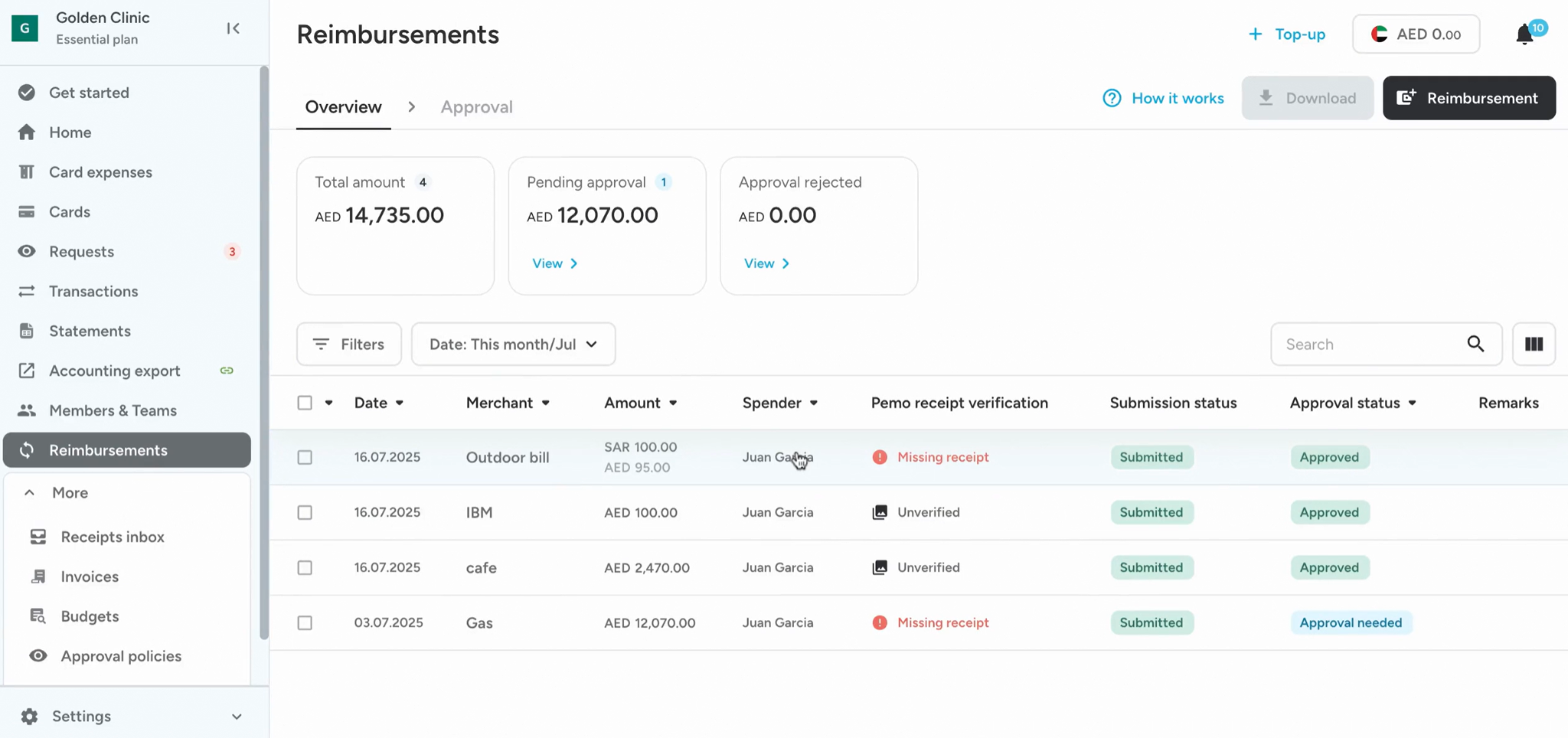
When a team member genuinely needs to spend personal money, the flow is short.
- The employee opens the reimbursements tab from desktop or the mobile app.
- They enter the date, the amount, and the merchant.
- They snap a photo of the receipt and attach it.
- They can add notes or tags if the expense needs context for finance later.
- They hit submit. That's the employee's job done.
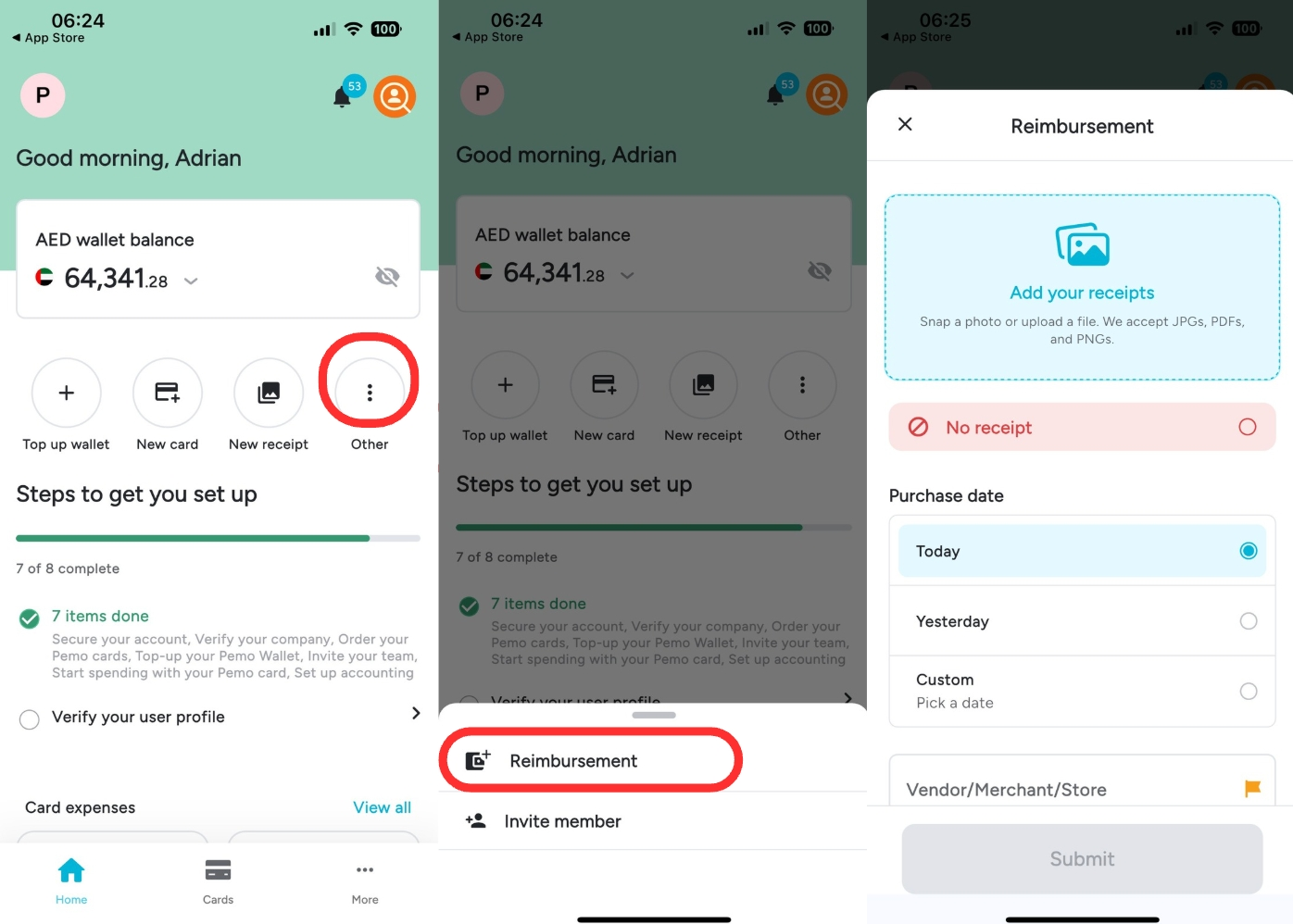
On the admin side, the reimbursement appears in the approval queue.
Finance can see the receipt, the amount, the submitter, and what it's for, all in one view. Approval is a click.
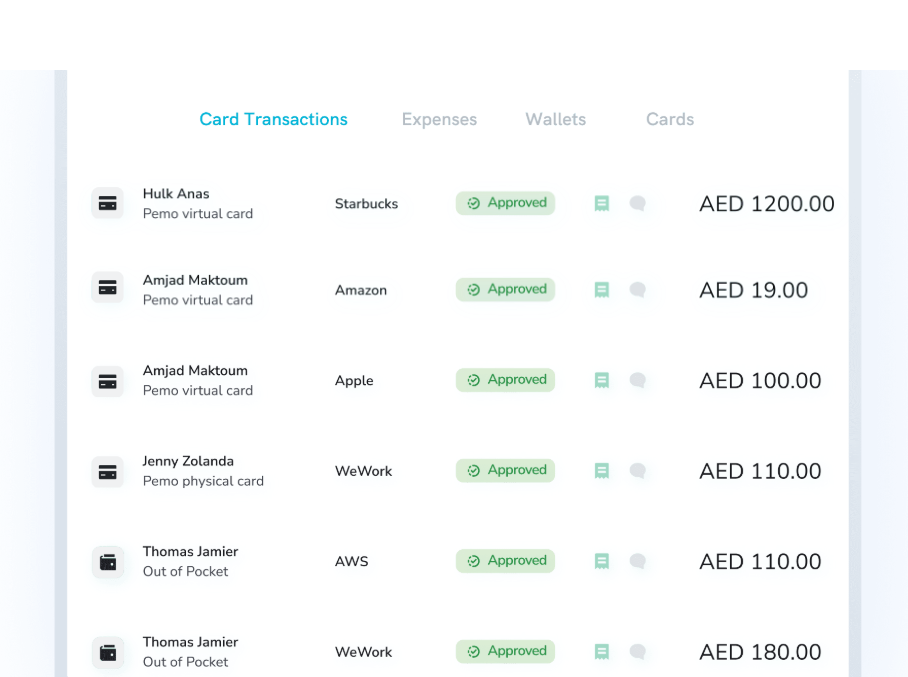
If something's missing, finance can ask for clarification inside the platform without starting a new email thread.
Once approved, the reimbursement is logged against the right cost centre, coded to the right category, and sits next to all the card spend that already lives in the system.
Payout happens through your usual run, but the data is clean and ready.
You can see the complete reimbursement process with Pemo here.
How does Pemo automate the accounting side of reimbursements?
Pemo automates the accounting side through Pemo Copilot, the AI engine that codes every transaction the moment it lands and pushes the cleaned data straight into your accounting platform.
Every transaction Pemo captures, whether it's a card expense or a reimbursement, runs through Copilot before it reaches your accountant.
The engine assigns the right chart of accounts code, picks the right vendor, applies the correct VAT treatment, and pulls the receipt data into the line item.
It also learns from you. When your bookkeeper corrects a categorisation, Copilot remembers.
A few months in, most teams find Copilot is getting categorisation right on its own most of the time, and the bookkeeper is approving entries instead of coding them from scratch.
The sync is real-time, so the reimbursement you approved on Tuesday morning is already sitting in Xero or Wafeq by Tuesday afternoon, coded, VAT-tagged, and ready for reconciliation.
Pemo's Pricing
Pemo has a free plan called Kickoff for up to 2 card users, which gets you unlimited virtual cards, the mobile app, expense reports, card spending limits, and Excel exports.
To unlock the full petty cash and accounting features, you'd move onto one of our 2 paid plans:
- Essential: Starts at AED 29/month per card user. Adds cashback on online ad spend, direct accounting integrations, spend analytics, and customisable approval workflows.
- Business+: Custom pricing starting from 20 card users. Adds higher cashback rates, custom onboarding, a dedicated CSM, and priority support.

Sign up for Pemo for free
Pemo offers an all-in-one expense management software for SMEs and growing businesses in the UAE, with pre-loaded corporate cards that turn every transaction into a tracked, categorised, audit-ready expense.
Our cards and AI software work together so your finance team stops chasing receipts, month-end reconciliation moves much faster, and your spending stays inside the rules you set before anyone swipes a card.
If you're looking for expense management software with smart corporate cards for your UAE-based team that offers:
- AI receipt matching and real-time spend visibility.
- Direct sync with QuickBooks, Xero, Zoho Books, Wafeq, and Tally.
- Cashback on Google Ads and Meta Ads.
- AED pricing that starts at 29 a month.
Then you can sign up for the free Kickoff plan or book a demo to see why over 10,000 businesses across the MENA region run on Pemo.
FAQs
What's the difference between a card expense and a reimbursement on Pemo?
A card expense is a payment made with a Pemo virtual or physical card, and it appears automatically in the dashboard with no manual logging needed.
A reimbursement is when a team member pays with personal money and submits the receipt afterwards for approval and payback.
Card expenses are tracked in real-time as the transaction happens, and they don't need a separate approval step since they're already governed by the card's preset rules and limits.
Reimbursements need manual submission and admin approval before payout runs.
Do employees need physical cards, or are virtual ones enough?
For most UAE businesses, virtual cards cover the majority of use cases on their own.
They work everywhere Apple Pay, Google Pay, or Samsung Pay are accepted, which now covers most organised retail, restaurants, and online merchants in the country.
How fast does a reimbursement actually get paid back to the employee with Pemo?
That depends on your internal approval timeline and how often you run payroll, but the submission and approval side inside Pemo takes minutes.
Teams can set approval rules upfront and batch the smaller reimbursements into the next payroll cycle.
If urgency matters for a specific case, finance can approve and process the reimbursement outside the payroll cycle directly.
Can I set different limits and rules for different team members?
Yes. Each card can have its own spend limit, approved merchant categories, location restrictions, and per-transaction caps.
A junior team member might have a 2,000 AED monthly limit covering fuel and meals only, while a regional sales manager might have a 15,000 AED limit across travel, software, entertainment, and ad-hoc client expenses.


