
Expense reconciliation is the process of proving that every dirham your business spends has a receipt and a record in your books, and for many UAE companies, it's still one of the biggest reasons the month-end close drags on for days.
TL;DR
- Expense reconciliation means matching company spending against receipts, card statements, and accounting records until all of them agree.
- The UAE problem: petty cash boxes, shared company cards, out-of-pocket employee spending, and receipts photographed over WhatsApp leave finance teams reconstructing the month from scraps.
- The fix: capture every expense digitally at the point of payment with corporate cards, then let software handle the matching and categorization.
- Pemo offers the best expense reconciliation solution, as it combines corporate cards with expense management software in one platform. More than 10,000 businesses use our solution, and finance teams close their books up to 5x faster.
What is expense reconciliation?
Expense reconciliation is the process of checking that every expense in your books matches a real transaction, backed by a receipt or an invoice, with no gaps and no duplicates.
In practice, you're lining up two pictures of the same month and looking for differences:
- The first picture is the money that actually left the business. Card statements, petty cash logs, reimbursement claims, supplier invoices.
- The second picture is what your accounting system says happened.
When the two agree, your financial reports can be trusted.
When they don't, something needs investigating: a missing receipt, a duplicate charge, an expense booked to the wrong cost centre, or a transaction nobody can explain.
This is how finance teams catch the software subscription that quietly renewed twice, or the taxi fare that two employees both claimed.
It's also the foundation for everything downstream. Budgeting, forecasting, audits, and management reporting all assume the expense data underneath them is accurate.
None of this is conceptually hard.
The difficulty is volume. A single employee might generate 30 expenses a month, and each one needs the same checks.
Multiply that across a company and reconciliation becomes one of the most time-consuming jobs in finance, despite producing nothing new.
Why is expense reconciliation so hard for UAE businesses?
It's hard because so much company spending in the UAE still runs through channels that leave a weak trail: petty cash boxes, a shared company card, employees paying out of pocket, and receipts photographed and sent over WhatsApp.
Ask anyone who's closed the books for an SME here, and you'll hear the same war stories.
Each channel creates its own gaps. And those gaps stay invisible until month-end, when finance suddenly needs all of them filled at once.
Why do receipts keep going missing?
Receipts go missing because they're collected after the money is spent, sometimes weeks after.
A salesperson takes a client to lunch in Dubai Marina, stuffs the paper receipt into a jacket pocket, and forgets it exists until finance comes asking in the first week of the new month.
By then the thermal paper has faded, or the jacket has been through the wash with the receipt still in it.
Petty cash is worse. Money leaves the box with a verbal explanation and, on a good day, a handwritten note.
There's no transaction record at all, so finance ends up reconstructing purchases from memory.
Which is how unexplained gaps end up in the books.
The chase itself burns time too. Someone in finance sends reminder emails and escalates to managers, all to retrieve a piece of paper proving an AED 180 lunch happened.
And when the receipt never turns up, the business simply eats the documentation gap.
Why does manual matching drag out month-end close?
Matching by hand means checking the card statement against the receipt pile, then both against the accounting ledger, one transaction at a time. That's the whole drag, right there.
A 40-person company can easily produce several hundred card transactions a month.
Each one needs a receipt, a category, an approver, and a correct ledger entry.
Miss a single item and the totals stop tying out, so the team goes hunting for the difference.
That hunt is why so many finance teams lose the first week of every month to close.
It's also where errors creep in.
Manual data entry has a failure rate, and one transposed digit can eat an entire evening. Usually the last evening of the month.
The cruel part is that effort doesn't scale the problem away.
Doubling the headcount on reconciliation roughly doubles the cost of doing it, while the volume of transactions keeps growing underneath.
Why do monthly statements arrive too late to help?
By the time a monthly statement lands, the spending it describes is up to 30 days old, which makes it useless as an early warning.
If someone blew through a budget on the 3rd, you find out on the 31st at the earliest.
If a card was charged for something nobody recognizes, you're now investigating a three-week-old transaction with a cardholder who genuinely can't remember it.
Traditional bank cards were built to move money. The reporting came afterwards, as a by-product.
A company-wide view for the finance team was never part of the design.
So reconciliation turns into a kind of archaeology, with finance digging through last month's transactions long after anyone can explain them.
Decisions suffer as well.
A budget owner working from a 30-day-old statement is steering with a delayed map, and overspending only becomes visible once the money is gone.
Why do spreadsheets stop working as the business grows?
A spreadsheet depends on people typing things in, and every new employee, card, entity, and cost center multiplies the rows until the file buckles.
- At 10 employees, a shared Excel file is annoying but survivable.
- At 50, you're dealing with version conflicts, broken formulas, duplicated entries, and no reliable record of who changed what.
There's no audit trail either. A spreadsheet can't tell you whether an expense was approved before the payment or quietly added after the fact.
And plenty of UAE businesses run more than one entity, which usually means more than one spreadsheet, each with its own quirks and its own version of the truth.
Consolidating those at month-end is a project in itself. I've yet to meet a finance person who enjoys it.
What's the best way to handle expense reconciliation in the UAE?
The best way to handle expense reconciliation is to stop treating it as a month-end clean-up job and capture every expense digitally the moment it happens, which is exactly the model Pemo is built around.
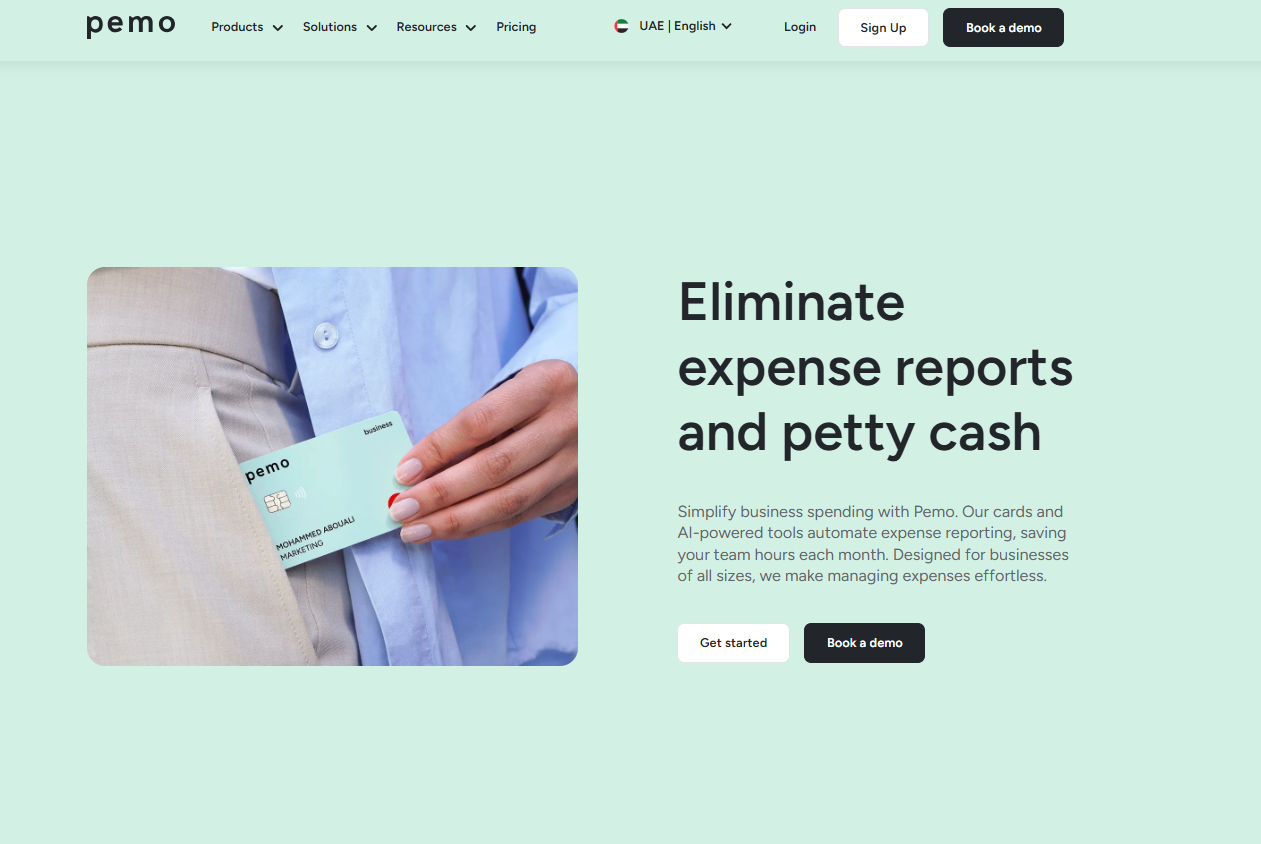
Pemo (that’s us) is a Dubai-based spend management solution that combines corporate cards with expense management software, made for businesses in the UAE and the wider MENA region.
The logic is straightforward:
If every transaction starts on a card tied to a person and a budget, with rules attached, and the receipt gets captured seconds after payment, then very little is left to reconcile when the month closes.
Done this way, most reconciliation work never gets created at all.
Let’s go over the features of Pemo: 👇
Virtual corporate cards that remove reconciliation work at the source
They remove the work by making every transaction digital from birth, so there's nothing to reconstruct later.
With Pemo, you can issue unlimited virtual cards in seconds and then map them to individual employees, software subscriptions, vendors, and projects.
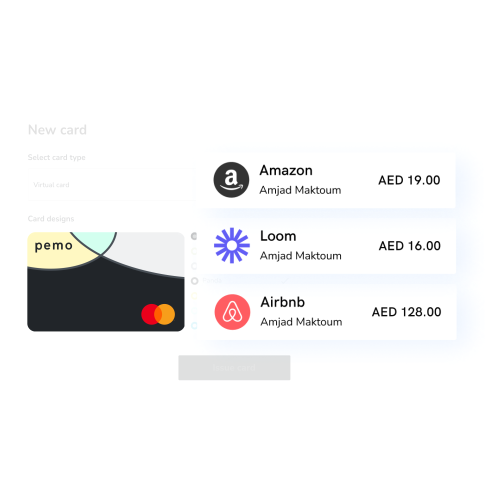
Each card carries its own rules:
- Spending limits per card or per team, adjustable in real time.
- Merchant category restrictions, so a travel card can't buy software licenses.
- Location controls for teams spending across markets.
- Instant freeze when something looks off.
The cards run on Mastercard, so they're accepted wherever Mastercard is, including through Apple Pay and Google Pay.
This setup removes the two worst reconciliation offenders.
Petty cash goes first, since employees no longer need cash for business purchases.
Out-of-pocket spending goes with it, along with the reimbursement claims finance would otherwise verify line by line.
Every dirham is tagged to a person, and a budget before anyone in finance even looks at it.
Match receipts to transactions automatically
Pemo ties receipt capture to the payment itself, so the match happens while the transaction is still warm.
A notification lands on the employee's phone. One photo later, the receipt is attached to the correct transaction, with no human matching involved.
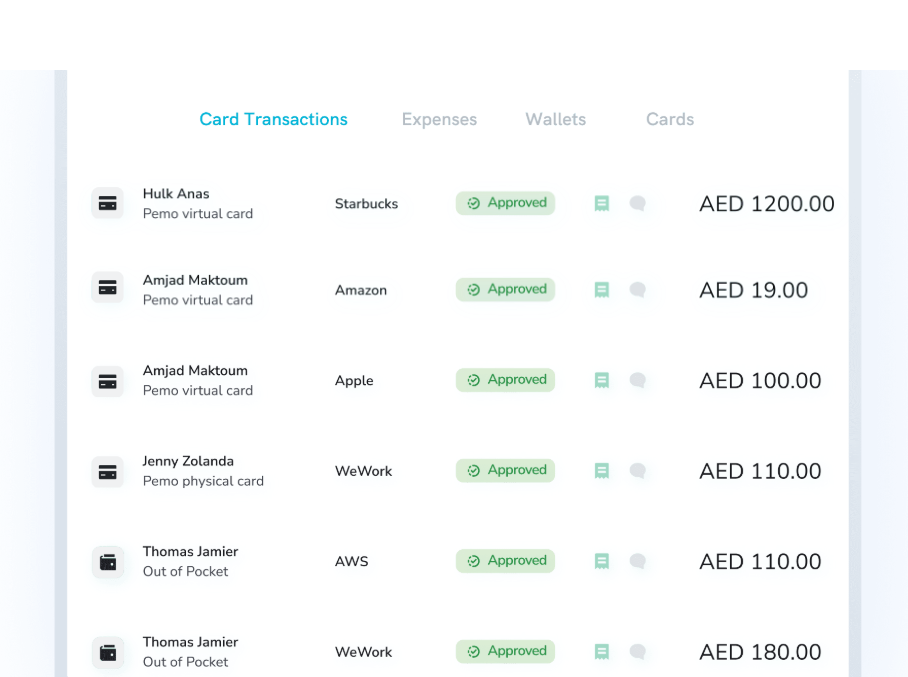
If a receipt is missing or looks wrong, the AI flags it automatically.
You can also set submission policies that flag any expense missing a receipt or other required detail, so incomplete claims get caught early.
Approvals follow the same pattern.
Managers get an instant notification and approve or reject in-app, with rules defined by spend amount, by team, or both.
By the time an expense reaches your books, it's already documented and approved, with the receipt attached where an auditor would expect to find it.
Sync reconciled data to your accounting software
Pemo connects directly to QuickBooks, Xero, Zoho Books, and Tally, and partners with Wafeq for teams on MENA-focused accounting software.
The connection does more than move numbers across.
Pemo Copilot, the platform's AI engine, categorizes each expense automatically, down to the chart of accounts and vendor details, and learns your patterns as it goes.
During setup, you map Pemo's categories to your own chart of accounts in a few clicks.
From there, you choose when transactions sync: daily on a schedule, or on demand whenever you trigger it.
If you'd sooner keep a manual workflow, everything exports in CSV or Excel format, which also covers accounting tools Pemo doesn't yet connect to directly.
Running more than one entity is covered too. Each entity connects to its own accounting setup with separate reports, so group structures don't collapse back into spreadsheet consolidation.
What does this mean for your month-end close?
It means most of the reconciliation has already happened before you sit down to close.
Approved expenses arrive in your accounting software already categorized, with receipts attached.
Every transaction carries an audit trail, so a question that used to take days of digging gets answered in seconds.
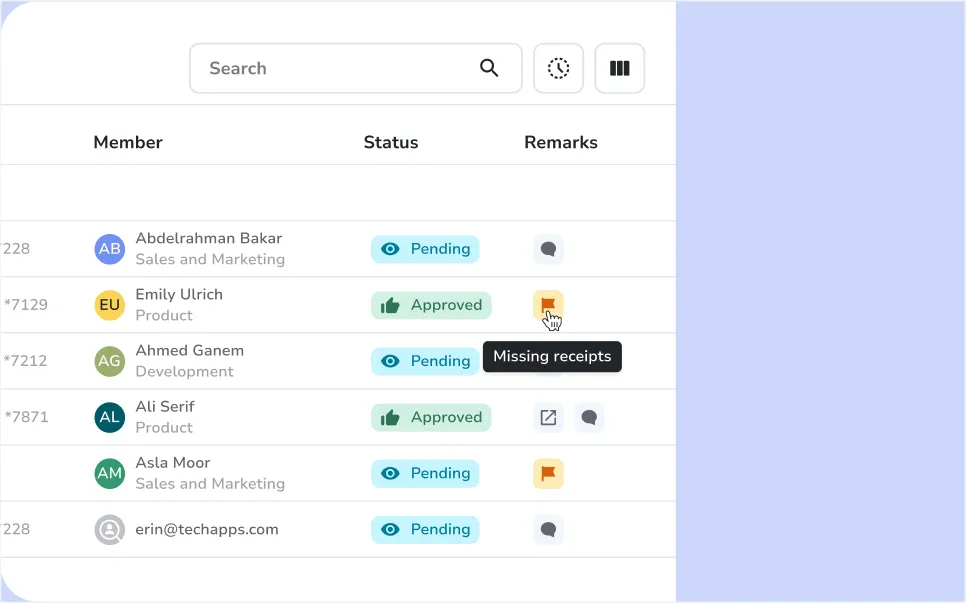
The results? Closing books up to 5x faster and retiring the receipt pile and the highlighter.
Your finance team will go from checking everything to handling the small number of transactions the system flags for a human decision.
Want the first week of the month back?
If your month-end close still involves a receipt pile and a highlighter, the problem probably isn't your team's discipline.
It's that the spending data was never captured properly in the first place.
Pemo's answer is to fix the capture problem itself: every employee gets a corporate card, and the receipt is grabbed while they're still at the till.
Clean, categorized data then flows straight into your accounting software, with nothing left to reconstruct.
Over 10,000 businesses have made that switch.
A free Pemo account is the quickest way to test it on your own spending, and if a walkthrough sounds better, you can book a demo with our team.
Expense Reconciliation FAQs
What's the difference between expense reconciliation and bank reconciliation?
Expense reconciliation matches individual business expenses against receipts and ledger entries, while bank reconciliation compares your ledger's cash balance against the bank statement as a whole.
How often should a business reconcile expenses?
Continuously, if your tools allow it, and weekly at minimum if you're doing it by hand.
Businesses that only reconcile at month-end discover problems weeks after they happen, when receipts are lost and memories have faded.
Does Pemo automate expense reconciliation?
Yes. Once an expense is approved, Pemo sends it to your accounting software with the category applied, which removes most of the manual reconciliation work.
Receipts are matched to transactions as employees spend, and Pemo's AI flags anything missing or anything that doesn't add up.
Can Pemo handle reconciliation across multiple entities?
Yes, Pemo supports multiple entities, with a separate accounting integration and separate reports for each one.
This is useful for UAE groups running several trade licenses, where consolidated visibility tends to be the hardest part of the job.


