
For most UAE businesses in 2026, corporate cards are the better default, because company money pays for each purchase and the card's limits apply at checkout.
Below, I compare corporate cards and expense reimbursement on six practical criteria, then cover the cases where a reimbursement claim is still the simpler route.
TL;DR
- Corporate cards fit spending that repeats: monthly costs like fuel, SaaS tools, ad top-ups, and client lunches can go on a company-funded card, capped when the card is issued.
- Expense reimbursement covers the exceptions: a cash-only supplier or a one-off purchase by someone without a card is easier to claim back.
- A simple sorting rule: any purchase type that turns up in claims every month is a candidate for a card.
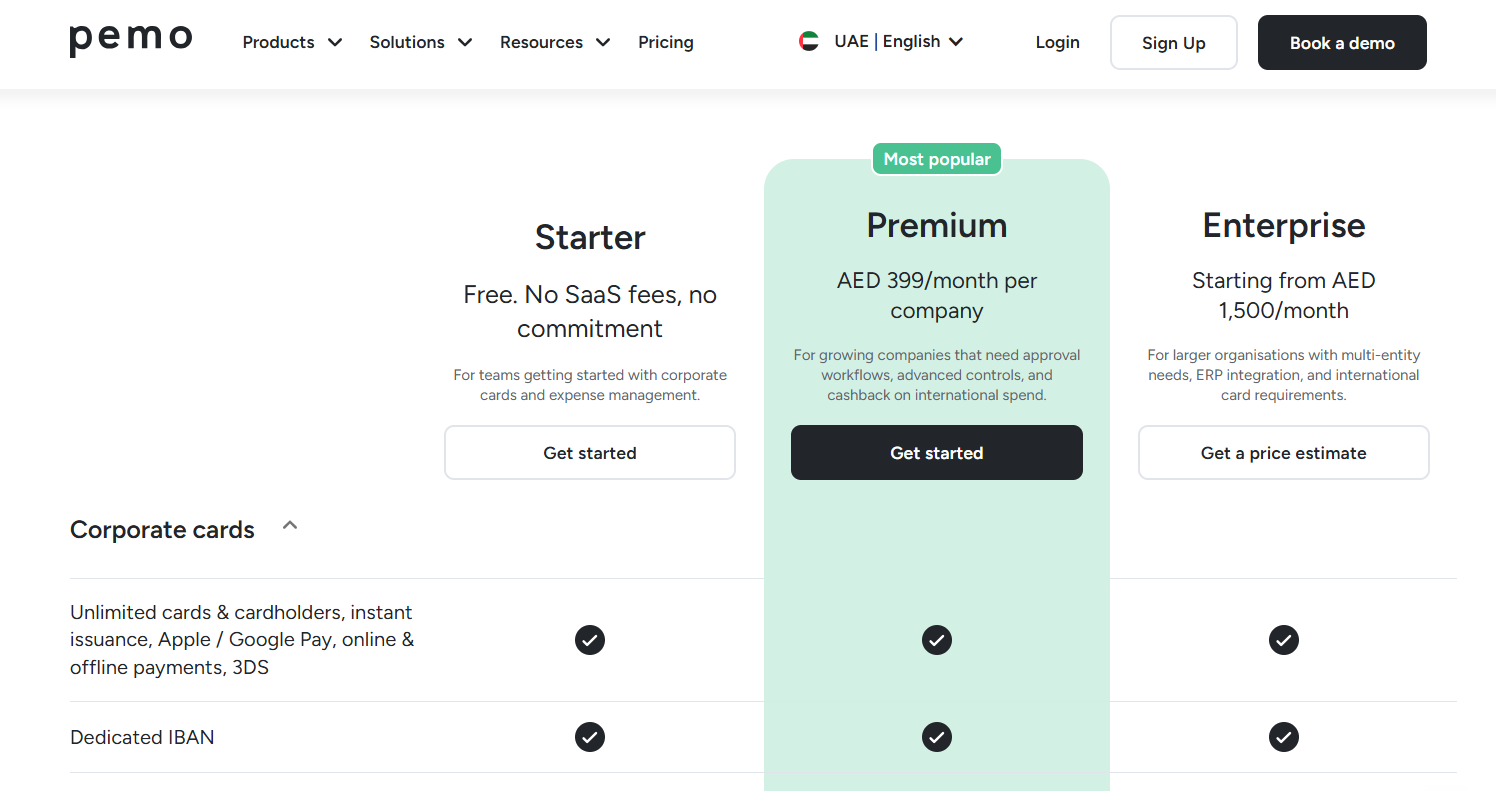
- Pemo handles both: unlimited virtual and physical cards are included on every plan, plus reimbursements management on Premium (AED 399/month per company) and Enterprise.
Are corporate cards better than expense reimbursement?
Corporate cards are the better choice for recurring business spending, mainly because employees don't have to front the money.
Reimbursement still wins for occasional costs, where issuing and managing a card would create more admin than the claim itself.
A corporate card is a payment card the company issues to an employee, drawing on company money through either a prepaid balance or a credit line.
Expense reimbursement means the employee covers a business cost with personal money and claims it back from the company later, using the receipt as proof.
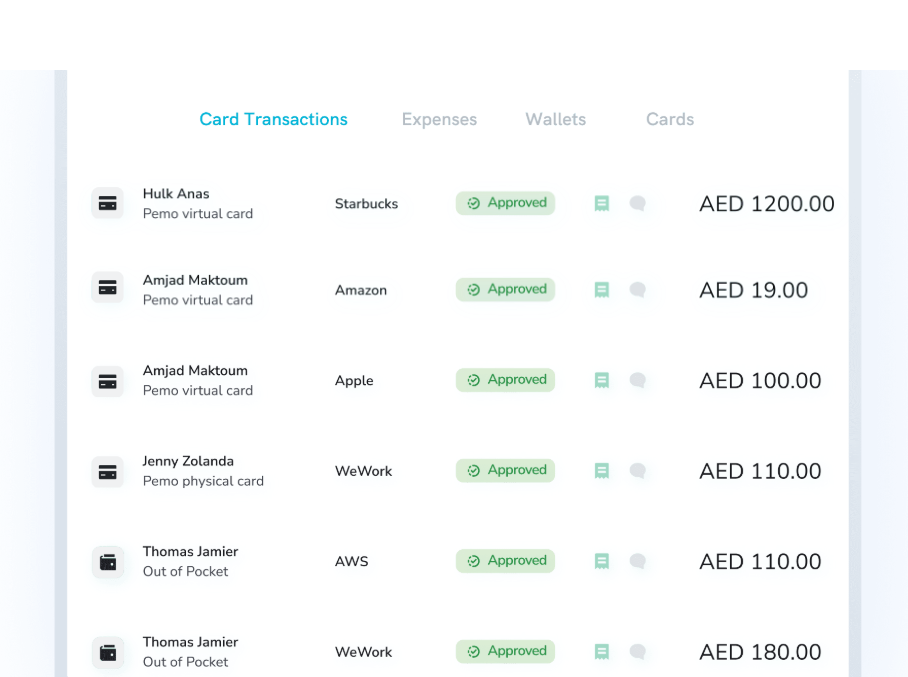
Side by side, the two methods look like this:
➡️ If you're still choosing a card format, our virtual vs. physical cards comparison is a good next read.
Where do card payments and reimbursement claims differ day to day?
Card payments and reimbursement claims differ most on who carries the cost and on how soon finance finds out about it.
Corporate cards come out ahead on most of the criteria below.
For a team that rarely spends, reimbursement can still be the cheaper option.
Who carries the cost until the purchase is settled?
Under expense reimbursement, the employee carries the cost until the claim is paid, which can take most of a month.
Say a site supervisor pays AED 3,200 for equipment hire on the 3rd.
If claims are paid out with salaries on the 28th, that supervisor has funded the company for 25 days.
A second or third claim in the same month turns that into a sizeable personal float.
A company-funded card removes that float, since the purchase is paid from company money at checkout.
That holds for prepaid cards, which spend a balance topped up in advance, and for credit-based cards that bill the business afterwards.
How quickly does finance see the spending?
On card platforms with live transaction feeds, spending reaches finance as soon as the card is used.
A reimbursed expense is invisible to finance until someone files the claim.
A receipt forgotten in a wallet after a long trip can push that back by several weeks.
The delay distorts budget tracking mid-month.
A marketing lead might believe a campaign budget is half used when the real figure is closer to 80% once unclaimed spend is counted.
Late claims cause trouble at month-end too, arriving after finance has started closing the period.
Is the spending policy enforced before or after payment?
Card limits enforce the spending policy before payment: a transaction over the cap is declined.
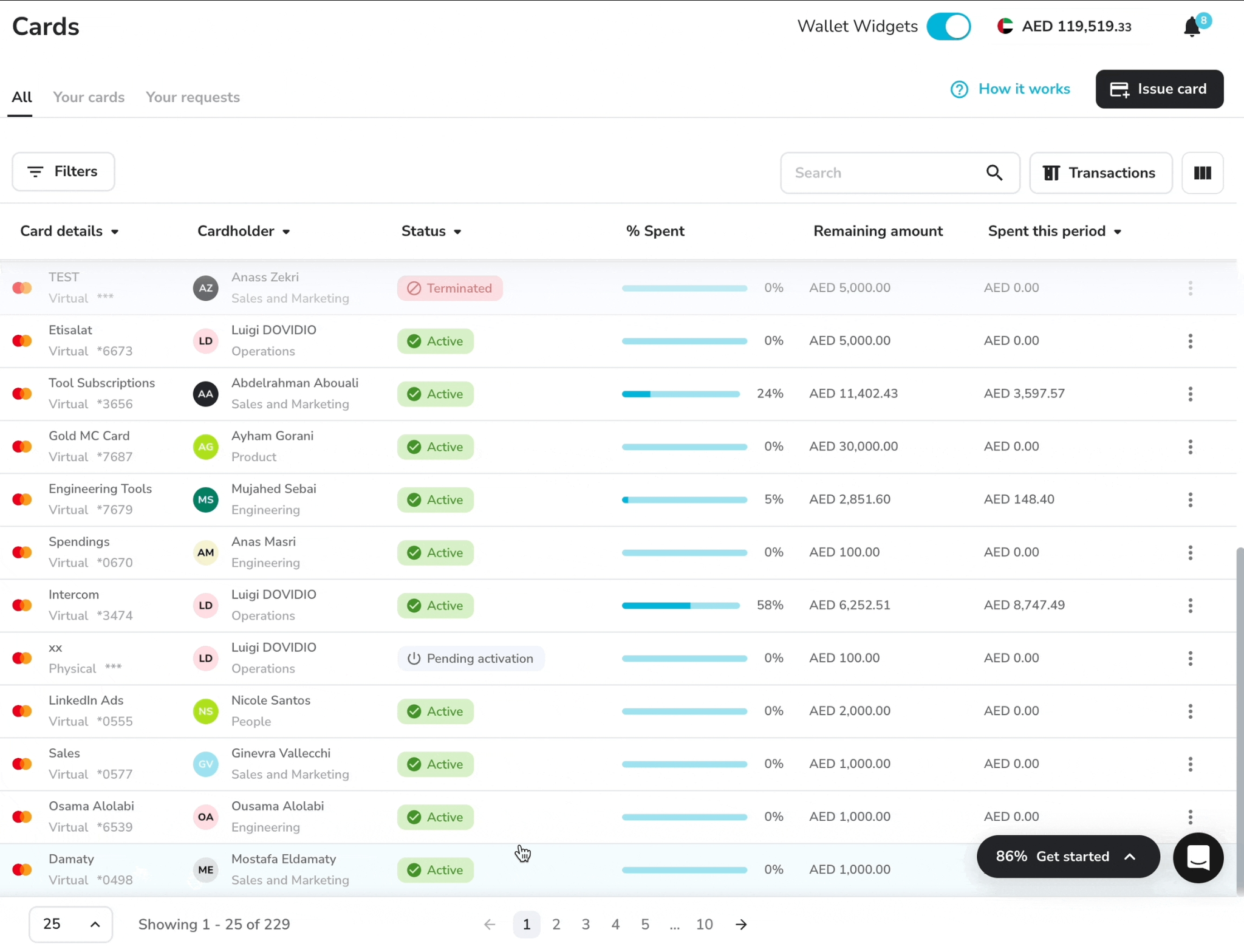
With reimbursement, the policy is checked afterwards by whoever approves the claim.
On a card capped at AED 500 per transaction, an AED 900 purchase is blocked at checkout.
Under reimbursement, the same AED 900 has already left the employee's account by the time a manager sees it.
At that point the manager has to pick between approving an out-of-policy claim and leaving a colleague out of pocket.
Do corporate cards leave cleaner receipts and VAT records?
Corporate cards usually leave the cleaner trail.
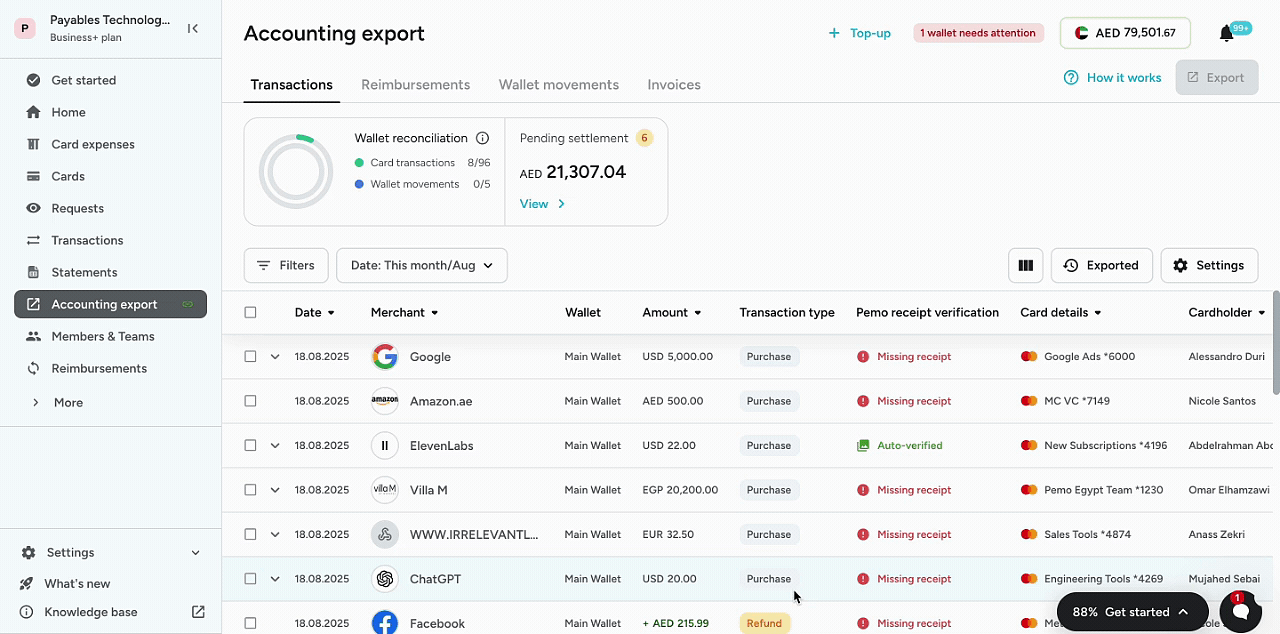
Every card payment creates a transaction record holding the merchant, amount, date, and cardholder, even before a receipt is uploaded.
Receipts still go missing on cards.
With a card, though, finance can spot a transaction with no receipt attached and follow up on it.
A lost receipt under reimbursement can stall the claim entirely, leaving the expense out of the books.
For VAT-registered UAE companies, the tax invoice carries the details your accountant works from.
The earlier that document is captured, the more complete the record.
Whether a given expense qualifies for VAT recovery is a question for your tax adviser, regardless of which payment method was used.
💡 If receipt collection is the main problem for your team, this roundup of receipt management tools compares the software that collects and matches them.
Which approach costs less to run?
A manual reimbursement process carries no platform or card fees, though each claim takes finance time to check, approve, record, and pay out.
Dedicated employee reimbursement software can cut that admin for teams that keep a claims process.
A card programme shifts most of that work to the point of purchase.
Depending on the provider, it may add a monthly subscription or foreign exchange charges on international spend.
For a business where two people spend a handful of times a year, claims are probably the cheaper route.
Once a team is processing dozens of claims a month, the hours spent on them can end up costing more than a card programme.
What does misuse look like under each method?
Misuse under each method takes a different shape: an out-of-policy purchase on a valid card, or a claim that's inflated or filed twice.
A spending cap puts a ceiling on any single mistake.
A card with an AED 2,000 monthly limit is declined once it reaches AED 2,000 for that month.
If a card looks compromised, an admin can freeze it within seconds.
Problems with claims tend to surface during review, leaving the approver as the main safeguard.
When is a reimbursement claim still the better option?
A reimbursement claim is the better option when a card can't make the payment, or when the purchase is so rare that a card would go unused.
These examples show where each method tends to fit for a UAE team:
When sorting through old claims, move any purchase type that shows up every month onto a card, leaving the once-or-twice-a-year items as claims.
If cash payments come up often for your team, our petty cash management software roundup compares tools built for that kind of spend.
For the rules those remaining claims should follow, see our UAE employee expense policy guide.
How do you move a team from reimbursements to corporate cards?
Moving a team onto corporate cards starts with the claim history: three months of claims will show which spending recurs and belongs on a card.
This sequence keeps the change manageable:
- Export three months of claims: sort them by category and by employee to find the repeat purchases.
- Pick the recurring categories: for many teams, travel and software top the list.
- Decide how cards are assigned: a card per employee suits travel and meals. For subscriptions and ad accounts, a card per vendor is easier to track.
- Set limits before handing cards out: each card's monthly limit and per-transaction cap should match the budget it covers.
- Document what stays as a claim: the exceptions, receipt requirements, submission deadline, and approver.
- Connect your accounting software: card spend and approved claims should post to the same ledger under the same categories.
Our article on employee expense reimbursement management covers the claim and approval flow for the expenses that remain.
What does Pemo offer for corporate cards and reimbursements?
Pemo covers both methods in one account: corporate cards for recurring spend, plus reimbursement claims for the exceptions on Premium and Enterprise.
The two sides work together like this:
- Cards first: unlimited virtual and physical cards carry their own limits, keeping recurring spend out of the claims queue.
- Claims for the exceptions: out-of-pocket purchases are submitted from desktop or mobile with the receipt attached.
- One review queue: finance approves card expenses and claims inside the same account.
- Coded for your books: Pemo Copilot suggests the accounting fields for both expense types before they sync.
Let's go over the features: 👇
Virtual and physical cards with the spending rules built in
Every plan, including the free Starter plan, comes with unlimited corporate cards.
- Virtual cards: usable the moment they're created, in Apple Pay and Google Pay too.
- Physical cards: for in-person payments, delivered within 72 hours.
- Single-use virtual cards: expire automatically after a single payment.
- Limits by period and transaction: a cap per day, week, month, or year, plus a per-transaction maximum.
- Merchant category restrictions: part of Premium and Enterprise, as are ATM withdrawals on request.
- Instant freeze: admins can freeze or unfreeze any card from desktop or mobile.
Reimbursement claims next to card expenses
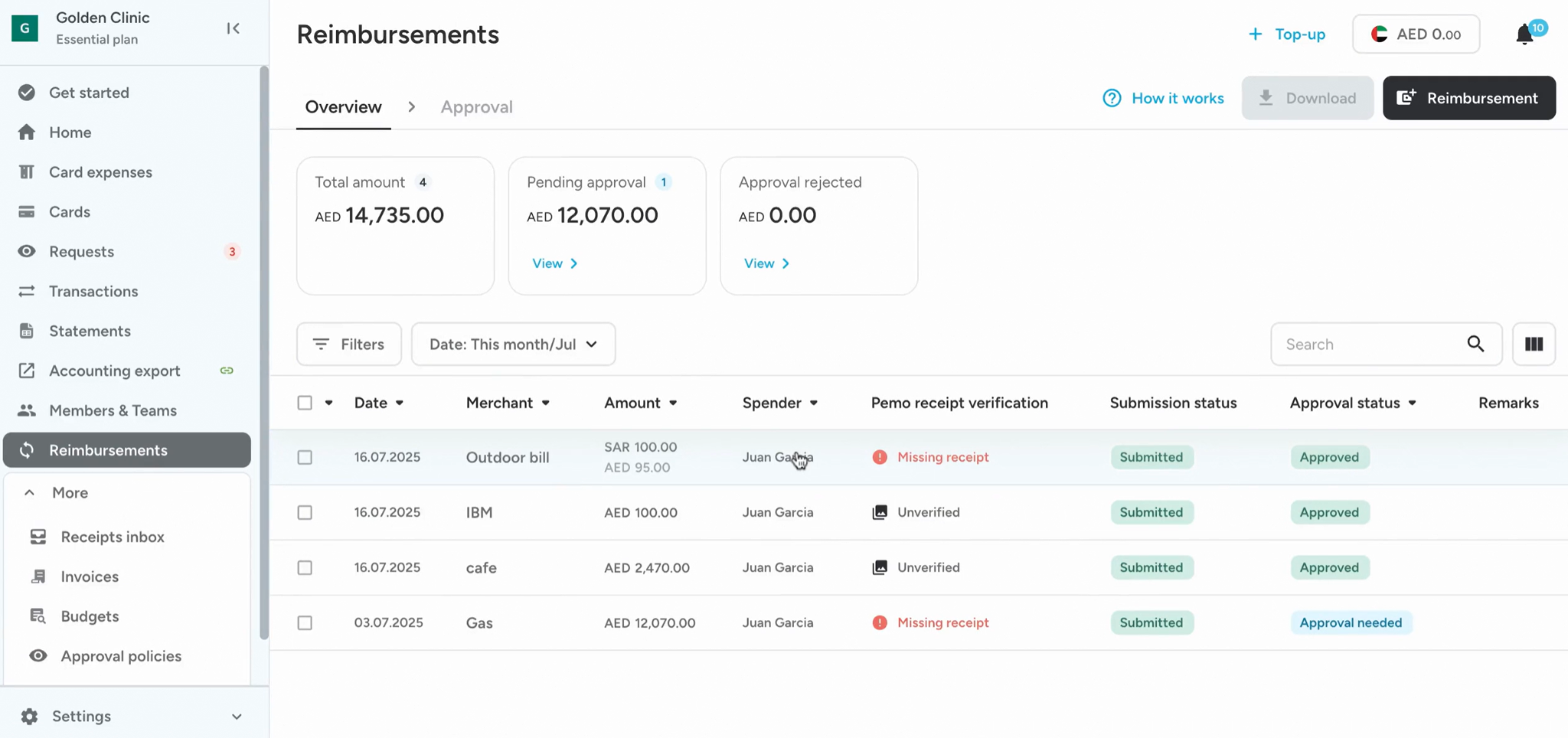
Reimbursements management covers the purchases a card couldn't, on the Premium and Enterprise plans.
- Submission from desktop or mobile: the team member adds the purchase details, such as date and merchant, then uploads the receipt as a photo or file.
- Separate views: card spend and out-of-pocket claims are listed apart, under one login.
- Approval Policies: rules by spend amount, team, category, or project, with multi-layer approval workflows on Premium and Enterprise.
- Duplicate detection and receipt reminders: included on Premium and Enterprise.
- Payout: approved claims can be batched into your next payroll run, or processed outside the payroll cycle when one is urgent.
Pemo Copilot prepares card spend and claims for your books
Pemo Copilot reviews every card expense and claim, using AI to suggest the accounting fields before your bookkeeper signs off.
- Auto coding: chart of accounts code, vendor, VAT details, and other accounting fields filled in automatically.
- Editable suggestions: any field can be changed by your team, with Pemo Copilot learning from each correction.
- Receipt matching: AI Copilot receipt verification and matching on every plan.
- Direct integrations: Xero, QuickBooks, Zoho Books, Odoo, Wafeq, and Mazeed on every plan, plus NetSuite and Dynamics 365 Business Central on Premium and Enterprise.
More detail on the sync is on the accounting automation page.
Pemo's pricing
Every Pemo plan includes unlimited users and unlimited physical and virtual cards:
- Starter: free, with no SaaS fees and no commitment, covering instant card issuance, AI Copilot receipt matching, standard accounting integrations, and 0.5% cashback on international spend.
- Premium: AED 399/month per company, adding reimbursements management, merchant category restrictions, multi-layer approval workflows, VAT visibility, and up to 2% cashback on international spend.
- Enterprise: from AED 1,500/month, adding international cards for employees outside the UAE, budgets, custom ERP integrations, and a dedicated implementation manager.
Sign Up For Pemo For Free
Pemo combines corporate cards and expense management software for UAE businesses, covering each expense from the card payment through to your accounting software.
Card spend is logged automatically, with out-of-pocket claims approved alongside it on Premium and Enterprise.
If you'd like fewer reimbursements without losing the option altogether, Pemo includes:
- Unlimited virtual and physical cards: on every plan, including the free Starter plan too.
- Reimbursement management: claims handled next to card expenses on Premium and Enterprise.
- Pemo Copilot: AI receipt matching and accounting field suggestions for every expense.
- Direct accounting sync: Xero, QuickBooks, Zoho Books, Odoo, Wafeq, and Mazeed.
Sign up for the free Starter plan or book a demo to walk through the setup for your team.
⚠️ Disclaimer: This article was last updated on the 15th of October, 2026, and if there's any misinterpretation of the information, please contact us, and we will fact-check it. This is not legal or accounting advice, so always consult with a qualified professional before making decisions.
Frequently asked questions
Can a business run cards and reimbursement side by side?
A business can run both, using corporate cards for recurring spend and reimbursement claims for the exceptions.
The setup stays manageable when both feed the same system under the same expense categories.
Otherwise, finance ends up reconciling two separate sets of records at month-end.
Are receipts still required for card purchases?
Receipts are usually still needed for card purchases, because the transaction shows that a payment happened without the tax invoice behind it.
The card transaction is already recorded, leaving the employee only to attach the receipt.
On Pemo, your company's submission policy decides whether a receipt is mandatory, with AI Copilot matching uploaded receipts to card transactions on every plan.
Premium and Enterprise add receipt reminders.
How is a prepaid corporate card different from a credit card?
A prepaid corporate card can only spend money the company has loaded in advance.
Corporate credit cards draw on a credit limit, with the balance billed to the company later.
Pemo cards are prepaid, spending from your Pemo wallet balance in the same way a debit card would.
The corporate cards vs. P-cards vs. business credit cards breakdown compares the options for UAE businesses.
Should every employee have a corporate card?
Only employees who spend on the company's behalf regularly get much value from a card.
Someone who buys a work item once a year can stay on reimbursement with little extra admin for finance.
Pemo's current plans don't charge per card, as each one includes unlimited cards.
Does Pemo's free plan include reimbursements?
Reimbursement management is part of Pemo's Premium and Enterprise plans, not the free Starter plan.
Starter covers card expenses and accounting integrations for teams getting started with corporate cards.
Premium costs AED 399/month per company, adding reimbursement management and VAT visibility.


