
Are you trying to work out which employee reimbursement software deserves a place in your UAE finance stack in 2026?
In this guide, I'll walk through the 10 best employee reimbursement tools for the UAE market in 2026, with their features, pricing, and honest pros and cons.
TL;DR
- Pemo offers the best employee reimbursement software in the UAE, with smart corporate cards that prevent most reimbursements and a built-in flow that captures and pays the rest.
- Spendesk and Xpence suit UAE teams that want corporate cards and reimbursement controls in one place.
- Expensify, Rydoo, and Zoho Expense handle dedicated expense reports and reimbursements, while SAP Concur, Tipalti, BILL, and Happay cover enterprise and global payouts.
What are the best employee reimbursement tools in the UAE in 2026?
The strongest reimbursement tool for a UAE business is Pemo, whose spend management software and corporate cards keep most reimbursements from ever being raised, then handle the few that remain in the same dashboard.
Finance teams rarely buy everything from one vendor, though.
So I've sorted the 10 best employee reimbursement tools in the UAE into three groups: all-in-one spend management with reimbursement, dedicated expense reporting, and enterprise and global reimbursement.
The table below puts all 10 side by side:
What are the best all-in-one reimbursement and corporate card platforms in the UAE?
These platforms hand your team cards to spend on, so most out-of-pocket claims never come up, and they process the ones that do in the same place:
#1: Pemo
Pemo offers the best employee reimbursement software in the UAE with our virtual corporate cards, AI receipt matching, and direct sync into the accounting software UAE finance teams already run.
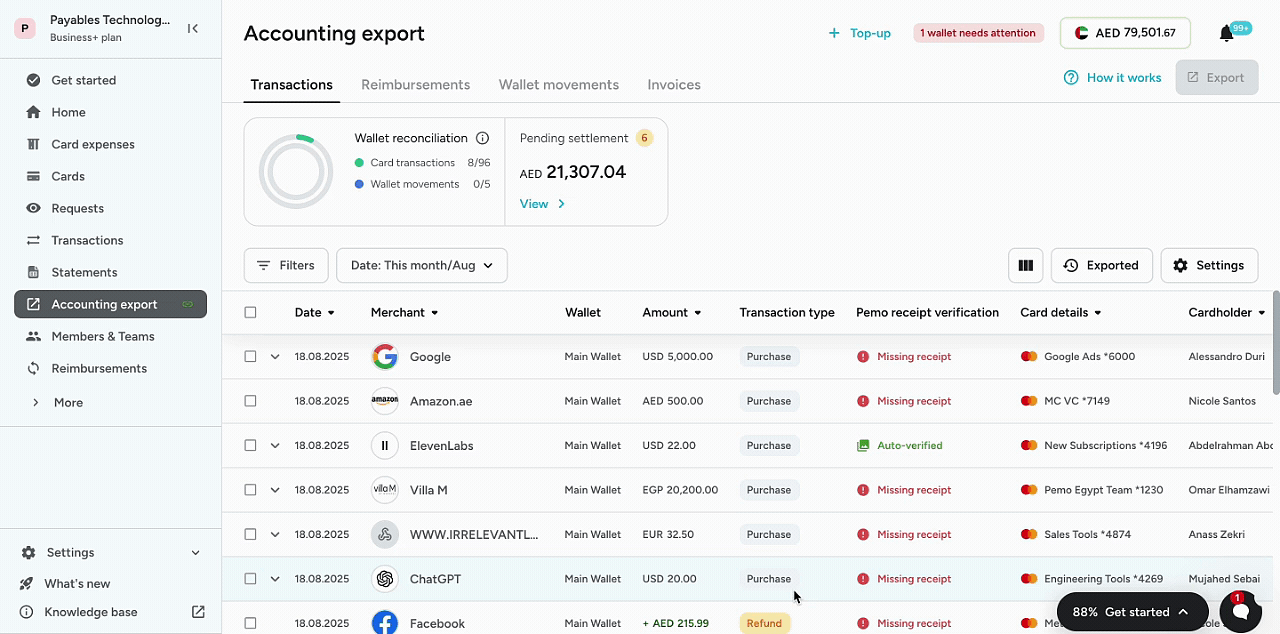
Full disclosure: Even though Pemo is our platform, I'll give you an honest, objective view of why Pemo is the best employee reimbursement software in 2026.
The reason most teams need employee reimbursement software in the first place is the out-of-pocket claim.
An employee pays for something on a personal card or in cash, files a claim days later, hunts for a receipt they may have already lost, waits on a manager to approve it, then waits again for payroll to pay them back.
The whole process exists because the spending happens before the company ever sees it.
We closed that gap. Pemo gives every team member a corporate card with the rules set before they swipe.
The payment becomes the record, the receipt attaches the moment the card is used, and the entry posts to your accounting software in real time, so most reimbursements never need to be raised.
Let's go through the features that make Pemo the right pick for UAE businesses in 2026: 👇
Stop most reimbursements before they happen
Most out-of-pocket spend is predictable: taxis, meals, fuel, software subscriptions. Put a company card in the right hands and that spend never turns into a claim.
Pemo issues physical and virtual cards, so they clear anywhere a card is accepted, online or in person, and through Apple Pay or Google Pay.
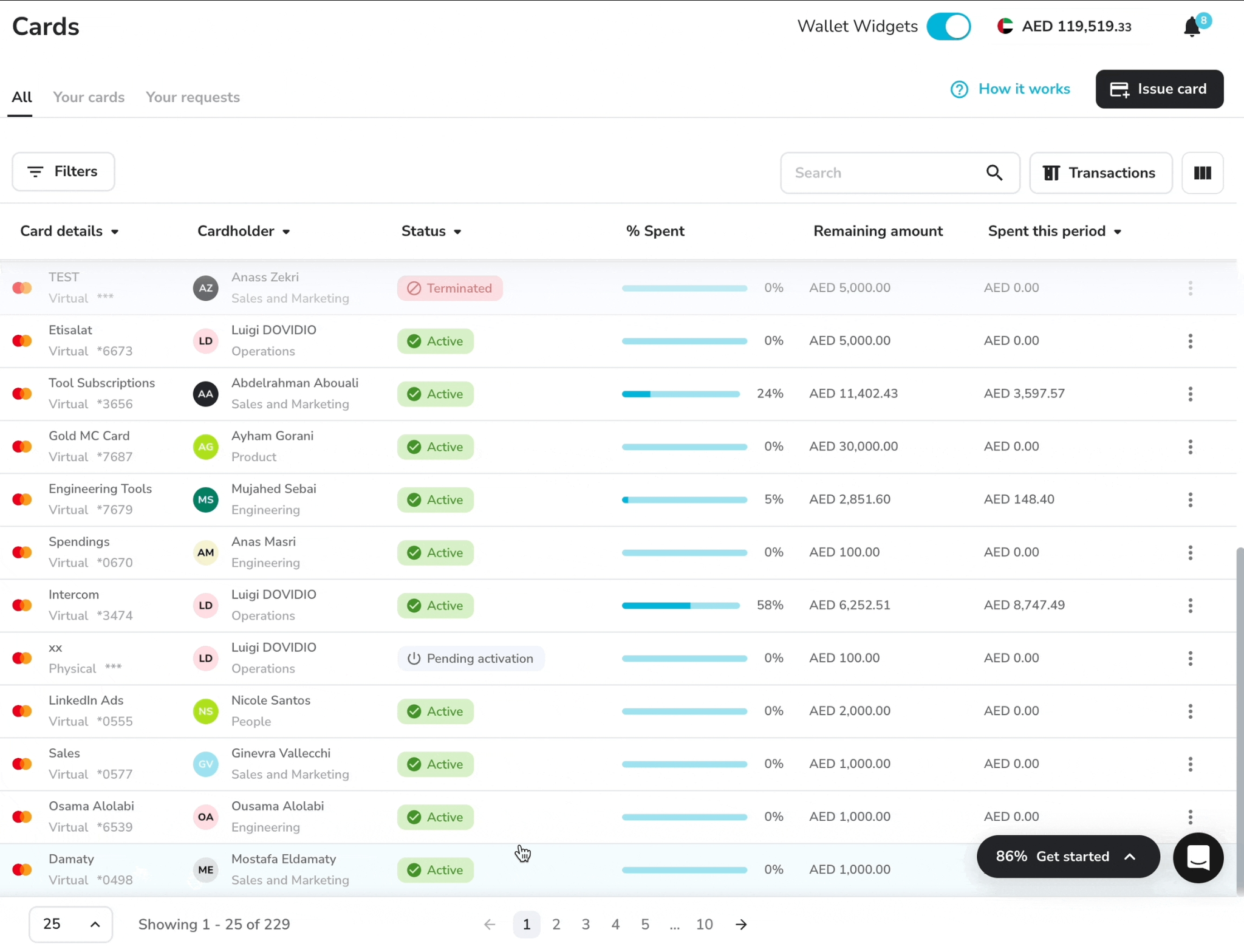
You manage them from one place, with the controls finance needs already built in:
- Unlimited virtual and single-use cards on every tier, so a card can be tied to one vendor, one subscription, or one campaign.
- Merchant-category, vendor, and location locks, so a card only works where you've allowed it.
- Per-card and per-transaction limits, with daily and monthly caps you can adjust on the fly.
- One-tap freeze and unfreeze, with fraud monitoring running underneath.
Move that routine spend onto cards, and most of the reimbursement queue dries up before approval enters the picture.
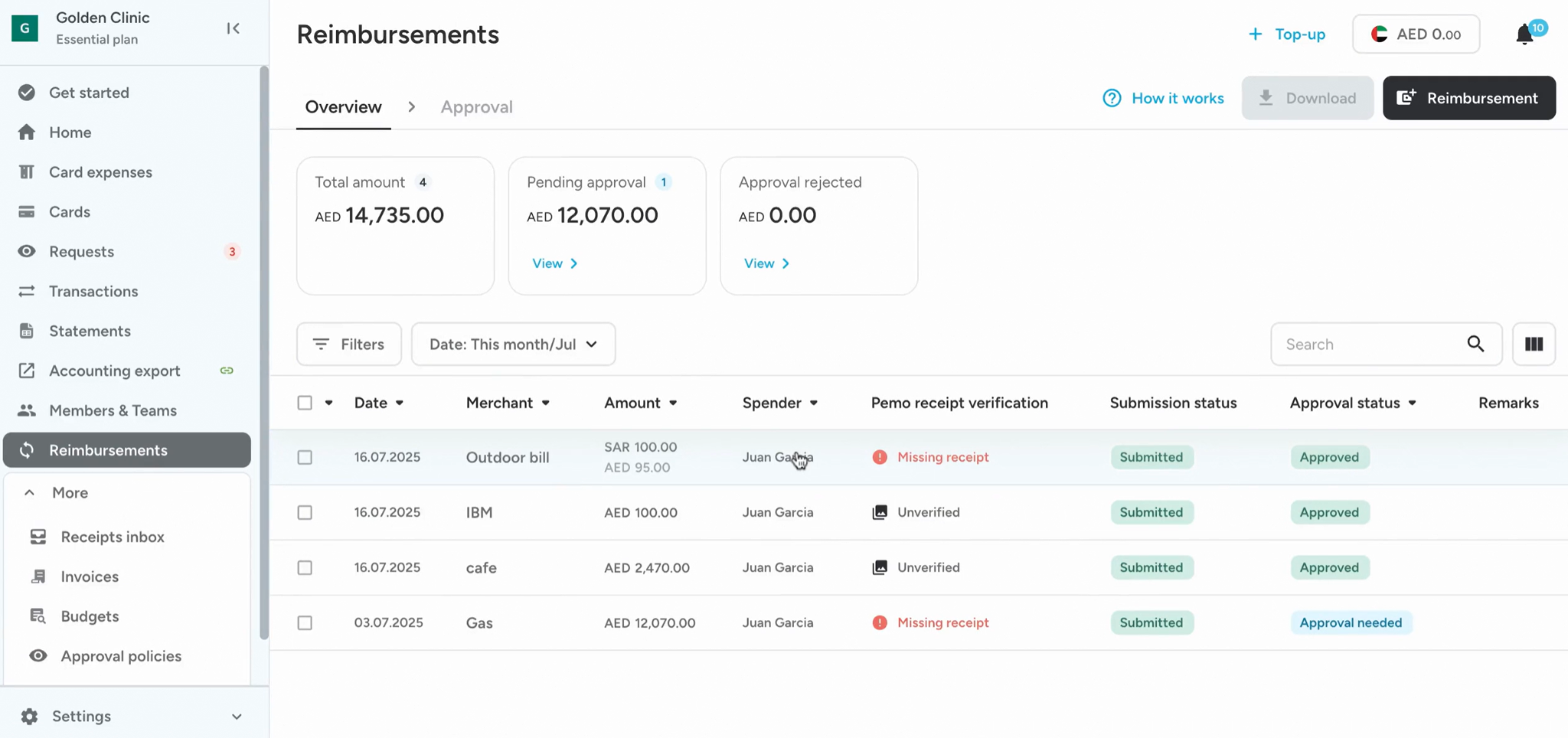
Process the claims that remain in one flow
Some spend can't touch a card. A cash tip, or a supplier who only accepts a transfer to a personal account.
For those, Pemo keeps reimbursement in the same place as card spend, so finance never switches tools.
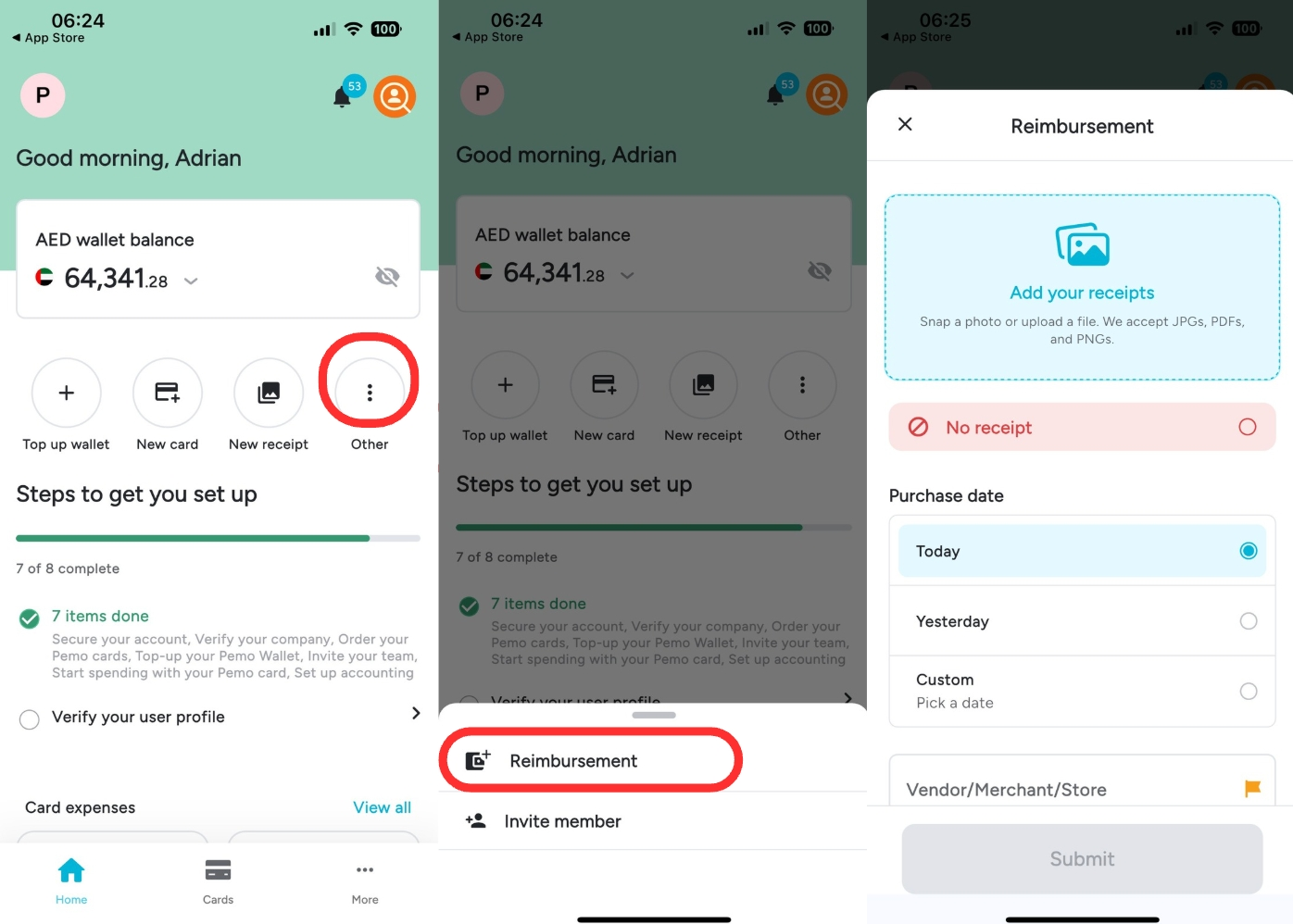
An employee opens the reimbursements tab on web or mobile, types the amount and the merchant, and adds a photo of the receipt.
The claim then reaches an approval queue showing the receipt, the figure, and who submitted it, and a manager clears it in one click.
You define the routing once:
- By amount, so a AED 5,000 claim goes straight to the CFO.
- By category, so marketing claims reach the CMO and IT claims reach engineering.
- By team, so each regional manager signs off their own people.
➡️ Configure the rules at the top, and every future claim routes itself.
A faster month-end close
Every Pemo transaction, card or reimbursement, passes through Pemo Copilot before your accountant sees it.
Copilot codes the chart of accounts, picks the vendor, sets the VAT treatment, and adjusts itself as your bookkeeper makes corrections.
That cleaned data syncs in real time to QuickBooks, Xero, Zoho Books, Wafeq, or Tally, so a claim you approve on a Tuesday morning is coded and VAT-tagged in the ledger by the afternoon.
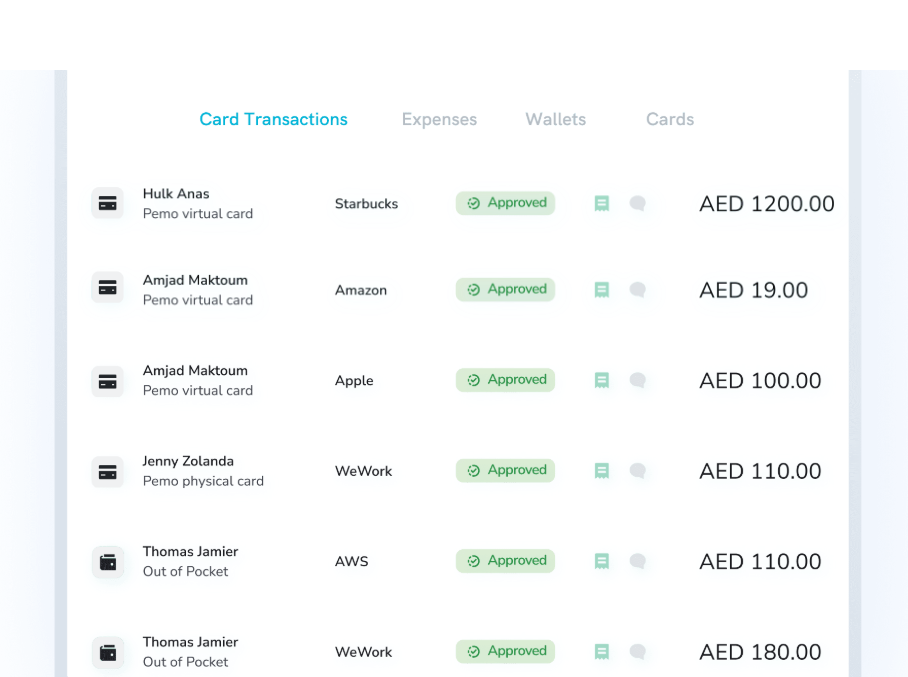
Month-end turns from a rebuild into a quick review, and most teams close up to five times quicker.
💡 On average, Pemo users report monthly savings of AED 7,350 and roughly 138 admin hours back.
Pemo's Pricing
Pemo runs a free tier and two paid ones:
- Kickoff: AED 0/month: aimed at solo founders and small teams, covering up to 2 physical cards, unlimited virtual and single-use cards, 0.5% cashback on ads, and unlimited AI receipt collection.
- Essential: AED 29/month per cardholder: aimed at teams putting expenses on autopilot, covering up to 20 physical cards, up to 2% cashback, and advanced card controls.
- Business+: Custom pricing: aimed at established companies wanting deeper automation and control, with unlimited physical cards.

Pros and Cons
✅ A genuinely free tier, with unlimited virtual cards and unlimited AI receipt matching.
✅ Cards, reimbursement, bill payments, and accounting sync in one platform.
✅ A UAE-native build, priced in AED, wired into regional accounting tools.
✅ Cashback up to 2%, plus hotel and software perks.
✅ Spend rules you set by category, vendor, and location before money moves.
❌ Spending runs through a prepaid wallet, so you load funds up front, and there's no credit line.
#2: Spendesk
Best for: UAE teams wanting cards, procurement, and reimbursement in a single procure-to-pay tool.
Similar to: Pemo, Rydoo.
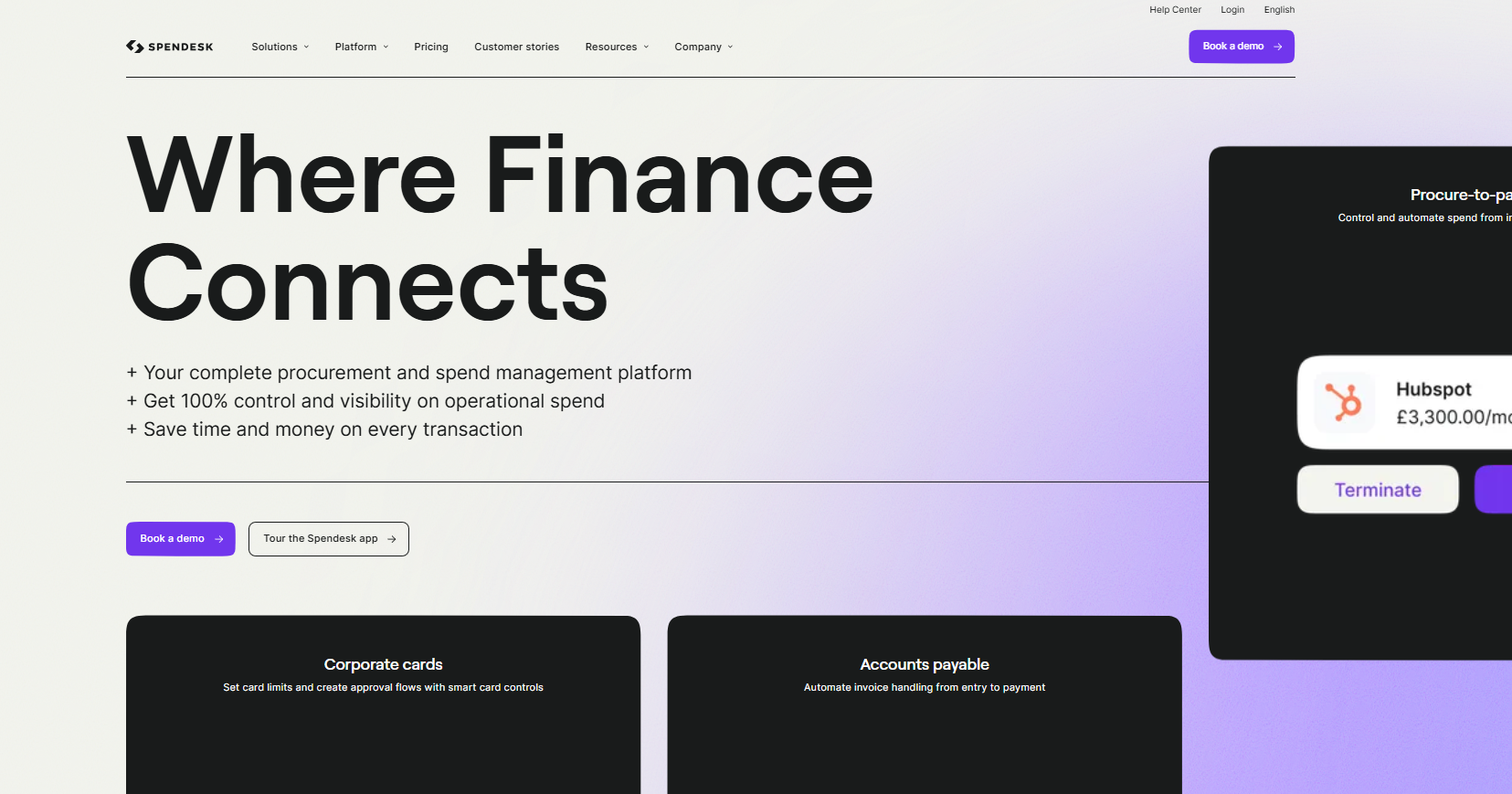
Spendesk pulls company cards, invoice processing, procurement, and reimbursements into one procure-to-pay platform, and thousands of finance teams run on it.
Features
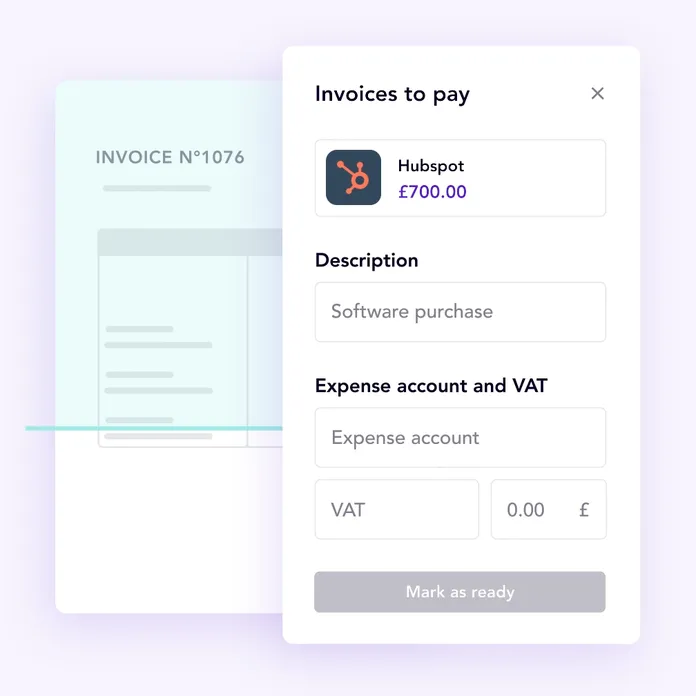
- Company cards: Physical and single-use virtual cards carrying their own rules, usable through Apple Pay and Google Pay.
- OCR-based reimbursement: Staff photograph a receipt and claim from the app, with the fields read off the image.
- Procurement workflow: Purchase requests, supplier invoices, and sign-offs handled in one chain.
- Export automation: Reporting and accounting exports run with little manual handling.
Pricing
Spendesk keeps pricing off its site, so you’ll have to contact them for a quote.
Pros and Cons
✅ Procurement and reimbursement on one rail, from request to reconciliation.
✅ Well-developed budgets and approval chains.
✅ Catches duplicate invoices and entry errors.
❌ A Trustpilot reviewer mentions that Spendesk’s support team took more than a week to get a reply and another week to get another reply.
#3: Xpence
Best for: Freelancers and small UAE teams that want prepaid Visa cards with bookkeeping attached.
Similar to: Pemo, Mamo.
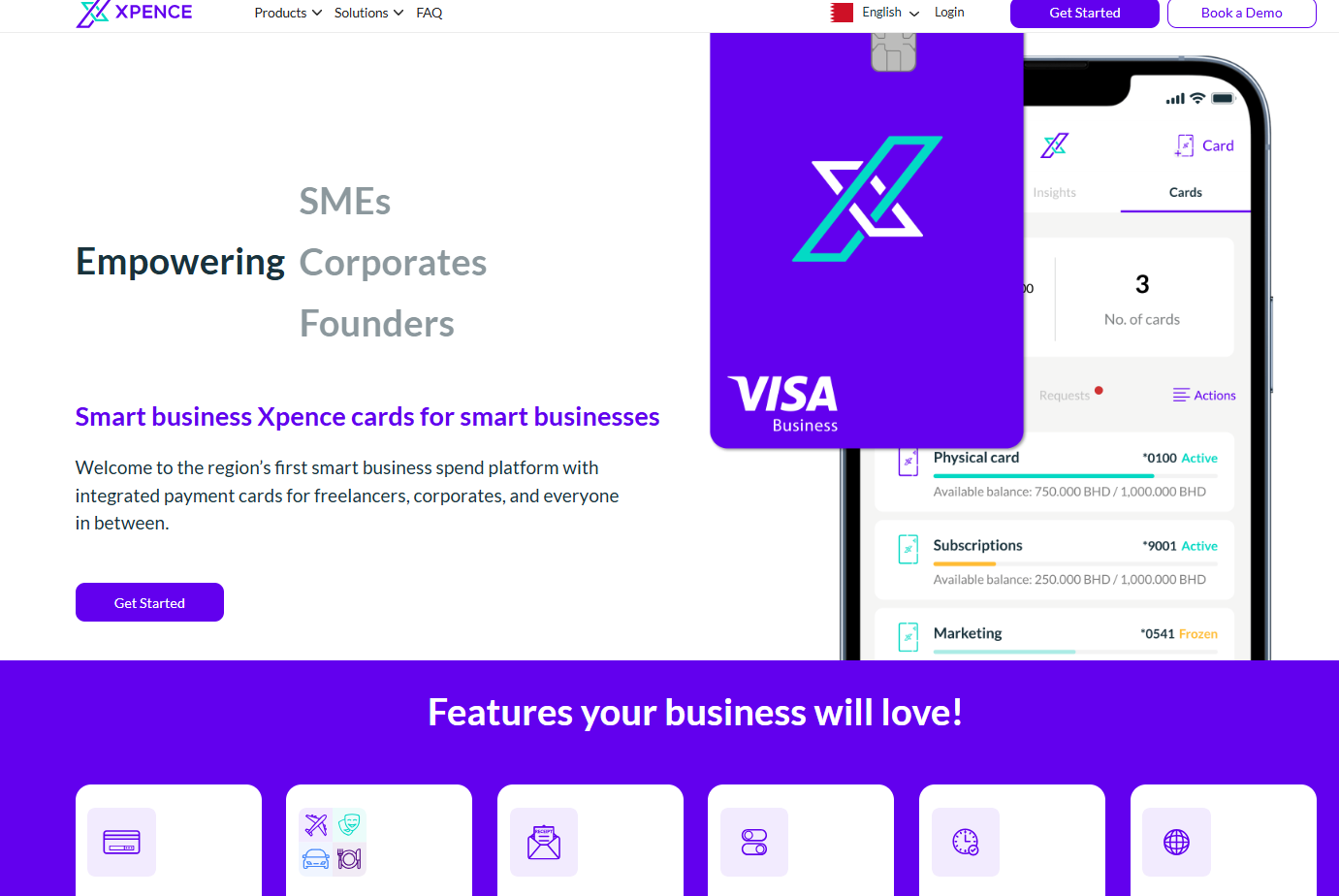
Xpence serves freelancers, startups, SMEs, and larger firms across the UAE and Bahrain.
Each person carries a prepaid Visa card, and spend gets categorised the moment it happens, so reimbursement records build up beside card activity.
Features
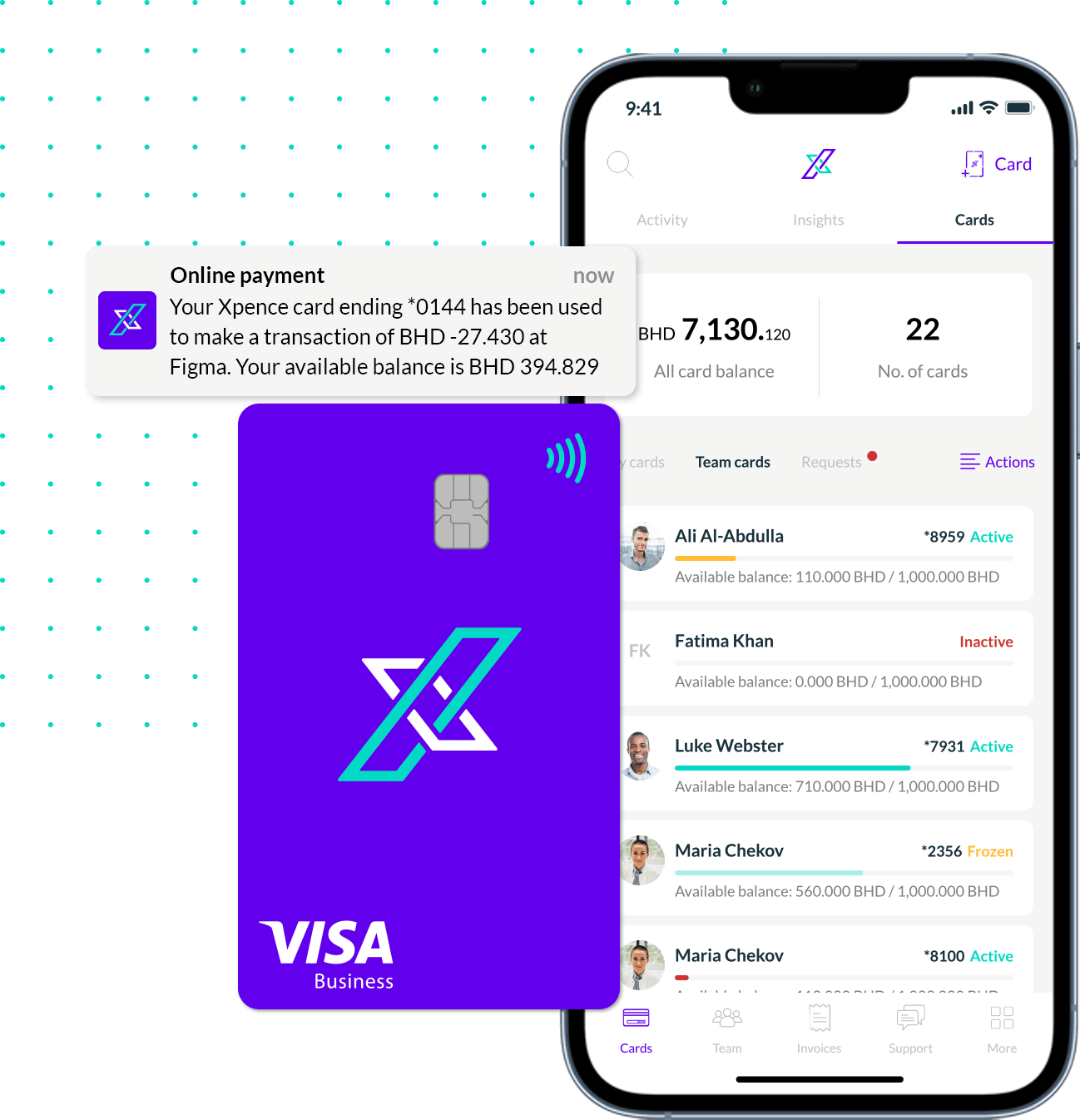
- Prepaid Visa cards: Physical and virtual, accepted worldwide, each with limits and rules you set.
- Live bookkeeping: Categorisation happens at the point of spend, leaving a detailed trail with no data entry.
- In-app approvals: Staff request spend, and managers approve from their phones in the moment.
- Built-in invoicing: Raise invoices and take online payment from the same account.
Pricing
Xpence doesn't share its pricing publicly. You'd need to contact their team for a walkthrough and a custom quote.
Pros and Cons
✅ A prepaid setup that caps spend at the funds you load.
✅ Works for a one-person business and a full team alike, which many platforms can't.
✅ Notes and receipts are pinned to each transaction.
❌ No public pricing, unlike many Xpence alternatives.
What are the best dedicated expense and reimbursement tools in the UAE?
These tools center on the claim itself, from capturing the receipt through to paying the employee back, and they work alongside whatever cards you already use:
#1: Expensify
Best for: Quick receipt scanning and expense reports for teams of any size.
Similar to: Rydoo, Zoho Expense.
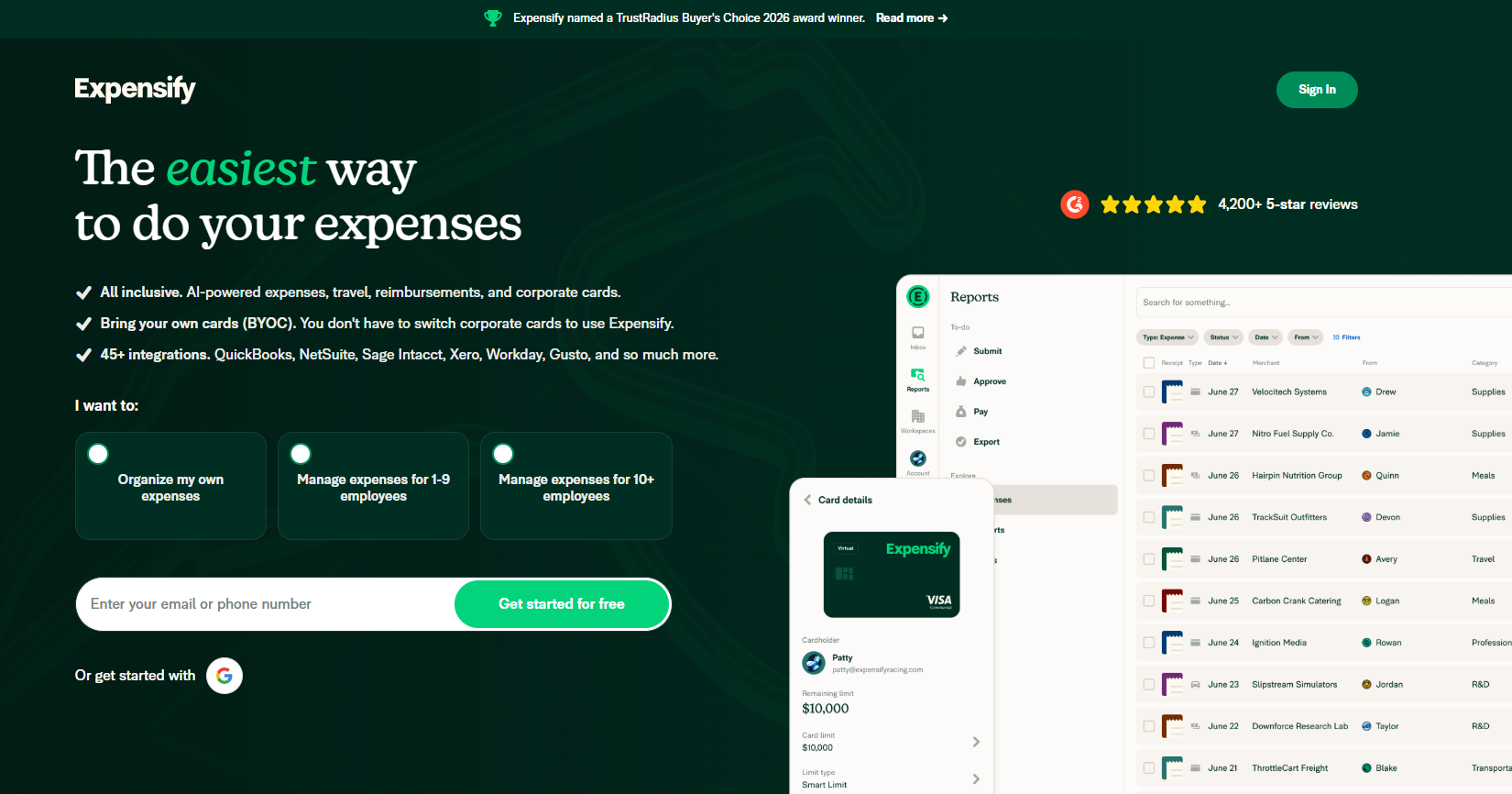
With over 15 million members, Expensify has spent 15 years on one problem: moving a receipt from someone's pocket into the books with the fewest taps possible.
It also leaves your existing corporate cards in place, linking them for reconciliation with no switch required.
Features
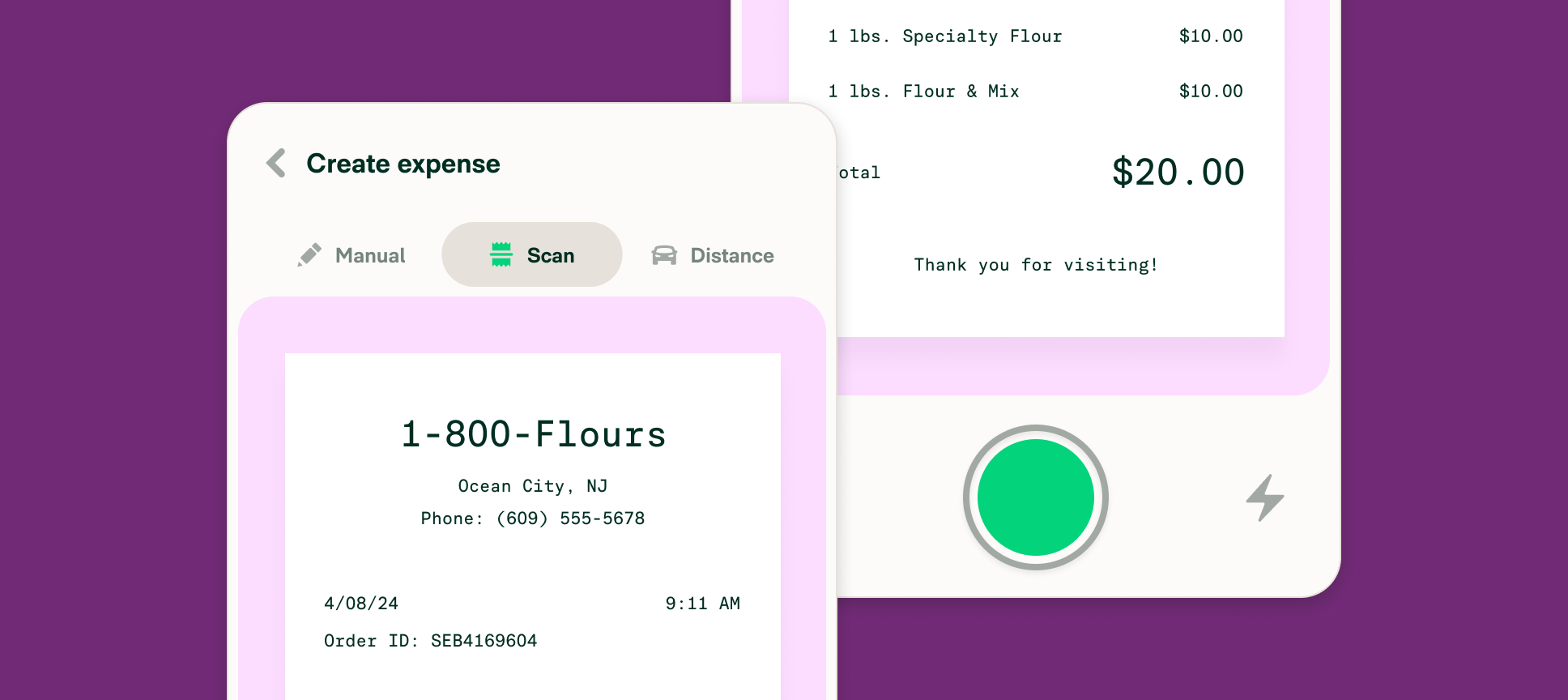
- SmartScan: Snap, email, or text a receipt in, and the details populate themselves.
- Concierge AI: Sorts categories, catches policy breaks, and files reports with no manual step.
- Existing card linking: Connects cards from over 10,000 banks for automatic matching.
- Cross-border payouts: Reimburses staff and contractors in local currency where the payout region is covered.
Pricing
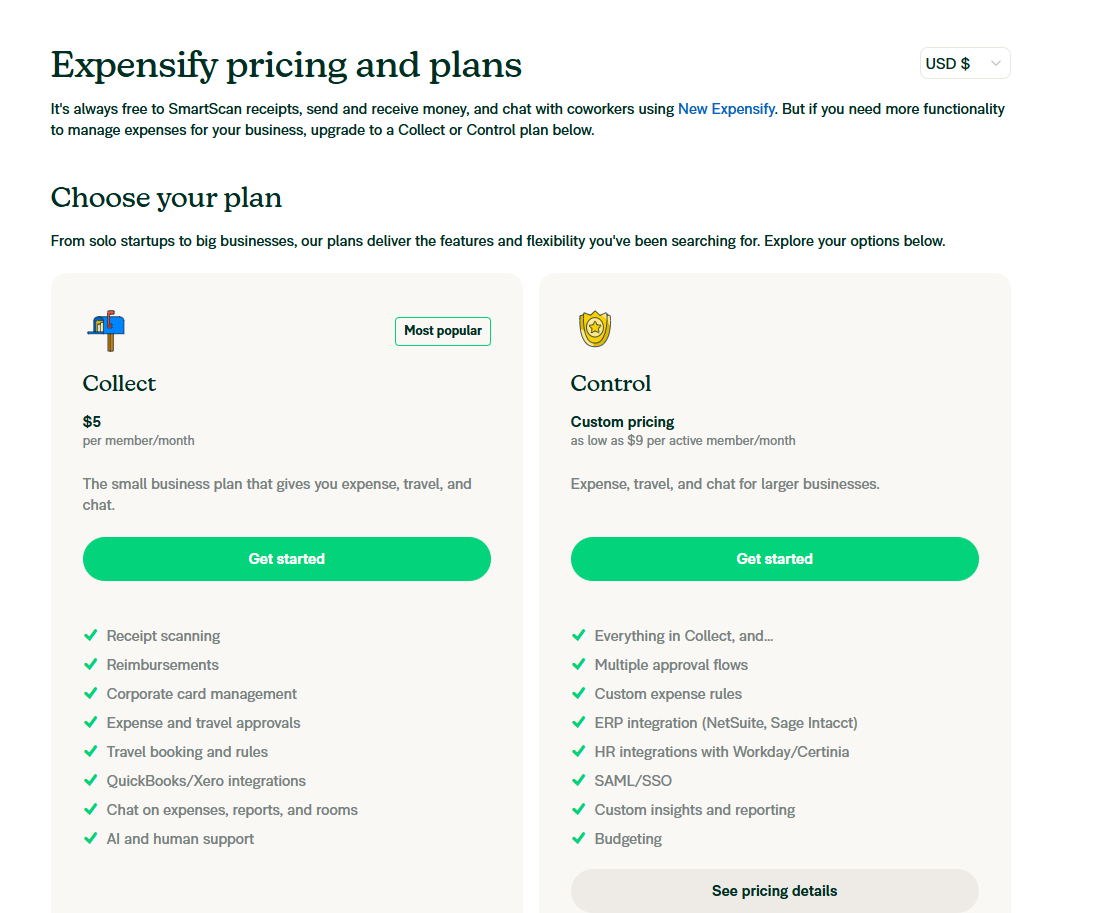
Expensify has 2 paid plans that you can choose from:
- Collect: $5/month/user, which offers receipt scanning, reimbursements, corporate card management, expense and travel approvals, and travel booking & rules.
- Control: Custom pricing, which can be as low as $9/month/active member, and adds multiple approval flows, custom expense rules, ERP integration, and budgeting.
The platform also has a free version that lets you SmartScan receipts, send and receive money, and chat with coworkers using their New Expensify solution.
Pros and Cons
✅ Genuinely quick, mobile-first capture.
✅ Keeps the cards your business already carries.
✅ Over 45 integrations, QuickBooks, Xero, NetSuite, and Workday included.
❌ Expensify did a big update in January 2026 that's still difficult to get used to for interfacing as an admin, according to one G2 review.
#2: Rydoo
Best for: Multinational finance teams needing compliant expense handling across borders.
Similar to: Expensify, Happay.
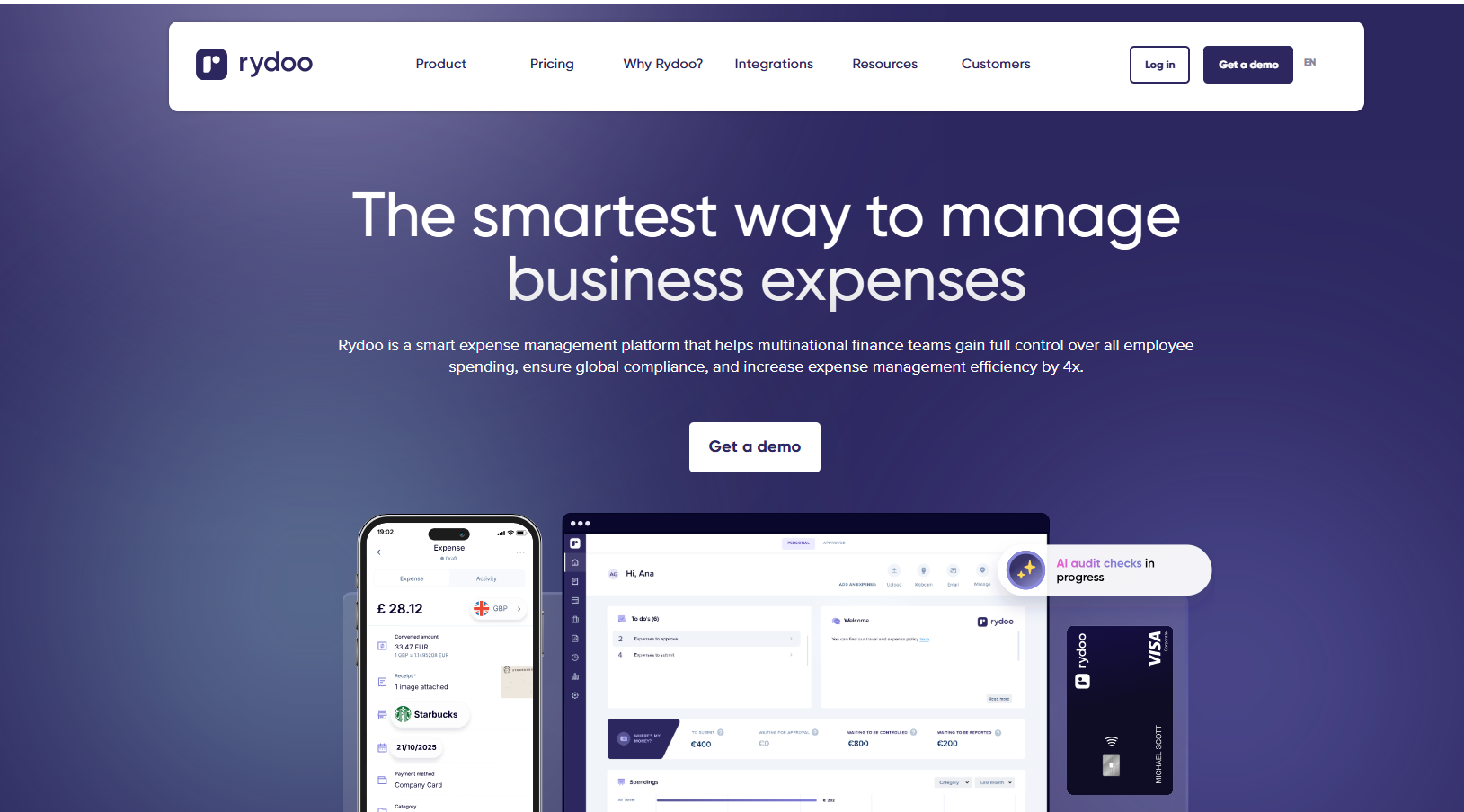
Rydoo covers expenses in over 130 countries, with names like Deloitte and Sodexo on its books.
Its case is compliance at volume: AI checks every claim, leaving your team to deal only with the ones that fail.
Features

- Receipt scanning: A photo fills the expense fields within seconds.
- Smart Audit: AI screens each claim for policy breaks and surfaces them pre-approval.
- Per diem and mileage rules: Allowance and mileage rates pulled from official data in over 80 countries.
- ERP links: Ties into over 35 finance, HR, ERP, and travel tools, SAP, NetSuite, Xero, and Microsoft Dynamics among them.
Pricing
Rydoo doesn't have a free plan. Paid plans start at:
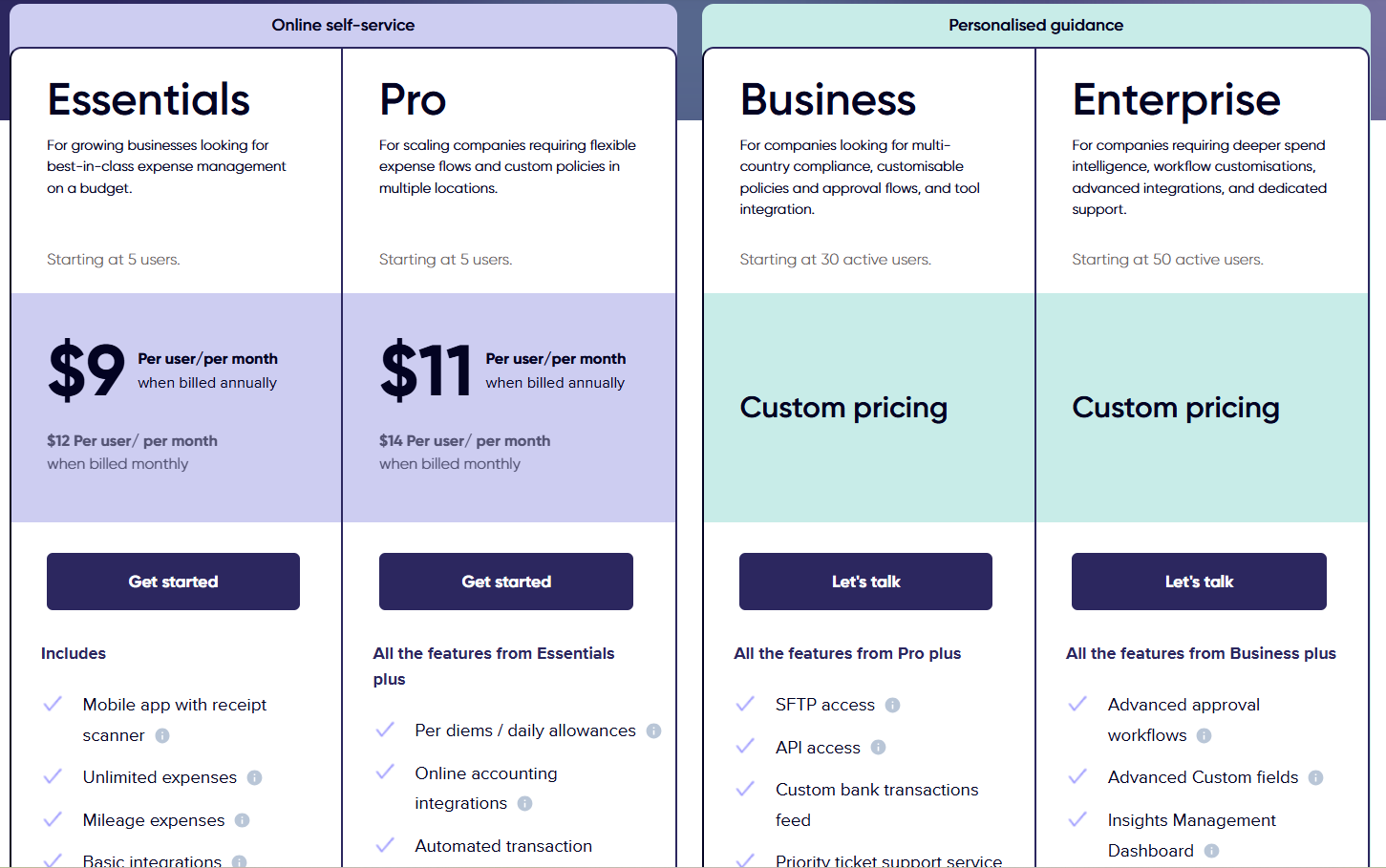
- Essentials: $9/user/month annually for the receipt scanner, unlimited expenses, and basic integrations.
- Pro: $11/user/month for per diems, customisable policies, and multi-country compliance.
- Business and Enterprise: Custom pricing for SFTP, API access, and SSO.
Pros and Cons
✅ Capable AI audit that trims manual review.
✅ Broad ERP and travel hooks for layered stacks.
✅ Active-user billing higher up, so dormant seats cost nothing.
❌ Business and Enterprise plans do not have public pricing.
#3: Zoho Expense
Best for: Teams already standardised on Zoho Books or the wider Zoho suite.
Similar to: Expensify, Rydoo.
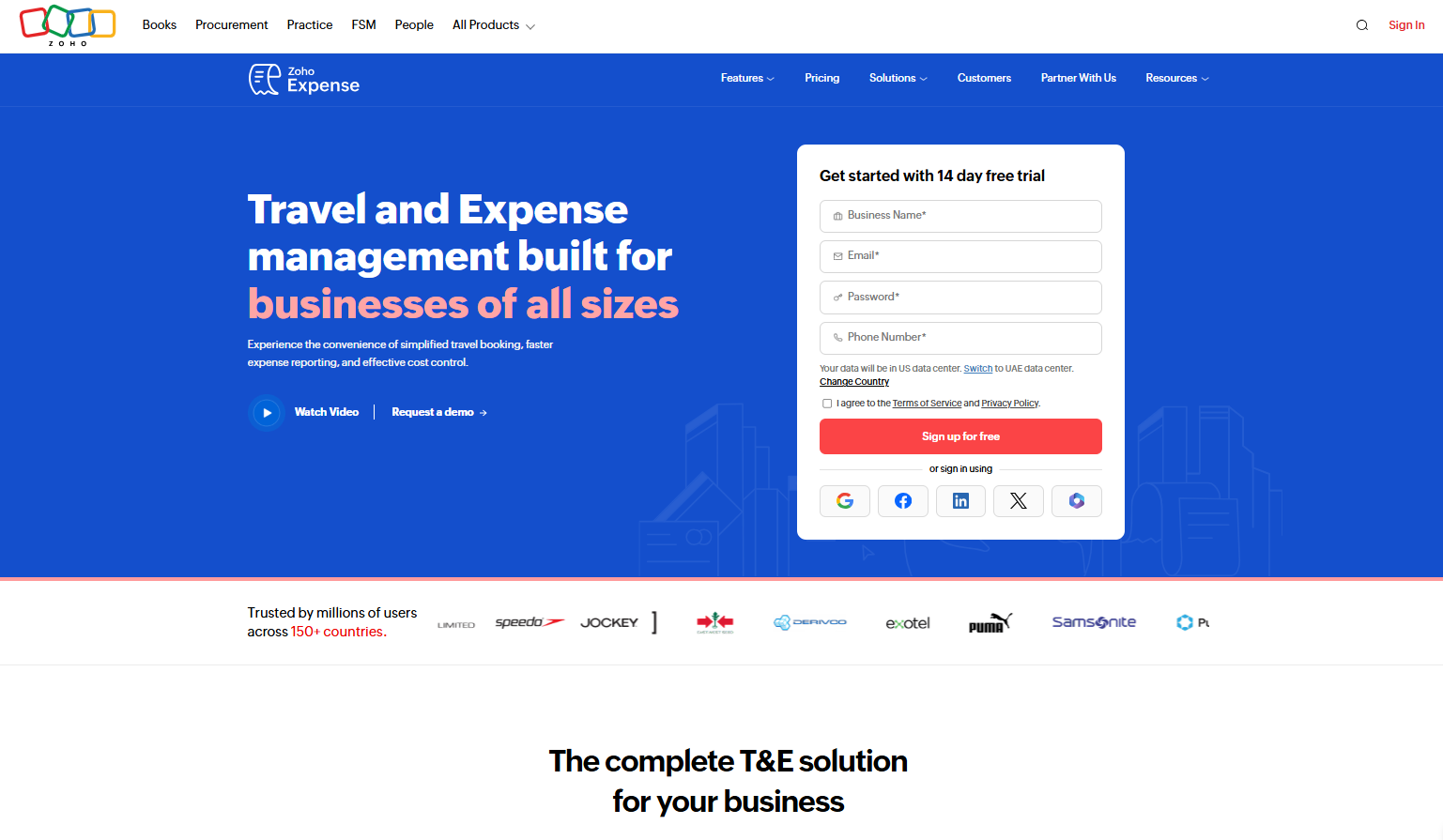
Zoho Expense belongs to the Zoho suite, which pays off if your books already run on Zoho Books.
It operates in over 150 countries including the UAE, handles multiple currencies, and pays reimbursements once a claim clears.
There's no card of its own, so it pairs with whatever bank cards you carry.
Features
- Autoscan: Lifts vendor, amount, date, and tax off a photographed or emailed receipt.
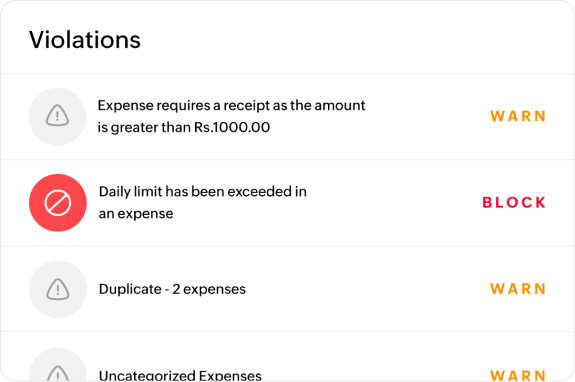
- Layered approvals: Routes claims by amount, department, or category, with an audit trail throughout.
- Card matching: Pulls in card transactions and ties them to the right expense entry.
- Native Zoho sync: Pushes expenses into accounting as vendor payments with minimal setup.
Pricing
Zoho Expense offers a free plan for up to 3 users with expense reports, expense tracking via personal cards, and accounting integrations.
The platform has 3 paid tiers:
- Standard: AED 11/user/month (billed annually) with 5 minimum users, which adds corporate card management, multiple expense policies, mileage expenses via GPS, and custom user roles.
- Premium: AED 22/user/month, which adds an online travel booking tool, an in-built travel desk management tool, and automated per diem management.
- Zoho Spend: Custom pricing, which includes modules for corporate travel, expense management, cards, procurement, AP support, and payroll.

Pros and Cons
✅ Low cost.
✅ Strong OCR, little manual keying.
✅ Two-way sync for Zoho Books users.
❌ Some of the workflows can feel a bit rigid at times, according to one G2 reviewer.
What are the best enterprise and global reimbursement platforms in the UAE?
This last group fits larger or globally distributed teams that need accounts-payable-grade automation and deep ERP integration across multiple entities:
#1: SAP Concur
Best for: Enterprises with serious travel volume and detailed expense policy.
Similar to: Rydoo, Tipalti.
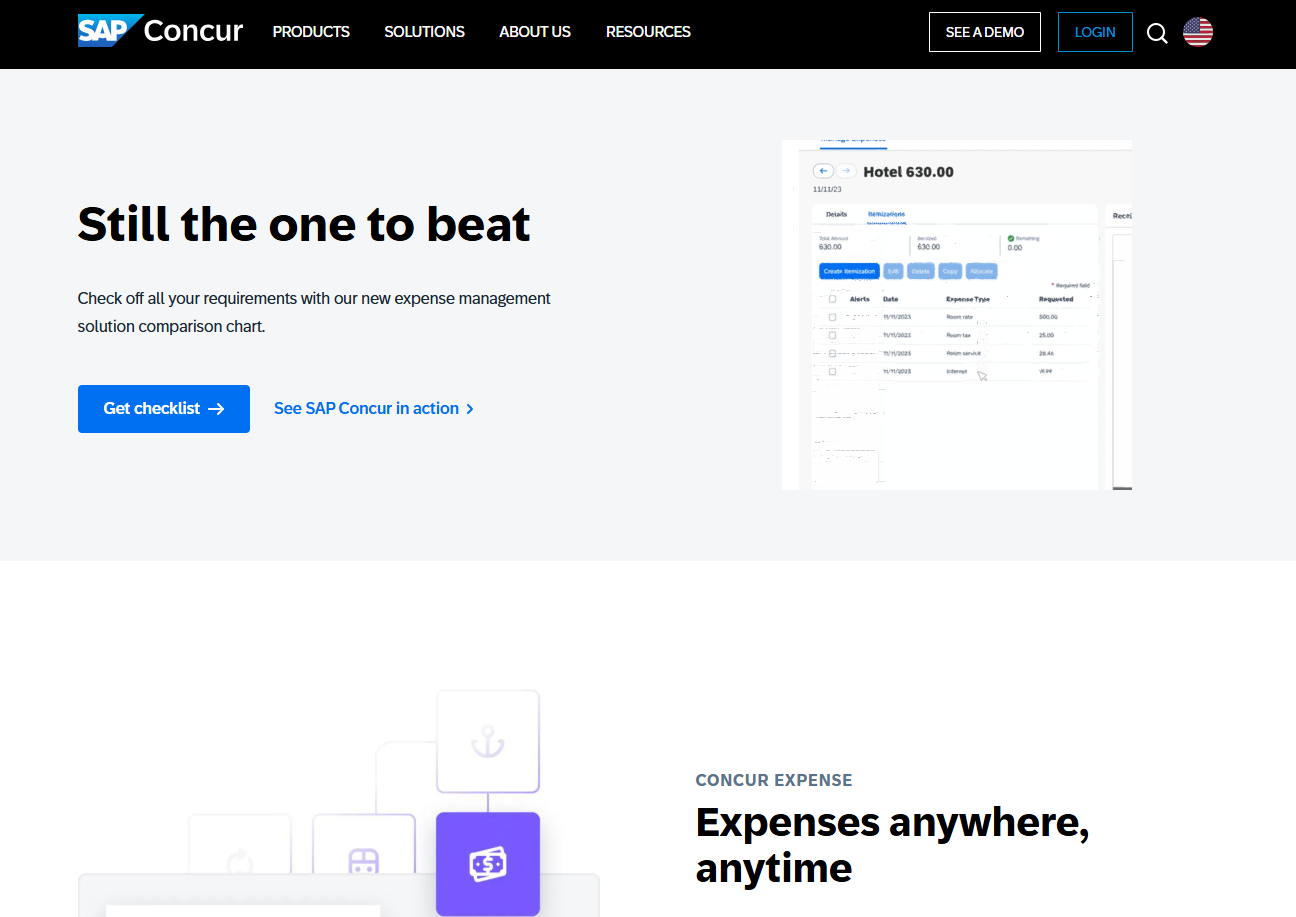
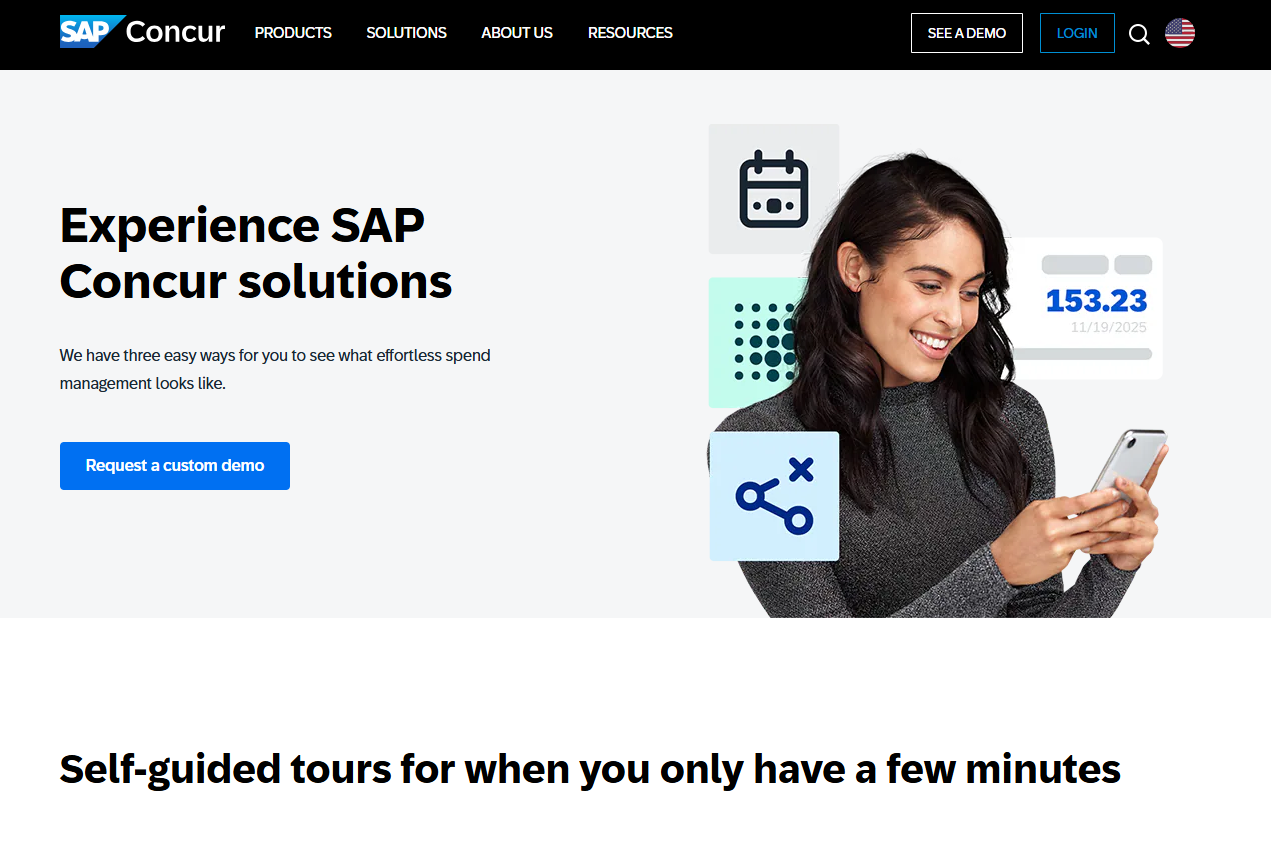
SAP Concur has been the default enterprise travel-and-expense tool for years, and few rivals match its global coverage.
You can begin with expense and reimbursement, then layer travel or invoice modules on later.
There's no native card, and the depth comes at the cost of price and setup effort, so it leans enterprise.
Features
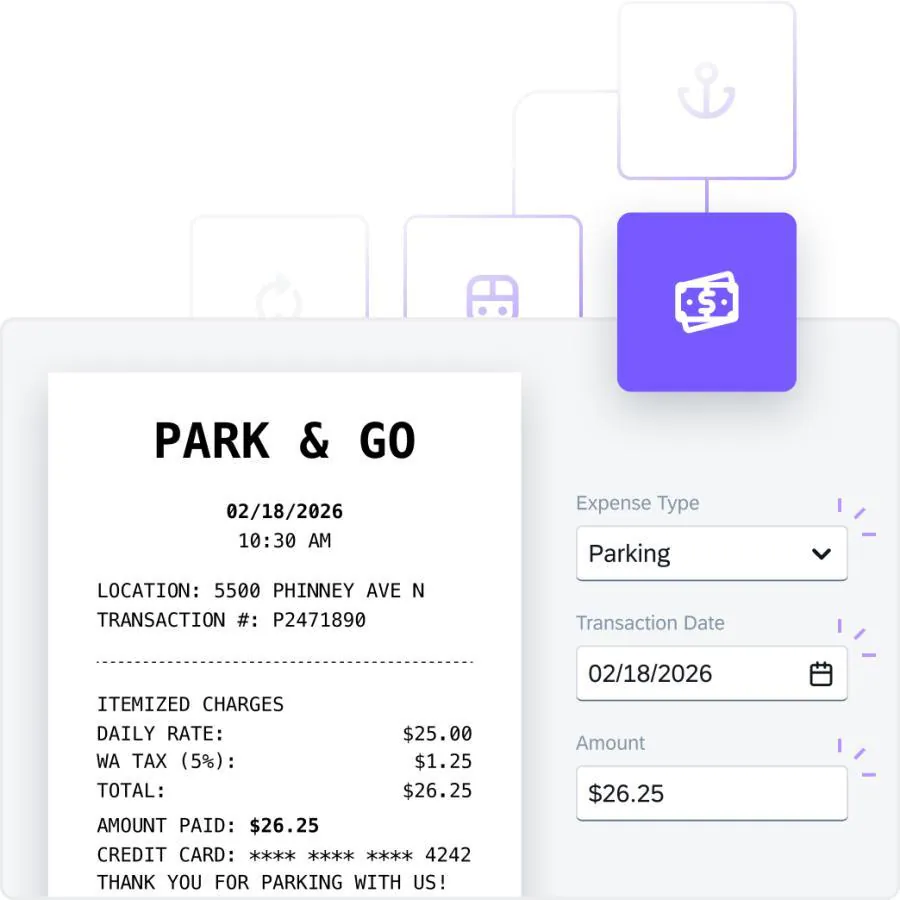
- Capture and reimbursement: Mobile submission, with payback tracked through the approval chain.
- Policy engine: Reimbursement checks against your rules and flags anything off-policy.
- Travel module: Books flights, hotels, cars, and rail in the same system.
- ERP hooks: Connects into SAP and most major accounting and HR platforms.
Pricing
SAP Concur has custom pricing, so you’d have to contact them to get a quote.
Pros and Cons
✅ Deep policy and compliance control.
✅ Travel and expense together at scale.
✅ Extensive ERP and partner network.
#2: Tipalti
Best for: Global reimbursements spanning many countries and currencies.
Similar to: SAP Concur, BILL.
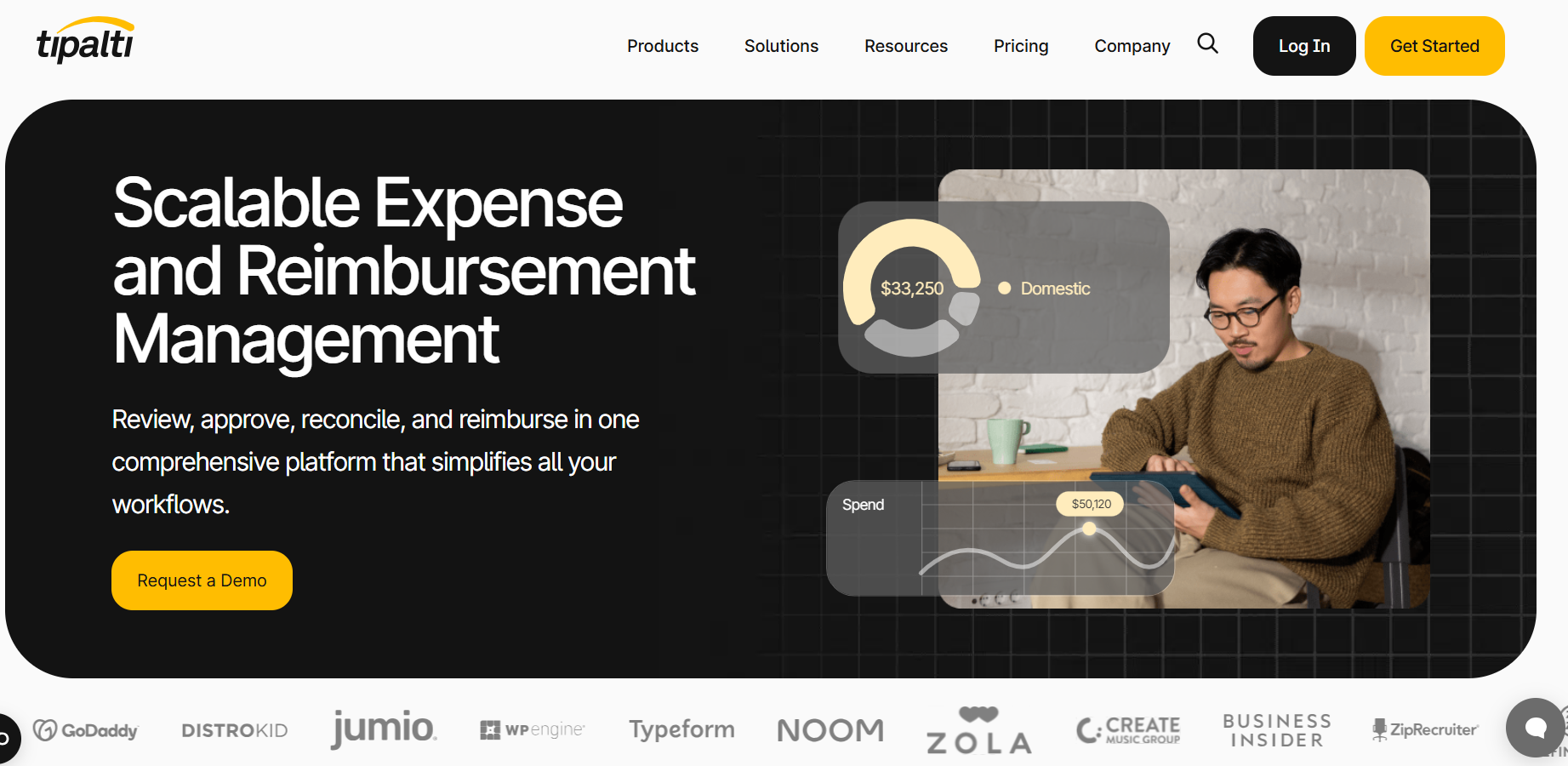
Tipalti made its name in accounts payable and layers an expense-and-reimbursement module onto the same platform.
Reach is the selling point for reimbursement: payouts span 196 countries and over 120 currencies, which suits paying people across borders.
Features
- Worldwide payouts: Reimburses staff in 196 countries over local rails.
- Expense module: Handles submission, approval, reconciliation, and payback in one chain.
- Card reconciliation: Matches spend across Mastercard, Visa, and AmEx programs.
- ERP sync: Feeds NetSuite, Sage Intacct, and QuickBooks to speed the close.
Pricing
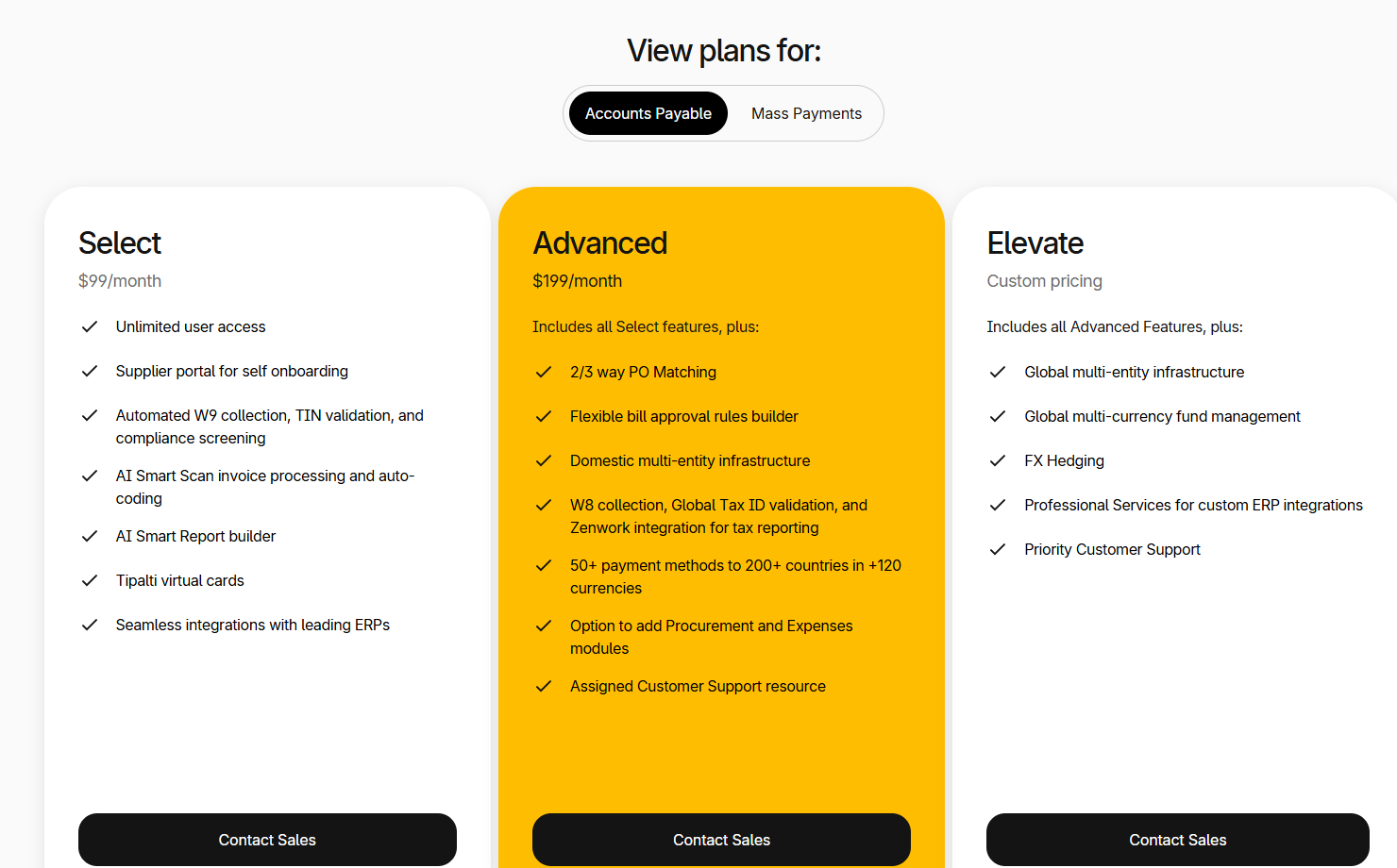
Tipalti has 3 plans that you can choose from:
- Select: $99/month with supplier portal, AI invoice scanning, and ERP integrations.
- Advanced: $199/month adds multi-entity, multi-currency, and 2 and 3-way PO matching.
- Elevate: Custom pricing for fully featured procurement and advanced budget management.
Pros and Cons
✅ Real worldwide payout coverage.
✅ Solid multi-entity and multi-currency handling.
✅ Dependable ERP sync for AP-led teams.
❌ Higher starting price at $99/month than some of the other competitors on the market.
#3: BILL
Best for: Finance teams wanting reimbursement beside their accounts payable and receivable.
Similar to: Tipalti, Expensify.
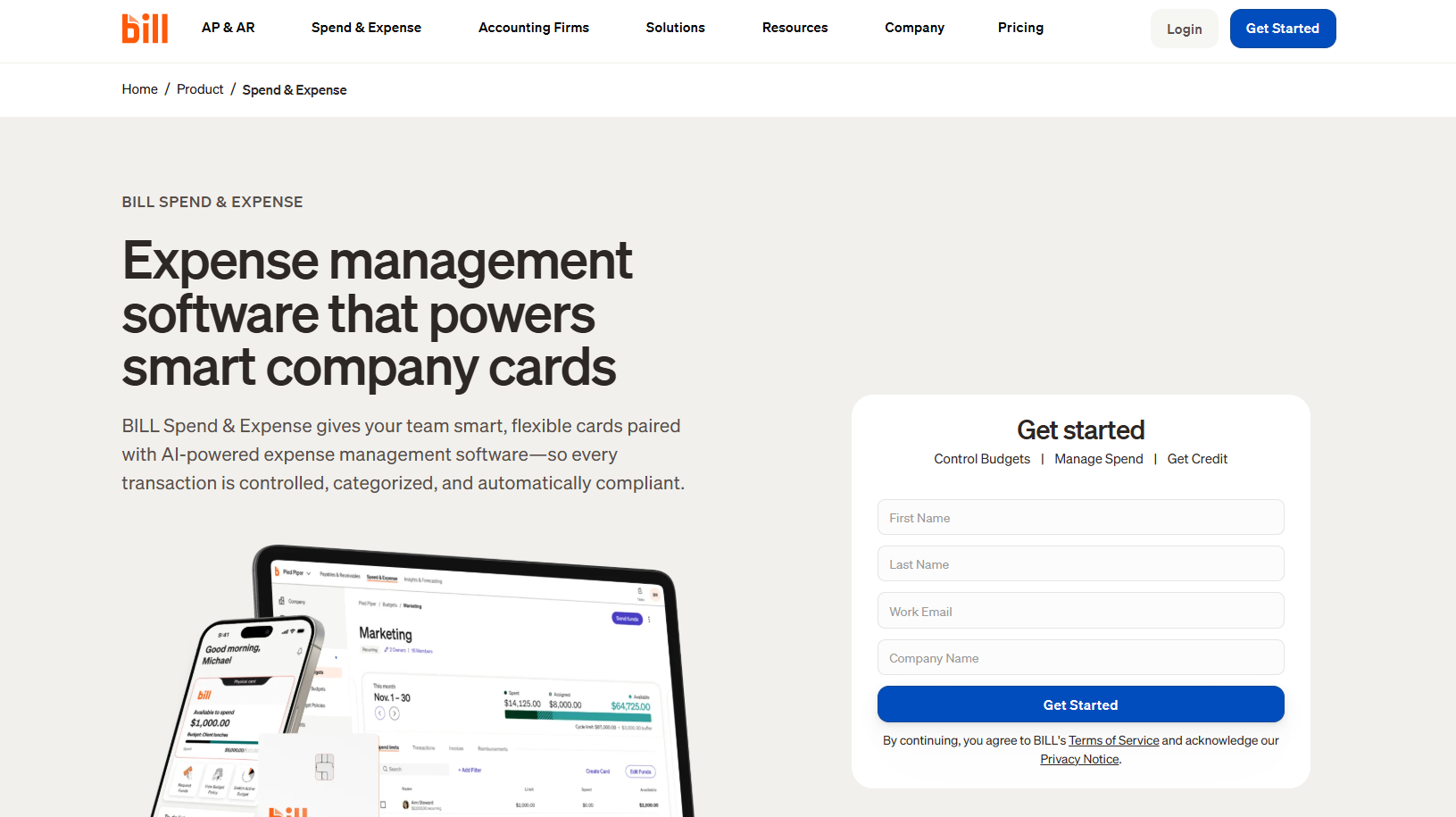
BILL runs accounts payable, accounts receivable, and spend-and-expense from one platform.
Its Spend and Expense product, once called Divvy, covers corporate cards, budgets, and reimbursement, so spend reporting stays close to AP and AR.
A caveat for UAE buyers: the BILL Divvy Card is US-issued, and both the card and its credit lines are geared to US entities.
Features
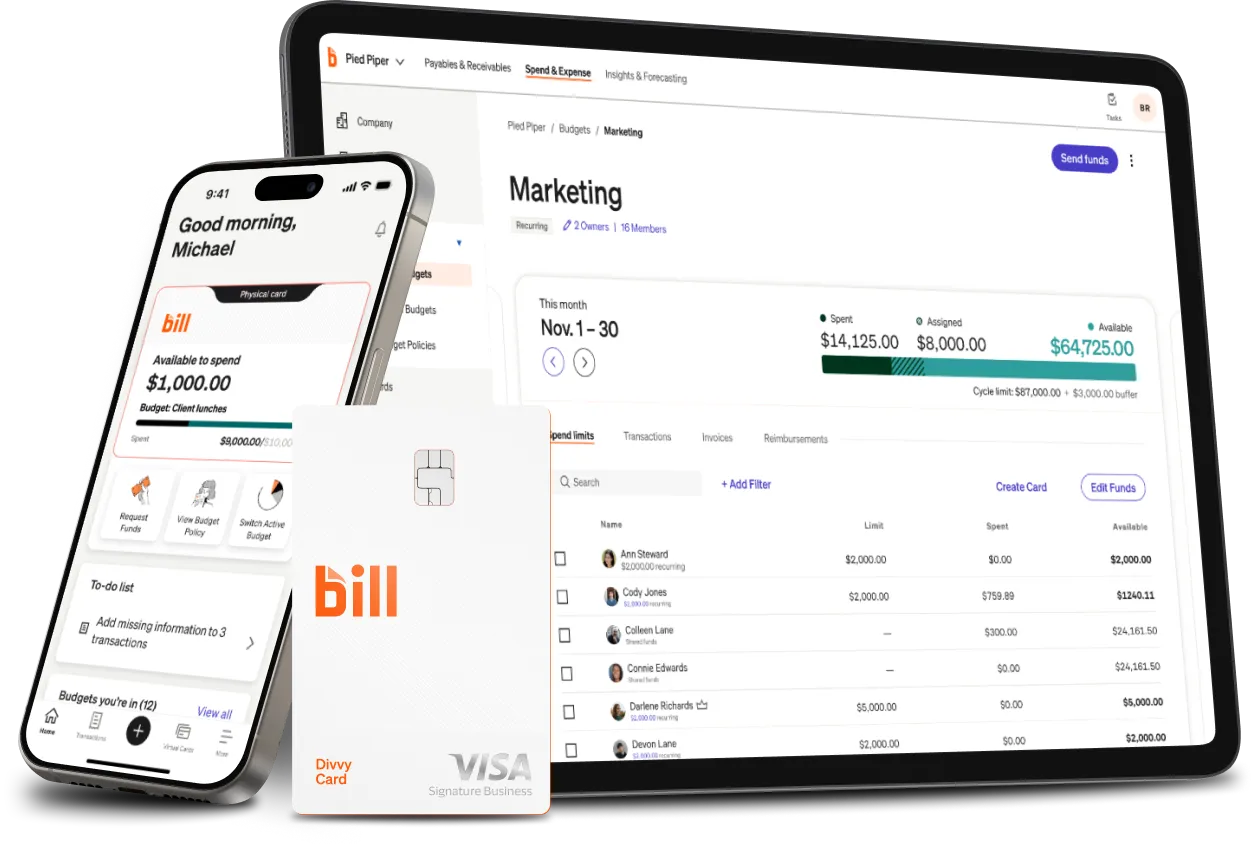
- Spend and Expense: Cards, budgets, and reimbursement in a single view.
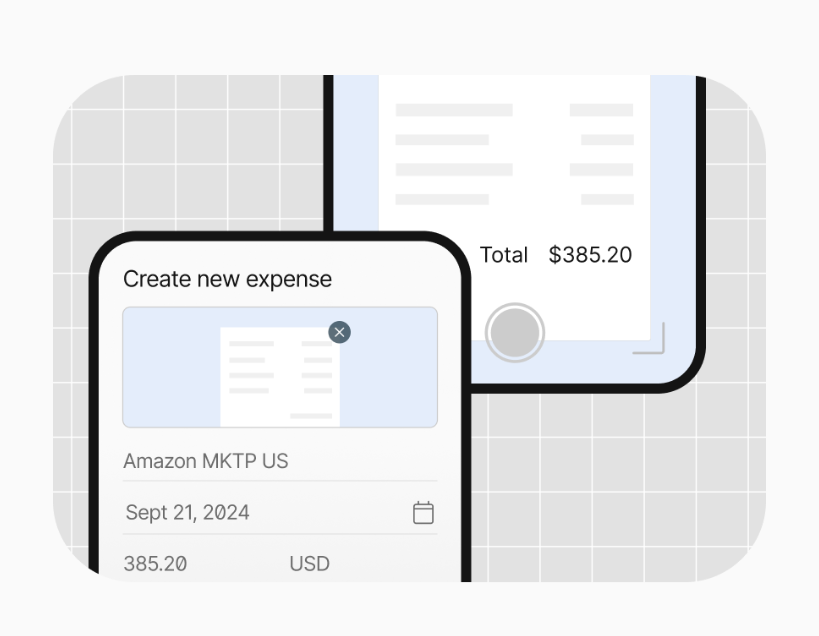
- Receipt capture: Snap-and-submit, with categories assigned automatically.
- Budget rules: Caps by person, department, or project.
- Accounting sync: Hooks into QuickBooks, NetSuite, Sage Intacct, and Xero.
Pricing
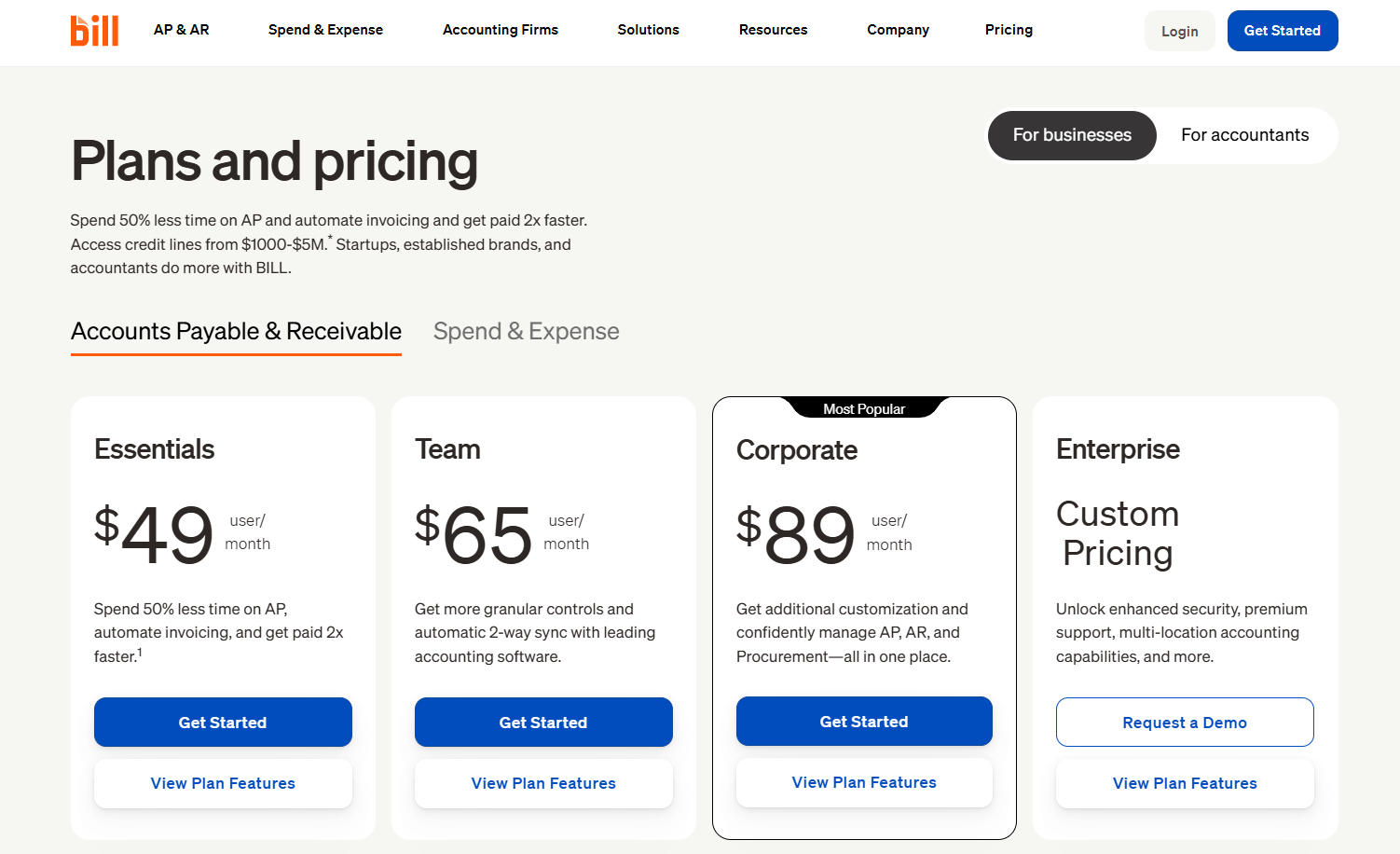
BILL has 4 paid plans:
- Essentials: $49/user/month for AP and AR basics with live chat support.
- Team: $65/user/month adds custom roles and granular controls.
- Corporate: $89/user/month for combined AP and AR with custom approvals.
- Enterprise: Custom pricing for premium support and multi-location accounting.
Pros and Cons
✅ No-cost spend and expense software.
✅ Reimbursement, AP, and AR on one platform.
✅ Quick budget setup by project or person.
❌ Enterprise pricing is custom.
#4: Happay
Best for: Enterprises wanting travel booking, expense reports, and prepaid cards together.
Similar to: Xpence, Rydoo.

Happay carries the travel-and-expense programs of over 8,000 businesses, the bulk of them in India, where it calls itself the category's largest.
It runs the whole trip, from the flight booking to the reconciliation that follows.
Features
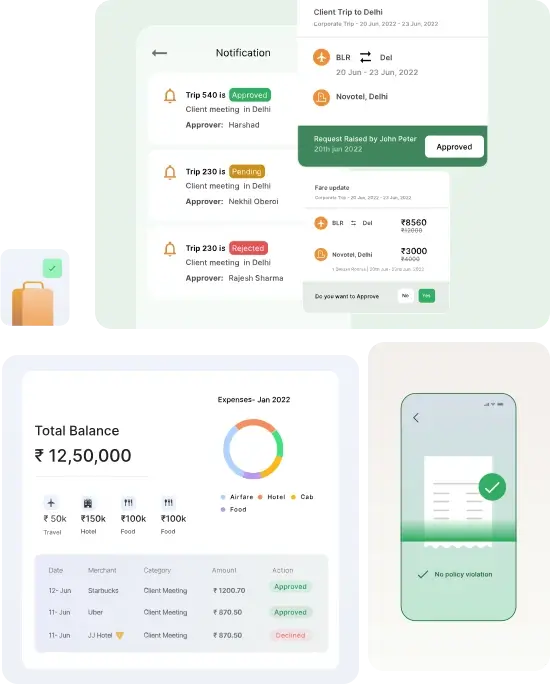
- Self-booking: Travellers book flights, hotels, and cabs within the limits you set, keeping overruns down.
- Xpendite capture: AI lifts expense detail from receipts and other sources.
- SmartAudit: Automated checks catch duplicate bills and off-policy claims pre-approval.
- Prepaid cards: Stand in for cash advances, with instant top-ups, rules, and in-app approvals.
Pricing
Pricing isn't published. You'll need to contact their team for a quote and demo.
Pros and Cons
✅ Travel, expense, and payments on one platform.
✅ Strong fraud and policy automation.
✅ A claimed 3-to-5-day filing-to-reimbursement turnaround.
❌ Happay is quite limited as it's not able to handle transactions in foreign currency, according to one G2 review.
Next steps: try Pemo for free
Pemo brings spend management, smart corporate cards, and automated accounting together for UAE finance leaders.
Each transaction shows up with its receipt and category already attached; the gap between spending and reporting closes, and most reimbursements never get raised at all.
If you want a reimbursement tool that hands you:
- Up to 2 free cards on Kickoff, with unlimited virtual and single-use cards.
- AI receipt matching that links receipts to transactions, no reminders sent.
- A claim, approval, and payback flow for the spend that has to stay personal.
- Up to 2% cashback on business spend, plus hotel and software discounts.
- Direct accounting sync, so reconciliation keeps pace with spending.
Then you can sign up for the free plan or book a demo to see why over 10,000 businesses across the MENA region run on Pemo.
⚠️ Disclaimer: This article was last updated on the 2nd of July, 2026, and if there's any misinterpretation of the information, please contact us, and we will fact-check it.


