
A UAE company can be fully licensed and already invoicing while having nowhere to put the money until its bank account opens.
In this article, I’ll go over how you can open a business bank account in the UAE, including the documents you need to prepare.
TL;DR
- The bank account opening process follows the same order whichever provider you pick: decide what the account has to do, assemble the company documents, choose a provider, apply and pass identity checks, answer the compliance questions about your business, then activate the account and set who is allowed to release money.
- Most of the timeline is decided by your paperwork: Trade licence, constitutional documents, share register, passports and Emirates IDs for shareholders and signatories, a board resolution naming who can release funds, proof of a business address, and an explanation of where the money comes from. Every document has to be current, legible, and consistent with the others.
- Pemo, powered by ruya, is the strongest fit for an SME opening its first account. The account underneath is a real UAE bank account provided by ruya, a licensed Shari'ah-compliant bank, carrying its own IBAN in your company's name, with supplier invoices, approvals, corporate cards, and accounting sync all running on the same login. It typically opens in one to three business days with no branch visit, no opening fee, no minimum balance, and no requirement to already bank elsewhere. Transfers run at AED 0.50 all in, with idle cash able to go on term with ruya at an expected profit of up to 3.75% per annum.
What counts as a business bank account in the UAE?
A business bank account is an account held at a Central Bank of the UAE licensed bank, in your company's registered name, with its own IBAN.
Ownership is what carries the weight in that sentence.
Money in the account belongs to the company as a legal entity. It does not belong to a shareholder who happens to be holding it.
That is what makes the account usable for invoicing customers and for producing a clean set of books at year-end.
How is it different from running the business through a personal account?
A personal account can technically receive a client payment. It cannot produce a record that cleanly separates company money from your own.
Every receipt and every payment out of a business account carries the company's identity. Your bookkeeper works from one ledger.
The opposite situation, where company transactions are scattered across personal cards and personal IBANs, turns month-end into reconstruction work.
Where does a card wallet stop being a bank account?
Some spend platforms give businesses a funding wallet that money is transferred into, used for topping up corporate cards.
A wallet like that holds card float and does not carry the rest of what a bank account does.
Pemo (that’s us) runs both, which makes the difference easy to see.
The Pemo Business Account, provided by ruya, holds the company's working money. Separately, a prepaid pool called the Card Wallet funds Pemo cards and nothing else.

Transfers run one way. Money moves out of the Business Account into the wallet on demand, never in the other direction.
Knowing which of the two a provider is offering you matters, because only one of them is a bank account.
Who can open a business bank account in the UAE?
Any company registered in the UAE with an active trade licence can apply. Whether that application succeeds is the provider's decision.
Approval turns on four things the compliance team has to satisfy itself about:
Whether the entity is properly registered, whether the people behind it can be identified, whether the ownership chain is traceable, and whether the business activity is one the provider is willing to bank.
Does mainland or free zone licensing change the process?
Not in substance. What changes is which authority issued your licence and, in turn, which authority the provider checks it against.
Mainland companies hold a licence from a Department of Economic Development. Free zone companies hold one issued by their free zone authority.
The document set is the same in substance. Mainland LLCs are usually asked for a Memorandum of Association, where a free zone entity may hold the equivalent constitutional document under a different name.
Do you need a UAE residence visa and Emirates ID?
Not universally, though it helps. Many providers ask the authorised signatory to hold a valid UAE residence visa and Emirates ID, because the person operating the account has to be identifiable and reachable.
Shareholders living outside the UAE are usually identified through passport copies and ownership documents.
Policy on non-resident signatories differs from provider to provider, so confirm it before you build the file.
For example, in Pemo’s case, documentation is reviewed case by case by our own compliance team and ruya's.
Which documents will a UAE provider ask you for?
Almost every provider asks for the same core files, as each document answers a specific question that has to be closed out before an account can be opened.
Two details are worth getting right before you upload anything:
- Every document has to be current, legible, and complete, including amendment pages on a trade licence.
- Names and ownership percentages have to agree across the licence, the constitutional documents, and the share register. A mismatch between any two of them is the kind of thing that sends a file back for clarification.
What else gets asked for on top?
Beyond the core file, providers ask for whatever they need to understand the business itself.
- VAT registration certificate: requested where the company is registered for VAT.
- Contracts or sample invoices: used to confirm that the stated activity matches real trade.
- A short business plan: usually asked of newly formed companies with no trading history.
- Source of funds explanation: covering where opening balances and expected inflows originate.
- Bank reference letters: requested by some providers for shareholders or for an existing entity. Our help centre has a walkthrough on how to get a bank reference letter from online banking at several UAE banks.
How does the application run, from first document to live IBAN?
The process runs in the same order regardless of which provider you pick. How long it takes is mostly decided by the parts you control.
Step 1: Decide what the account has to do
Write down the jobs before you shortlist anyone.
Receiving customer payments, paying UAE suppliers, running payroll, funding corporate cards, and sending money abroad are separate capabilities. Not every provider covers all of them.
International payments are the capability most worth confirming in writing, since support for them differs from provider to provider.
Step 2: Build the document file before you apply
Collect the full set from the table above into one folder, scanned properly at high resolution.
Check as you go that nothing has expired, that no page is missing, that scans are legible at full size, and that the ownership details agree across documents.
A complete file is the part of the timeline you can control. An incomplete one means an application that stalls in clarification cycles.
Step 3: Choose the provider
Weigh the account against what the business does day to day.
Traditional banks bring branch networks and credit facilities. Digital-first providers tend to compete on onboarding speed and running cost.
If the choice is still open, our guide to the 10 best business bank accounts in the UAE compares the main options.
Step 4: Apply and answer the compliance questions
Applications are increasingly submitted online, with document uploads and identity verification handled in an app or a web portal.
Expect questions about expected monthly turnover, who your customers are, which countries you deal with, and what your funds are used for.
Answer these precisely. Vague descriptions of business activity invite follow-up questions, and follow-ups are where the weeks go.
Step 5: Activate the account and decide who can move money
Once approved, the account goes live with its own IBAN in the company's name.
Before anyone uses it, settle who can prepare a payment and who can release one.
Separating those two roles is standard practice in corporate banking. That separation is what stops one person from moving funds unchecked.
Step 6: Connect the account to the rest of your finance setup
Customers need the IBAN before they can pay you into the account directly.
Supplier invoices need to point to whatever handles your approvals. Your accounting software and your corporate cards come next.
An account that is open but disconnected from your payables and your ledger just moves the manual work somewhere else.
How long does it take to open a business bank account?
Timelines depend on the provider and on how complete your file is. Published figures at the digital-first end are quoted in business days, and applications that run through branch review take longer.
We at Pemo have published a figure of one to three business days from the point where your paperwork is complete, with nothing to sign in a branch.
Ownership structure matters too. A single-shareholder company with a clean licence gives a reviewer less to verify than a layered structure with corporate shareholders behind it.
What sends a file back to your desk?
Published guidance from UAE providers and setup advisers keeps pointing at the same handful of problems.
- A date has passed: a lapsed trade licence, visa, or Emirates ID is commonly listed as an immediate stop on an application.
- A page cannot be read: glare, cropped edges, and photographs taken at an angle come back as resubmission requests.
- Two documents disagree: a shareholder percentage on the MOA that the share register does not support has to be reconciled.
- The activity looks wider than the licence: work described in the application that the licence does not cover raises a question the provider has to resolve.
- The money has no story: expected inflows with no explanation behind them are among the most frequently cited causes of delay.
What does a business bank account cost in the UAE?
Cost shows up in four places. Comparing providers on the monthly fee alone gives you an incomplete picture.
- Subscription or maintenance fee: a fixed monthly charge for holding the account.
- Minimum balance: some accounts require an average balance, with a fee applied in any month the balance falls below it.
- Transfer fees: charged per outgoing local payment, and separately for international payments where supported.
- Service fees: cheque handling, statements, and account opening charges, priced very differently from one provider to the next.
Digital-first accounts tend to price through a flat monthly subscription with no balance requirement. Balance-linked pricing is more common at traditional banks.
How do you open a business account with Pemo?
You submit your documents to Pemo, whose compliance team takes them through the process alongside ruya's.
The timeline is usually one to three business days once the file is complete, with no branch visit and no opening fee.
What you end up with is a UAE bank account registered to your company, carrying an IBAN of its own. The parts below cover how it works once it is live.
ruya holds the account and Pemo runs the software on top
Pemo is a financial technology platform, not a bank.
Your Business Account is provided by ruya, whose full legal name is Ruya Community Islamic Bank L.L.C., registered as an Islamic Specialized National Bank based in Ajman under licence number 01.01.08.067.2024.04 in the Central Bank of the UAE registry.
You never log into ruya separately.
Pemo's web and mobile apps carry the account, keeping balances, payments, cards, and accounting sync in one place.
The account can be your company's first
Newly licensed companies hit a circular problem. The trading history that makes a provider comfortable only accumulates once money has somewhere to land.
Pemo does not ask for an existing corporate account elsewhere.
Onboarding treats bank statements as optional, with paperwork reviewed company by company across both compliance teams.
For a company with no banking history to show, that removes the usual chicken-and-egg problem at the start.
Bill Pay handles supplier invoices from arrival to payment
Follow one supplier invoice through the account.
It arrives by photo, file upload, or email forwarding. Pemo's AI reads the details off the document, then hands the bill to whichever approval rules you have configured.
Payment executes from the Business Account once it clears authorisation. The vendor gets an email confirmation without anyone sending one.
Nobody keys that invoice into a separate banking portal, because approval and payment happen in the same place.
Batch payments let you submit several approved bills together for release in one authorisation. If accounts payable is the reason you are opening an account at all, our guide on how to automate accounts payable in the UAE goes deeper.
Two people are needed before money leaves the account
Preparing a payment and releasing one are permanently separate actions in Pemo.
Team members and accountants can upload bills. Approvers can approve them.
Only your designated POA, the Payment Order Authorizer, can release funds. Every release they make requires a one-time SMS code.
Automatic checks run underneath all of it. Duplicate bills get flagged before money moves, along with first-time vendor payments and IBAN mismatches.
Every action lands in an audit trail.
Idle cash can move into a Wakala deposit
Money sitting in the account can be placed on term with ruya through a Shari'ah-compliant Wakala deposit.
The bank acts as your agent in investing the funds, returning an expected profit when the term ends.
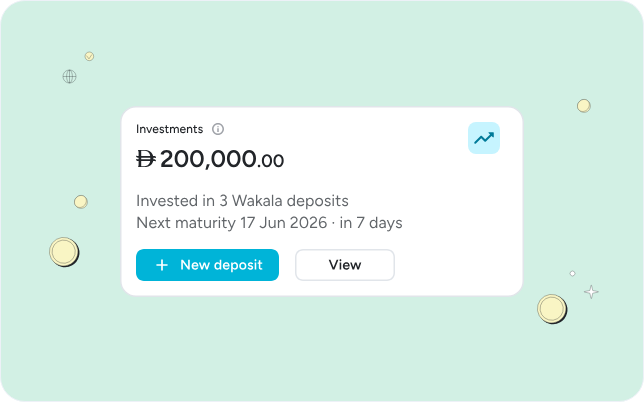
Each deposit runs from AED 5,000 up to AED 5,000,000, and you can hold more than one at a time. You choose the term when you open one:
Rates are reviewed regularly. Whatever rate applies to the term you pick is shown in the app before you confirm.
Cheques are collected from your office
Cheque deposits run through JMBR, ruya's courier partner, without a branch trip.
You log a collection request with the ruya help centre.
JMBR then arranges a pickup time and place before delivering the cheque to the branch for clearing. Post-dated cheques go through the same route.
Fees are AED 15.75 per collection request and AED 10 plus VAT per post-dated cheque lodgement.
The Card Wallet stays separate from the Business Account
Pemo cards are funded from the Card Wallet, a distinct prepaid pool.
Moving money from the Business Account into the Card Wallet takes a transfer inside the app. External top-ups work too, from any business bank account in your company's name.
Cheques and cash cannot go into the Card Wallet. A cheque you want to spend on cards is deposited into the Business Account first, then transferred across.
What the account costs
Subscription for the account lists at AED 200 per month, currently discounted to AED 99.
The first 100 companies get the subscription free until the end of 2026.
Local transfers cost AED 0.50 all in, made up of an AED 0.47 fee and AED 0.03 VAT.
There is no opening fee, and no minimum or maximum balance requirement.
Pemo's card and expense management plans are priced separately, starting with the free Starter plan, and are listed in the subscription plans and pricing article.
Next steps: open a business account with Pemo
Let’s go back to that licensed, invoicing company with nowhere to put the money.
With Pemo, the gap between that state and a live IBAN in the company's name is a document upload and, on the published timeline, one to three business days.
What you get at the end of it does more than hold cash.
Supplier invoices land in an approval queue and get paid from that same screen, with preparation and release kept in separate hands.
Idle balances can be placed on term with ruya. Cards, expenses, and accounting sync all run on the same login.
If you want a UAE business bank account that opens without a branch visit and offers:
- Your own IBAN: registered to the company and provided by ruya.
- Payables handled in the account: invoices captured, approved, and paid through Bill Pay.
- Idle cash on term: Shari'ah-compliant Wakala deposits from AED 5,000.
- Low running cost: local transfers at AED 0.50 all in, with no minimum balance.
Then you can apply to open an account, or book a call if you would rather see it run against your own invoices first.
⚠️ Disclaimer: This article was last updated on the 18th of September, 2026. Pemo is a financial technology platform, not a bank; the Business Account is provided by ruya. Expected profit rates are indicative and not guaranteed. This article is general information and not legal, tax, or accounting advice. If there is any misinterpretation of the information, please contact us, and we will fact-check it.
Frequently asked questions
Can you open a UAE business bank account without an existing corporate account?
Yes, with providers that allow it. Pemo states that no existing corporate bank account is needed, and that bank statements are optional during onboarding.
Requirements elsewhere vary, since some banks weigh trading history heavily when assessing a new application.
Does the account work for money coming in from abroad?
Receiving and sending are governed separately. That trips people up.
The Pemo Business Account can receive payments from international sources. Outgoing transfers currently cover AED payments within the UAE.
Is a Wakala deposit the same as a fixed deposit?
A Wakala deposit does a comparable job through a different legal structure. Your funds are invested under an agency arrangement, with an expected profit paid at maturity.
Wakala deposits with ruya follow a structure approved by ruya's Internal Shari'ah Supervision Committee. Because the rate is expected, it should not be read as a guaranteed return.
What happens if an application is rejected?
Ask the provider for the reason, because most rejections trace to a document problem that can be corrected and resubmitted.
Where the issue is structural, such as a business activity the provider does not bank, a different provider is usually the faster path.
Does the account come with corporate cards?
Cards come with your Pemo plan, not with the Business Account itself. The two products sit on the same login.
Cards draw on the Card Wallet, so funding them means one transfer from the Business Account inside the app.


