
A corporate cashback card hands part of a company's card spend back to the business as money, under rules that change from issuer to issuer.
I'll compare the 6 best corporate cashback cards in the UAE in 2026 by what each one pays back and what holding it costs.
TL;DR
- Pemo offers the best corporate cashback card in the UAE for companies with recurring overseas spend, returning up to 2% on Premium to the wallet its cards draw from.
- Mamo and Network International issue balance-funded business cards with uncapped cashback, Mamo paying up to 2% on non-AED spend and Network International up to 0.80%.
- Wio and ADIB both pay 2% on credit: Wio across most card spend up to AED 2,000 a month, and ADIB on payments billed outside AED.
- RAKBANK's Titanium Business card gives 1% at home and abroad for no annual fee, up to AED 1,000 a month.
- Personal cashback cards don't suit company spend: FAB's personal Cashback Credit Card terms let the bank claw back cashback when the card pays for business purchases.
What should UAE finance teams look for in a corporate cashback card?
A UAE finance team should check four things before applying: which payments qualify, what's left after fees, how payouts arrive and whether the card model fits the company.
I'd work through them in this order: 👇
The spend that qualifies
Most programmes split spend into domestic and international, but issuers draw that line in different places:
- Currency-based rules: anything billed in a currency other than AED counts as international.
- Merchant-based rules: a merchant located outside the UAE qualifies even when it bills in AED.
- Category carve-outs: government fees, utilities, school fees and fuel often pay a reduced rate.
- Standard exclusions: refunds and disputed payments rarely qualify, along with bill payments made through a bank's own channels.
➡️ Meta and Google bill many UAE advertisers in AED, which can leave ad spend outside a currency-based programme.
What's left after caps and fees
The advertised rate is only the starting point.
Four other numbers shape what the company keeps:
- Monthly caps: Wio's 2% stops once the month's cashback hits AED 2,000.
- Foreign transaction fees: a charge of 2.3% to 3.68% on foreign-currency spend can outweigh a 2% rate on that payment.
- Plan and card fees: monthly platform fees and annual card fees come out of the budget the cashback goes into.
- Finance charges: on a credit card, profit or interest on a balance carried past the grace period can cancel out the cashback.
For a quick comparison, AED 20,000 of qualifying spend returns AED 400 at 2% and AED 90 at 0.45%.
How the money comes back
Payouts differ between issuers in four ways that show up at reconciliation:
- Wallet credit: prepaid platforms pay into the balance the cards spend from.
- Statement credit: banks post cashback to the card account, sometimes only above a redemption threshold.
- Timing: Pemo and ADIB both pay a month's cashback during the following month.
- Reversals: a refunded payment usually reduces a later payout.
The card model and who can apply
Two card models appear on this list, alongside two eligibility rules worth checking:
- Prepaid cards: the company loads its own money before spending, leaving no credit limit or finance charge to manage.
- Credit and covered cards: a bank-set limit and grace period, after which profit or interest applies to any balance carried.
- Existing-customer rules: some banks only issue business cards to companies that already bank with them.
- Account requirements: a digital bank may tie its card to a paid business account plan.
➡️ Our corporate card comparison for UAE SMEs goes deeper into the prepaid-versus-credit choice.
What are the best corporate cashback cards in the UAE in 2026?
The best corporate cashback card in the UAE in 2026 is Pemo for companies with recurring international spend.
Mamo comes second for uncapped prepaid cashback, ahead of Wio's flat 2% on credit.
All 6 cards are compared below by cashback rate and cost:
I only included cards that pass four checks:
- Business-issued: a UAE company holds the card for business spending.
- Cash value: cashback arrives as money in a wallet or on a card statement.
- Published terms: the issuer's own pages state the rate and the spend it applies to.
- Open to UAE companies: a UAE-licensed business can apply, subject to the issuer's customer rules.
➡️ A note on scope: personal cashback cards and points or miles programmes are out, along with business cards whose rate is left to the issuer's discretion. For the basics behind these programmes, see our corporate cashback guide.
#1: Pemo
Pemo (that's us) offers the best corporate cashback card in the UAE for international spend, pairing monthly cashback with card controls and accounting exports.
Full disclosure: Even though Pemo is our own product, I've tried to keep this review balanced by naming the cards that pay more on the same spend.
Pemo cards are prepaid corporate cards that draw on the company's Pemo Wallet.
Qualifying cashback goes back into that wallet every month.
Every Pemo card comes from NymCard Payment Services LLC, which holds a Central Bank of the UAE licence for retail payment services and card schemes.
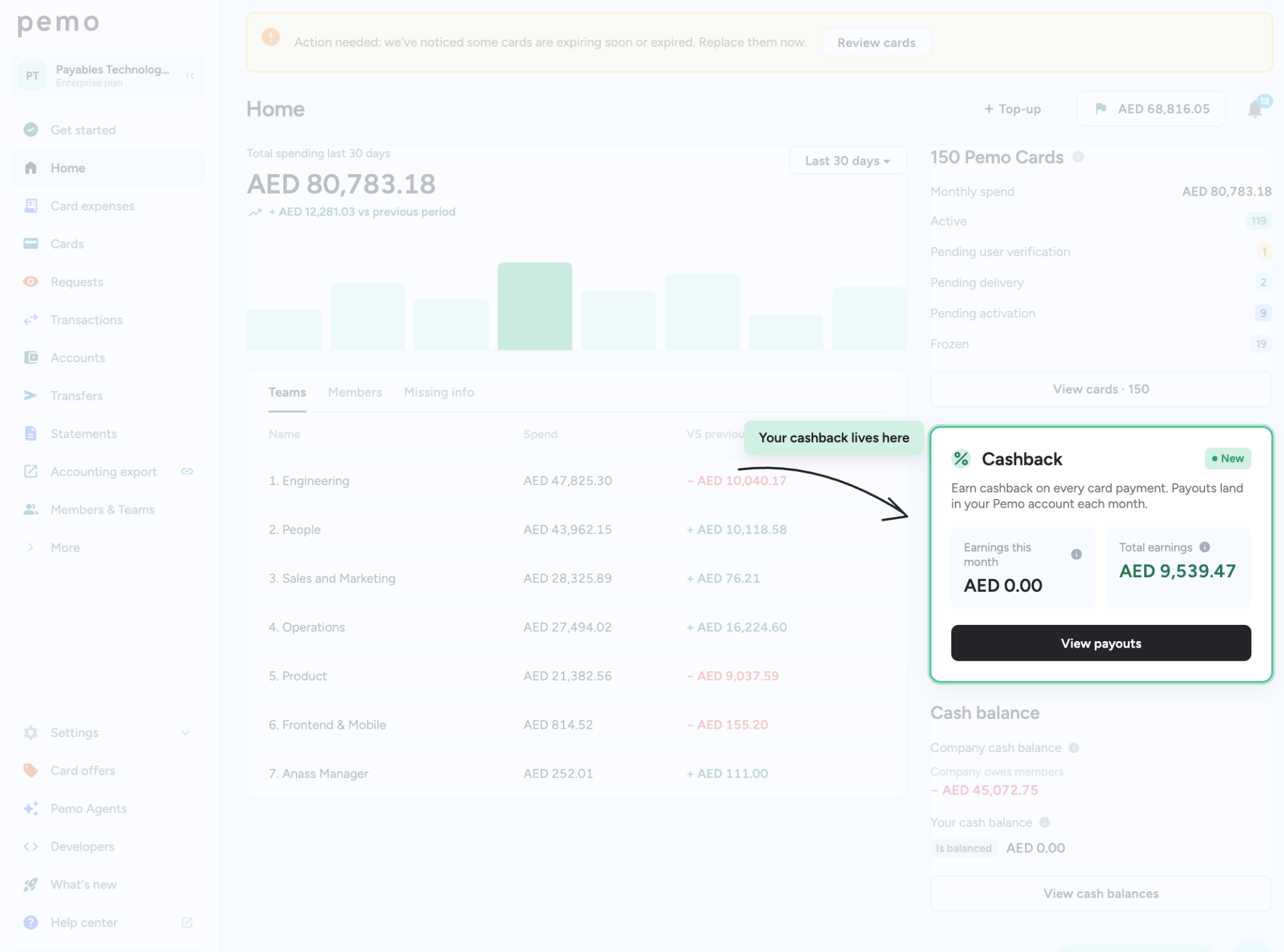
Over a typical month, Pemo's cashback works like this:
- Spend: team members pay overseas vendors and ad platforms on physical or virtual Pemo cards.
- Accrual: the Cashback tile builds up as qualifying payments settle.
- Payout: the month's total lands in the Pemo Wallet no later than the second week of the next month.
- Export: the finance team sends the payout to the ledger as money received, then matches it to its dated entry under View payouts.
Let's go over what puts Pemo first for corporate cashback: 👇
Cashback on international spend from the free plan
Rates rise with the plan, though the qualifying rules hold across Starter and Premium:
- Plan rates: Starter returns 0.5% and Premium up to 2%.
- Enterprise rates: agreed per company, including the only route to cashback from UAE merchants billing in AED.
- What counts: foreign-currency card payments or payments to merchants abroad, depending on the account's setup.
- Ad platforms billing in AED: Google and Meta charges count on accounts configured for cross-border spend, since neither company is UAE-based.
- No ceiling on Premium: the monthly payout isn't capped.
➡️ Each plan's rate is a maximum, set within that range by the account's foreign exchange fee profile.
Payouts reach the Pemo Wallet without a claim
Cashback becomes ordinary wallet money once it's paid:
- Monthly payout: one payment a month covers all qualifying spend from the month before.
- Live tracking: the Cashback tile shows the current month's accrual next to a dated list of past payouts.
- Business funds: payouts behave like any other wallet balance, with no redemption step and no expiry date.
- Excluded movements: ATM cash, transfers, wallet top-ups, refunds and anything disputed or unsettled.
- Rate changes: a new rate applies from the day it changes, leaving the payout open to adjustment until the 5th of the following month.

Card controls keep overseas renewals on company cards
Moving recurring overseas payments onto Pemo cards is usually the quickest way to raise the payout:
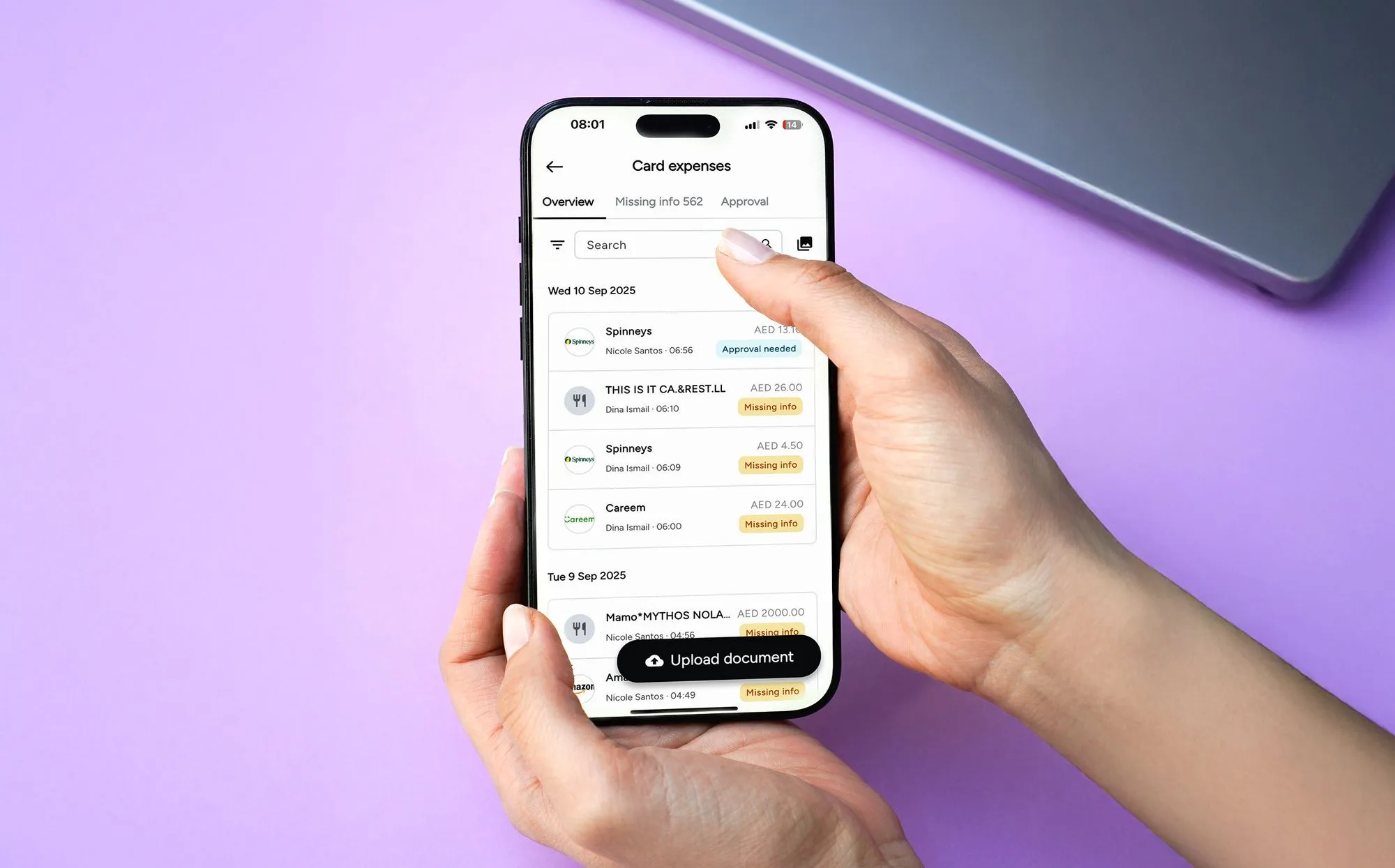
- Instant virtual cards: ready the moment they're created, which helps when moving a subscription off someone's personal card.
- One card per vendor: unlimited physical and virtual cards on every plan let a SaaS renewal or ad account run on its own card.
- Single-use cards: a card that closes after one payment suits one-off charges like an opening deposit with a supplier abroad.
- Location controls: a per-card choice between UAE only, International and Selected countries.
- Spend limits: on all plans, joined by merchant category restrictions on Premium and Enterprise.
➡️ Our virtual corporate cards guide walks through splitting subscriptions across cards.
A separate ledger route for cashback
Cashback leaves Pemo on its own export route, kept apart from new spending:
- Receive money: a payout arrives in Xero as a "Receive money" line on the Pemo Wallet's account, sharing a route with refunds and chargebacks.
- Filtered exports: a Transaction Type filter on the Accounting Export page pulls out money returning to the wallet, cashback included, before export.
- Payout matching: before the close, the Xero figure gets checked against the dated payout on the Cashback panel.
- Statement check: the Pemo Wallet Statement shows the month's cashback total.
➡️ Your accountant or tax advisor should confirm how cashback is treated before you pick the account for the credit side. Our double-entry accounting automation guide maps the full entry.
Pemo's pricing
Pemo charges one price per company on each plan, however many cards the team uses:
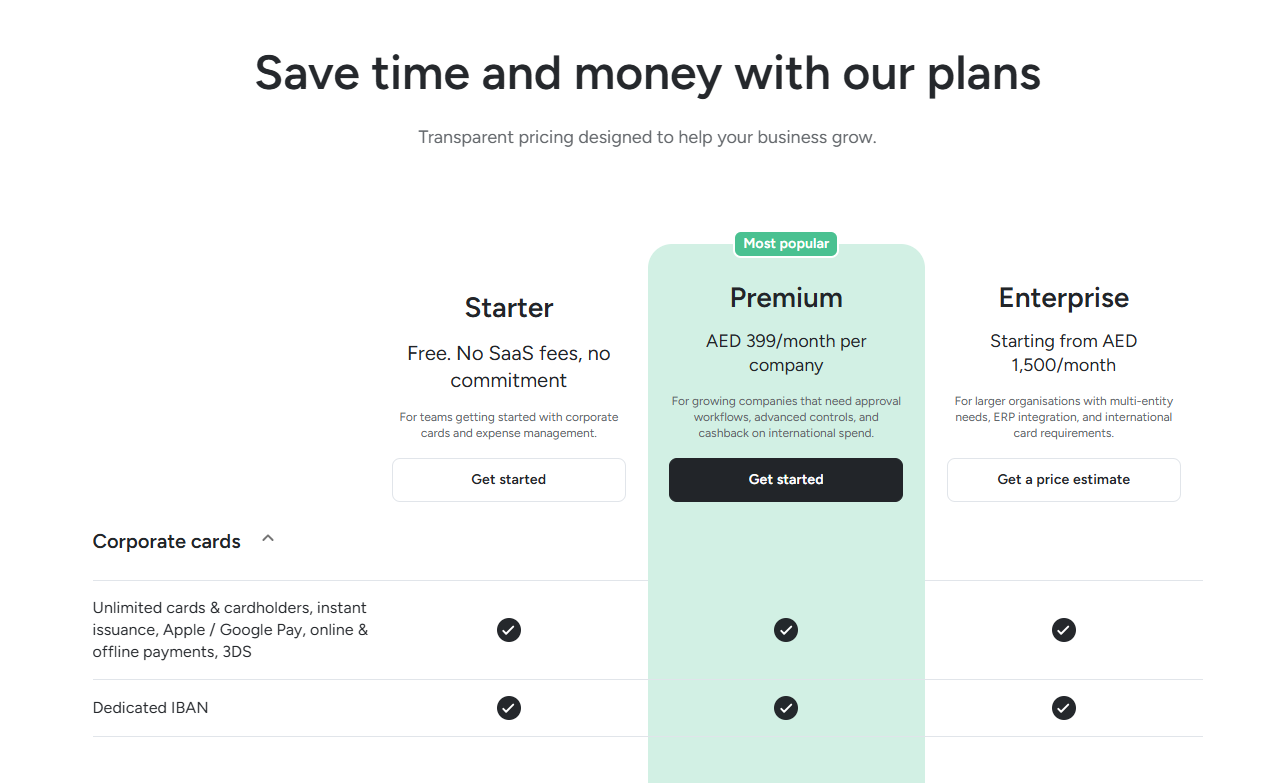
- Starter: AED 0, including unlimited physical and virtual cards and 0.5% back on international spend.
- Premium: AED 399/month per company, raising international cashback to up to 2% with no cap and adding multi-layer approvals and merchant category restrictions.
- Enterprise: pricing starts at AED 1,500/month for multi-entity setups, adding negotiated domestic and international cashback rates plus cards for team members based outside the UAE.
- FX fee: companies with KYB approval dated 1 July 2026 or later pay 3.68% on foreign-currency card spend, VAT included.
Pemo's pros and cons
✅ Cashback starts on the free plan.
✅ Google and Meta ads billed in AED can qualify on cross-border accounts.
✅ Premium breaks even on its AED 399 fee at roughly AED 20,000 of monthly international spend.
✅ Payouts export to Xero as money received.
❌ For companies with KYB approval from 1 July 2026, the 3.68% FX fee outweighs Premium's 2% cashback on a foreign-currency payment.
❌ Domestic spend needs Enterprise.
#2: Mamo
Best for: Businesses already collecting customer payments through Mamo.
Similar to: Pemo, Network International.
Mamo, regulated by the Dubai Financial Services Authority, combines payment collection with corporate cards funded from the same balance.
Cards top up straight from payments the business has collected, skipping a bank transfer.
Features
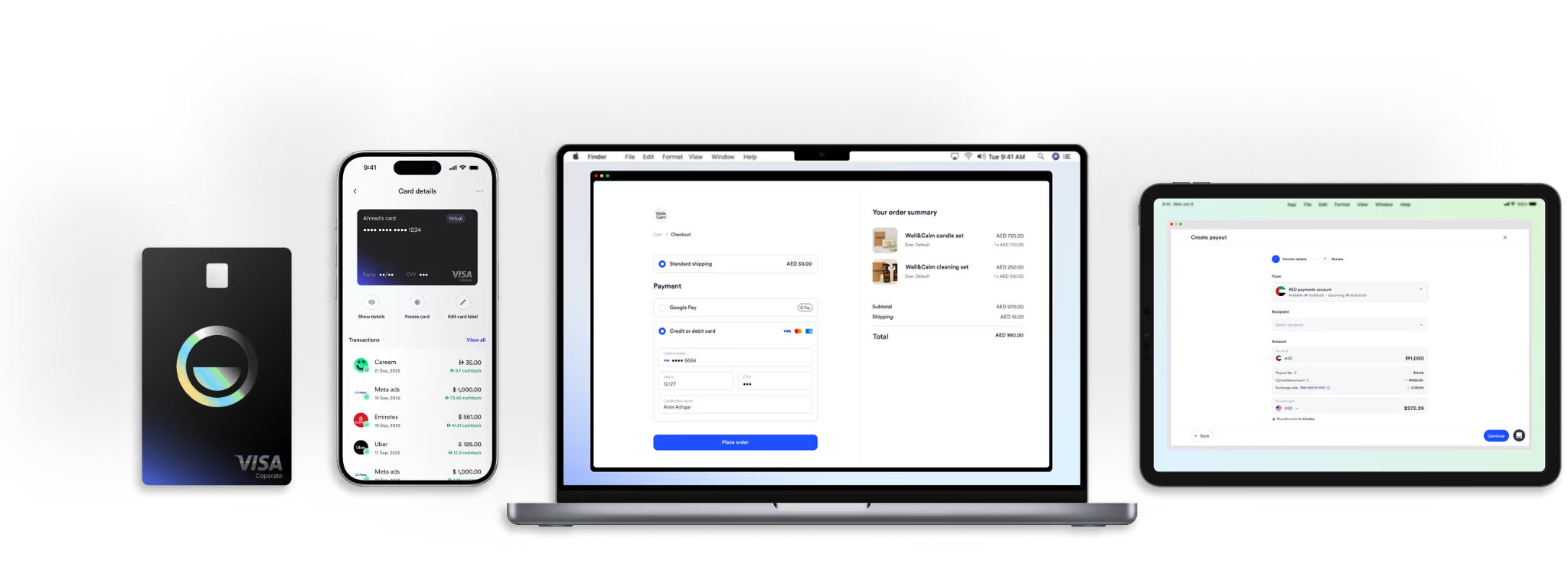
- Free cards: no issuance fee and no limit on debit, credit, physical or virtual cards.
- Spend controls: per-transaction and period limits alongside spending category controls.
- Receipt capture: transactions are logged as they happen, with receipts sent in over WhatsApp.
- AI assistant: budget tracking plus alerts on spending trends and unusual activity.
- Partner cards: virtual cards for instant payouts to suppliers.
- International team cards: virtual cards for employees and teams based outside the UAE.
Cashback terms
- Growth plan: 1% on non-AED spend and 0.4% on AED spend.
- Premium plan: 2% on spend outside AED and 0.5% in AED.
- Caps: none on either plan.
- Payout: cashback collects in a dedicated Cashback rewards account, from which it can top up a card or be settled to a bank account.
- Limited offer: 8% on non-AED spend for three months from card sign-up, up to AED 7,500 of cashback, for first-time Mamo corporate card users while spots last.
Pricing
Mamo's self-serve plans are priced per month before VAT, with an Enterprise tier above them:
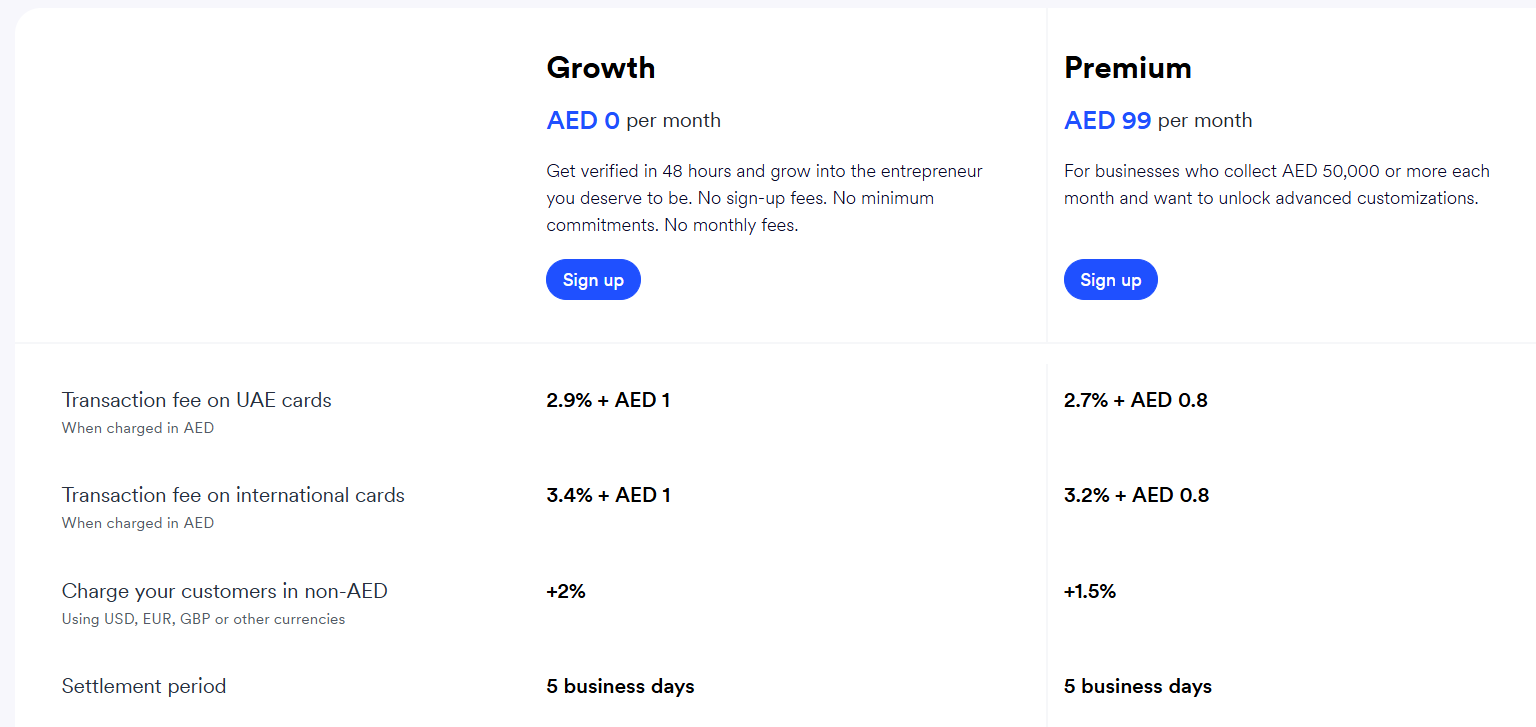
- Growth: AED 0, charging 2.9% plus AED 1 on each UAE card payment collected.
- Premium: AED 99/month for businesses collecting AED 50,000 or more a month, with lower collection fees and accounting software integrations.
- Enterprise: custom pricing above AED 500,000 a month in processing.
Pros and Cons
✅ Uncapped cashback on both plans.
✅ No charge for cards.
❌ Accounting software integrations require Premium.
❌ Growth pays half of Premium's rate on non-AED spend in terms of cashback, which is why some teams compare MamoPay alternatives.
#3: Wio Business Credit Card
Best for: A flat 2% on most card spend for Wio Business account holders.
Similar to: RAKBANK Titanium Business Credit Card, ADIB Business Platinum Covered Card.

Wio Bank's business credit card is applied for and approved in the Wio Business app.
One rate covers spend across categories up to a monthly ceiling, under Wio's terms.
Features

- Credit limit: up to AED 250,000.
- Interest-free period: up to 60 days on purchases.
- Quick Cash: cash drawn against the limit at a flat AED 1.50 a day per AED 1,000.
- Expense controls: budgets and employee expense management inside Wio Business.
Cashback terms
- Rate: 2% on card spend, subject to Wio's terms.
- Cap: AED 2,000 a month, reached at AED 100,000 of spend.
Pricing
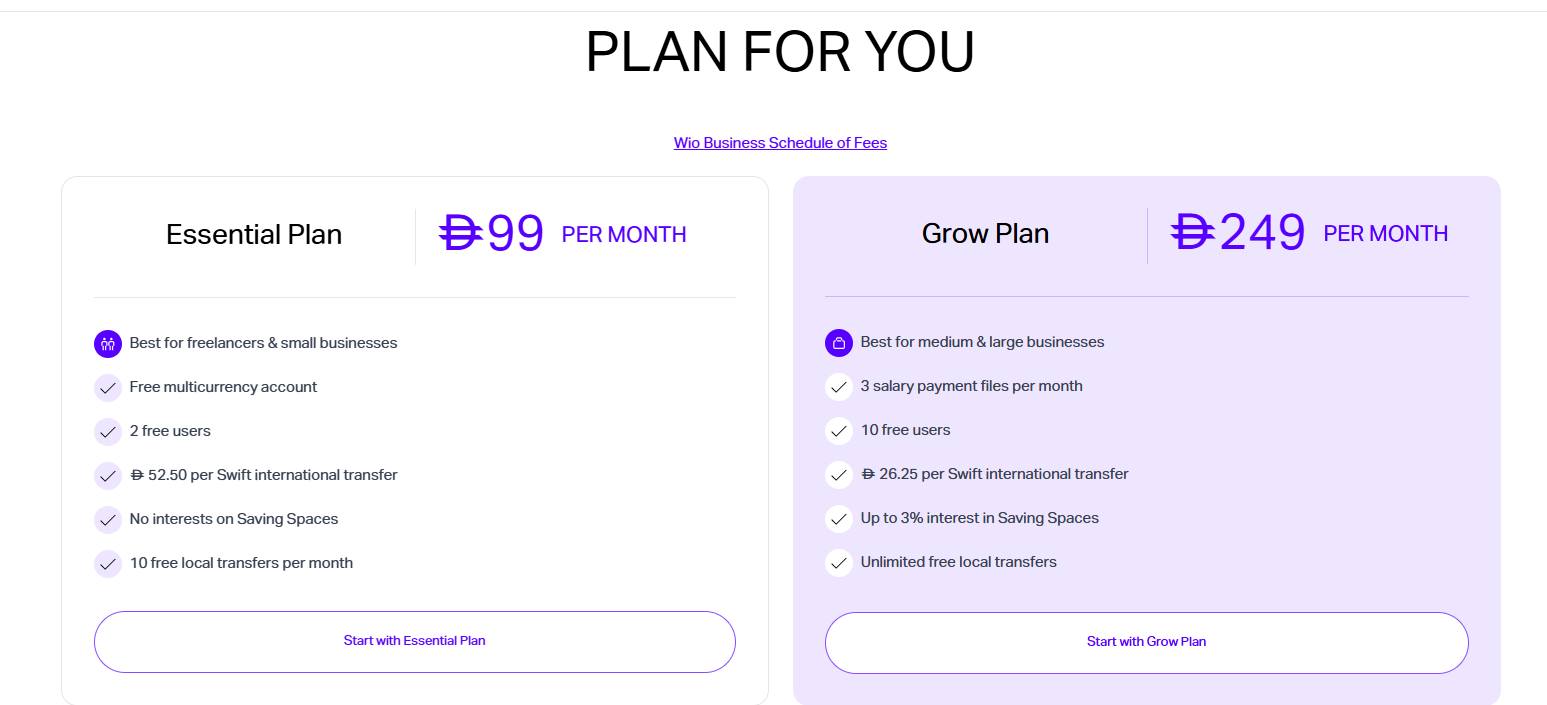
The card costs nothing for life but runs on a Wio Business account, priced on two plans with VAT included:
- Essential: AED 99/month.
- Grow: AED 249/month.
➡️ Wio Business also appears in our guide to AI business bank accounts in the UAE.
Pros and Cons
✅ One 2% rate across most card spend.
✅ No card fee.
✅ A long interest-free window of up to 60 days.
✅ Approval happens inside the Wio Business app.
❌ Cashback stops at AED 2,000 a month.
❌ Needs a Wio Business account on a paid plan.
#4: ADIB Business Platinum Covered Card
Best for: Existing ADIB customers looking for an Islamic covered card.
Similar to: Wio Business Credit Card, RAKBANK Titanium Business Credit Card.
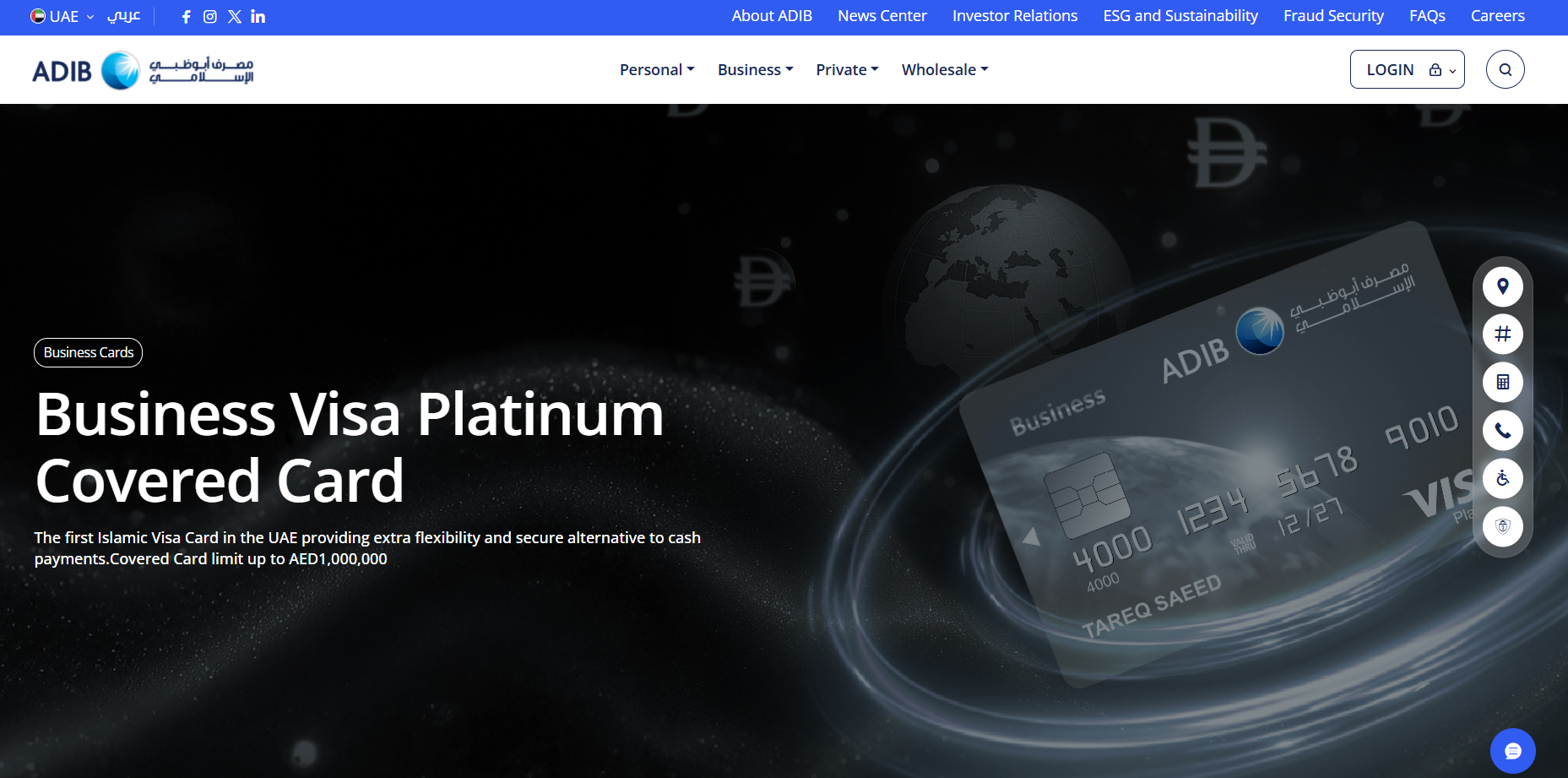
Abu Dhabi Islamic Bank offers this Visa covered card to its business banking customers for spending at home and abroad.
Cashback appears as a credit on the next card statement.
Features
- Card limit: covered limits up to AED 1,000,000.
- Supplementary cards: unlimited employee cards, the first four free.
- Card funding: top-ups through ADIB Direct online banking whenever the business needs them.
- Grace period: up to 55 days for each monthly payment.
Cashback terms
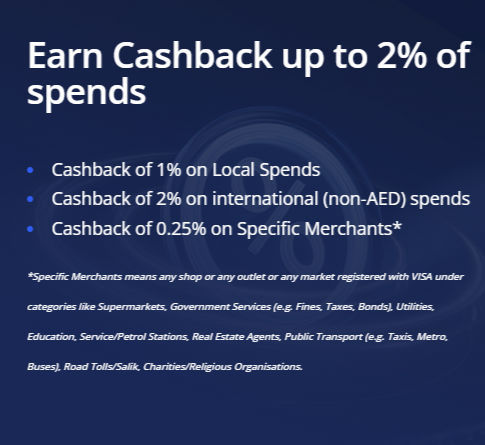
- International: 2% on transactions in currencies other than AED.
- Local: 1% on AED transactions.
- Set categories: 0.25% at merchants registered with Visa as supermarkets, government services, utilities, education, service and petrol stations, real estate agents, public transport, road tolls and Salik, and charities and religious organisations.
- Monthly ceiling: tied to the card's cover limit.
- Reversals: cashback on refunded or reversed payments comes back off the card account.
Pricing
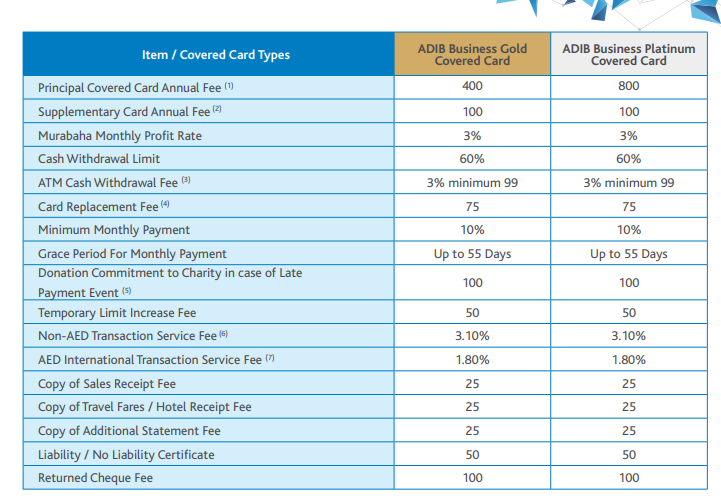
ADIB's September 2026 schedule of charges sets these costs for the Business Platinum card, all excluding VAT:
- Principal card annual fee: AED 99, charged from the first year.
- Supplementary cards: four free, then AED 99 a year from the fifth card.
- Monthly Murabaha profit rate: 3%, equivalent to 36% a year.
- Non-AED transaction fee: 2.3% of the transaction amount, added to Visa's exchange rate and Visa's own fee.
- AED transactions abroad: 1.99% when a payment made outside the UAE is charged in AED.
- Minimum monthly payment: 10% of the balance.
Pros and Cons
✅ 2% on spend billed outside AED.
✅ A Murabaha-based card from a UAE Islamic bank.
✅ Limits up to AED 1,000,000 leave room for higher spenders.
❌ Limited to existing ADIB customers.
❌ On foreign-currency spend, the 2.3% non-AED fee plus Visa's fee is higher than the 2% cashback.
#5: Network International Corporate Executive Card
Best for: An uncapped rebate on all card spend at a published 2.60% foreign transaction fee.
Similar to: Pemo, Mamo.
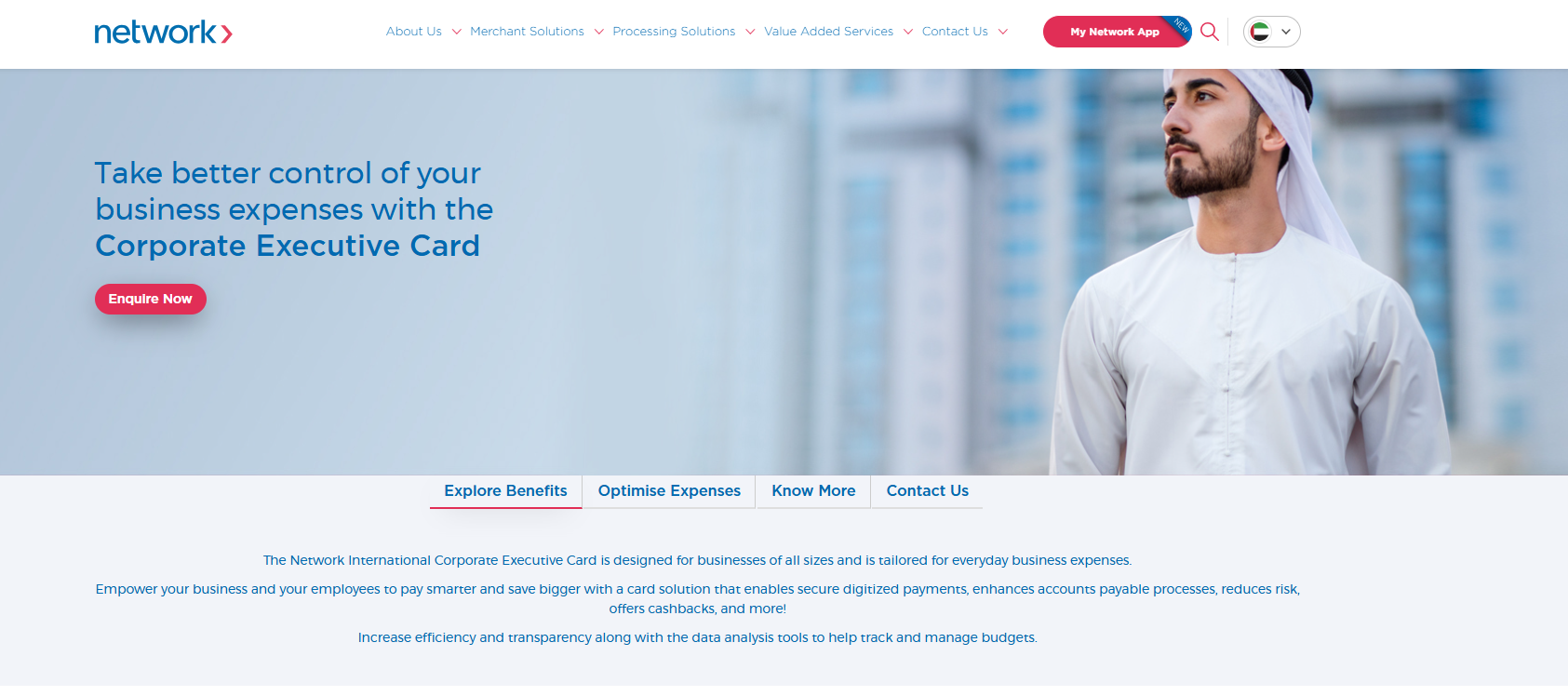
Network International's Corporate Executive Card is a commercial prepaid card for everyday business expenses, from a payments company licensed by the Central Bank of the UAE.
An expense management platform and a free self-service portal come with it.
Features

- Usage controls: daily and monthly limits per card plus merchant category blocking.
- Virtual cards: a linked virtual card for any employee card.
- Liability waiver: insurance covering the company for up to USD 25,000 per card a year if an employee misuses a card.
- VAT reclaim: preferential pricing on a partner's VAT reclaim service.
Cashback terms
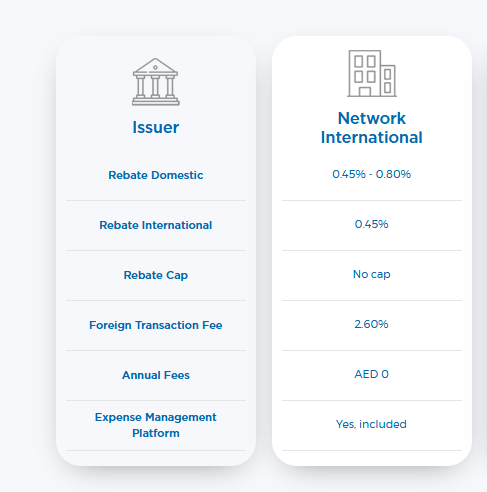
- Domestic rebate: 0.45% to 0.80%.
- International rebate: 0.45%.
- Cap: none.
- Higher spenders: companies spending over AED 500,000 a year can request a customised rebate.
Pricing
Two published charges apply to the card:
- Annual fee: AED 0.
- Foreign transaction fee: 2.60%.
Pros and Cons
✅ The rebate has no cap.
✅ Expense management platform included at no annual fee.
❌ At 0.45%, the international rebate trails the 1% to 2% most cards here pay abroad.
❌ Applying starts with an enquiry email, since the card page has no self-serve sign-up.
#6: RAKBANK Titanium Business Credit Card
Best for: 1% cashback on local and overseas spend without an annual fee.
Similar to: ADIB Business Platinum Covered Card, Wio Business Credit Card.
RAKBANK keeps its Titanium Business Credit Card separate from the personal Titanium card, positioning it for company purchases locally and overseas.
Cashback becomes redeemable at AED 100.
Features
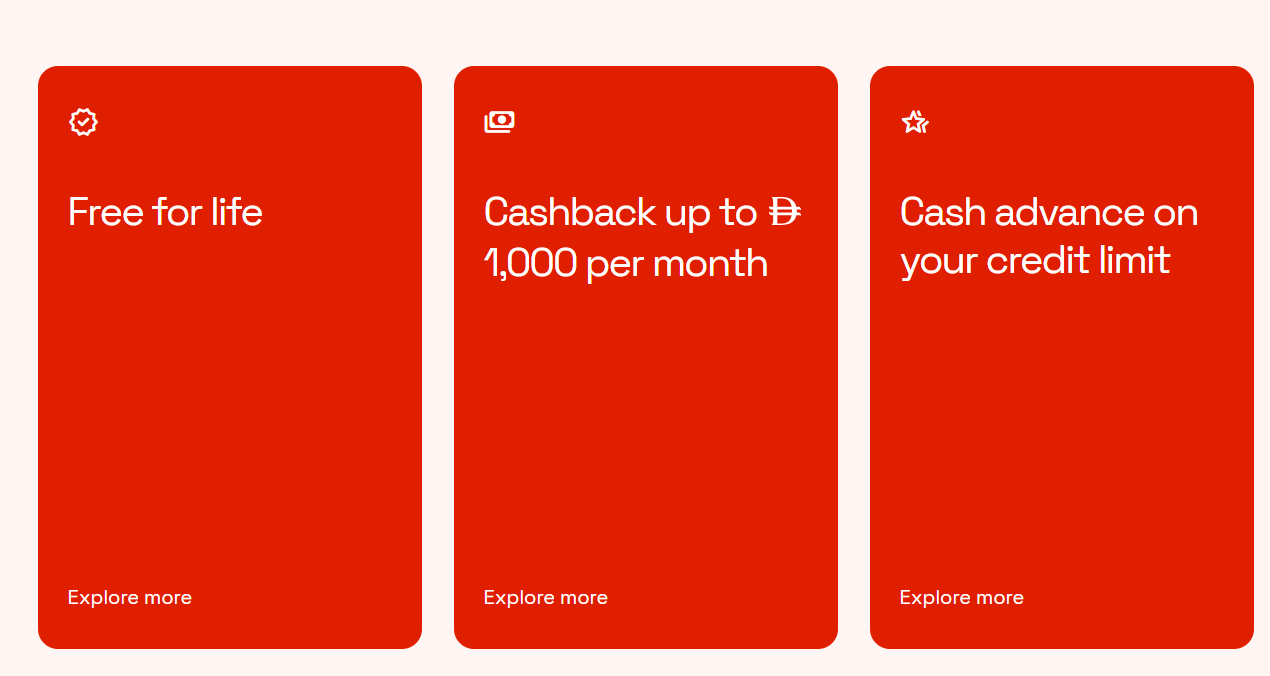
- Cash advance: cash drawn against the credit limit.
- Employee cards: additional employee credit cards on the company's account.
- Travel and lifestyle: travel insurance cover, hotel and car rental discounts, VAT and Wi-Fi benefits and a Credit Shield option.
- Eligibility: applicants aged 21 or older with a valid trade licence and business documents.
Cashback terms
- Standard rate: 1% on retail, internet and cash transactions, domestic or international.
- Lower-rate categories: 0.25% on charities, government services, bill payments, schools, education, transport, telecom, real estate and fuel.
- Monthly cap: AED 1,000.
- Channel exclusion: payments through RAKBANK's own channels, online banking and ATMs included, don't qualify.
Pricing
There's no annual fee to budget for, only finance charges on unpaid balances:
- Annual fee: none.
- Finance charges: interest at the rates in RAKBANK's Service & Price Guide.
Pros and Cons
✅ No annual fee.
✅ One rate for local and international spend.
✅ Additional credit cards for employees.
❌ Cashback tops out at AED 1,000 a month.
Next steps: Earn cashback with Pemo
Every card on this list pays back part of a company's spend under its own qualifying rules.
Pemo pays that cashback into the wallet its cards spend from, then exports each payout to the ledger as money received.
If you want a cashback card that also gives you:
- Mastercard savings: merchant offers from brands such as Google Workspace, Notion, DocuSign and HubSpot, claimed in the app on top of Pemo's cashback.
- Referral rewards: AED 1,000 for the first business you refer, rising to AED 1,400 each from the fifth.
- Apple Pay and Google Pay: on physical and virtual cards alike.
- Fast physical cards: delivery within 72 hours, on top of virtual cards that work straight away.
- In-app payment approval: online payments confirmed by push notification and Face ID.
Pemo's Starter plan is free to open, with cashback from the first qualifying payment.
To see it first, book a demo of the Cashback tile using your own spend.
⚠️ Disclaimer: This article was last updated on 5 November 2026 and covers general product information, not tax or legal advice. Card terms and fees change often. Please confirm current details with each provider.
Corporate cashback card FAQs
Can a UAE company use a personal cashback card for business spending?
It's risky, because personal cashback terms can rule out business use.
FAB's Cashback Credit Card terms, for example, allow the bank to claw back cashback and suspend the card when it pays for business purchases.
A card issued to the business keeps company spend in the company's name.
Is a prepaid card or a business credit card better for cashback?
A prepaid card suits companies that want cashback without a credit line or finance charges, since the money is already loaded.
A business credit card adds a credit limit and a grace period.
Any balance carried past that grace period attracts monthly profit or interest, which can wipe out a month of cashback.
Do AED payments to overseas companies count as international spend?
It depends on the card.
Pemo treats Google and Meta ads billed in AED as international on accounts configured for cross-border spend.
ADIB and Mamo define international spend by currency, placing an AED-billed payment under their AED rate.
How is corporate cashback recorded in the accounts?
On Pemo, a cashback payout reaches Xero as a "Receive money" entry against the Pemo Wallet's account.
The credit side goes to an account the finance team selects.


